

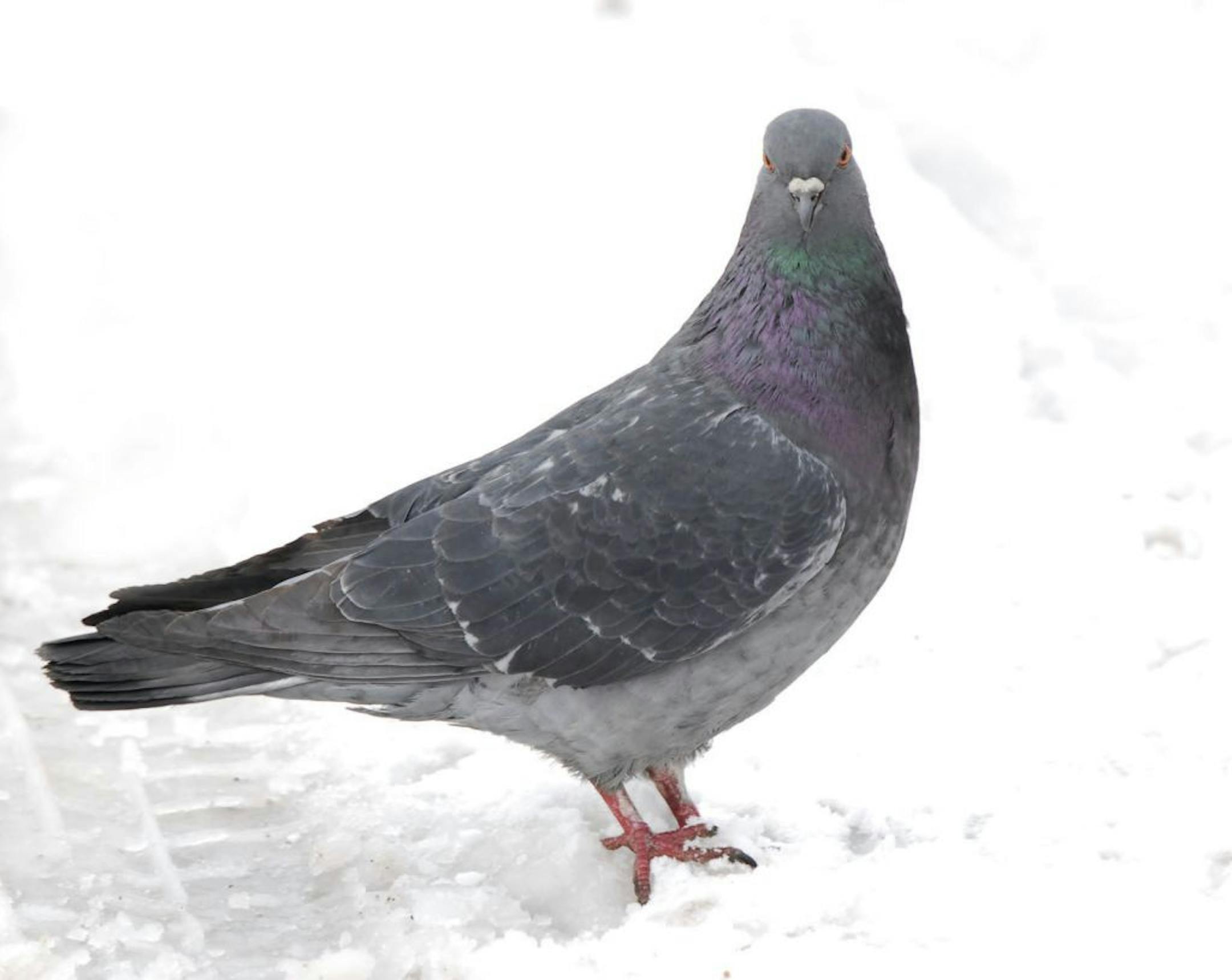
in 1855, Charles Darwin took up a new hobby. He started raising pigeons.
"The diversity of the breeds is something astonishing," he wrote in "On the Origin of Species." Pigeon breeding, he argued, was an analogy for what happened in the wild. Nature played the part of the fancier, selecting which individuals would be able to reproduce. Natural selection might work more slowly than human breeders, but it had far more time to produce the diversity of life around us.
Now, a team of scientists are following Darwin's example by using the birds to find clues to the way evolution works in general. To do so, they delved into a source of information Darwin didn't even know about: the genome.
So far, they have sequenced the DNA of 40 breeds, seeking to pinpoint the mutations that produced their different forms. The scientists are particularly interested in the mutations that produce radically new kinds of anatomy. "Pigeons are an ideal way to look at these things," said Michael Shapiro, a biologist at the University of Utah and the leader of the study published online in the journal Science.
The work supports Darwin's claim that all pigeon breeds descend from the rock pigeon, whose range stretched from Europe to North Africa and east into Asia. "It's a brilliant bit of investigative science, the type of research that hopefully will come to define the genomic era," said Beth Shapiro (no relation to Michael), an evolutionary molecular biologist at the University of California, Santa Cruz.
Archaeologists have speculated that rock pigeons flocked to the first farms in the Fertile Crescent, where they pecked at loose grain. Farmers then domesticated them for food.
Later, humans bred the birds to carry messages. By the eighth century B.C., Greeks were using pigeons to send the results of Olympic Games from town to town. Genghis Khan used pigeons to create a communication network across his empire in the 12th century A.D.
Eventually, people began breeding pigeons simply for pleasure. Akbar the Great, a 16th-century Mughal emperor, always traveled with his personal colony of 10,000 pigeons. He bred some of the birds for their ability to tumble through the air, and others for their extravagant beauty.


