

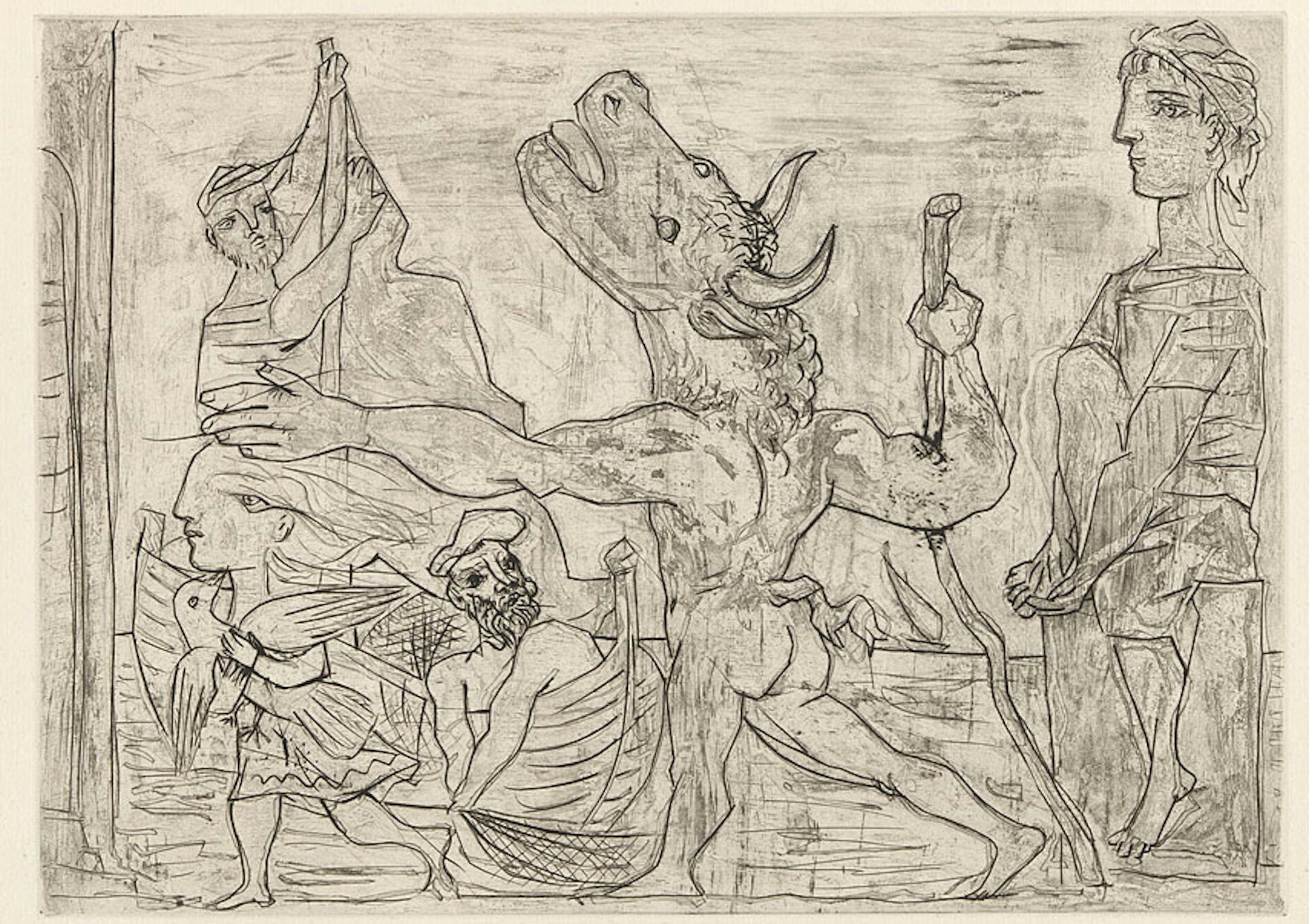
There's a bull tucked away in a closet-like gallery on the third floor of the Minneapolis Institute of Art. Several incarnations of the bull, in fact, all creations of Pablo Picasso, the famed artist who had a special connection with the massive beast.
"Picasso self-identified with bulls," said Tom Rassieur, curator of prints and drawings at Mia. "He thought of himself as half-man, half-bull."
"Picasso Cuts the Bull" is a hidden gem of a show — just 13 works-on-paper, organized around a set of proofs he made for the bullfighting linocut "Le Banderillero" (1959), which the museum acquired last year. (Mia owns 76 works by Picasso.)
After leaving his homeland of Spain, Picasso spent much of his life in Paris, the center of the art world at the time. But from 1948 to '55 he decamped to Vallauris, a village on France's Côte d'Azur.
One attraction was that the village had begun to stage bullfights. But Picasso also became enamored of linocut prints after meeting a master printer, Hidalgo Arnéra. He continued to return to Vallauris to print with Arnéra even after acquiring a château 90 miles away with his second wife, Jacqueline Roque.
The other charming pieces in this show — lithographs of the hillside village, color lithograph portraits, several etchings of bulls — speak to Picasso's experimental, versatile nature.
Working with Arnéra, Picasso revolutionized printmaking by pioneering a now-popular technique called reduction linocut. Instead of carving a separate linoleum block for each color in the print — an extremely time-consuming process — he used a single block that he would continue to whittle down, step-by-step, printing different colors on top of each other (lighter ones first, then black at the very end).
It's jokingly referred to as a "suicide print," because as the artist carves away at the block, there is no going back. Perhaps this all-or-nothing reality contributed to Picasso's fascination with the technique.


