

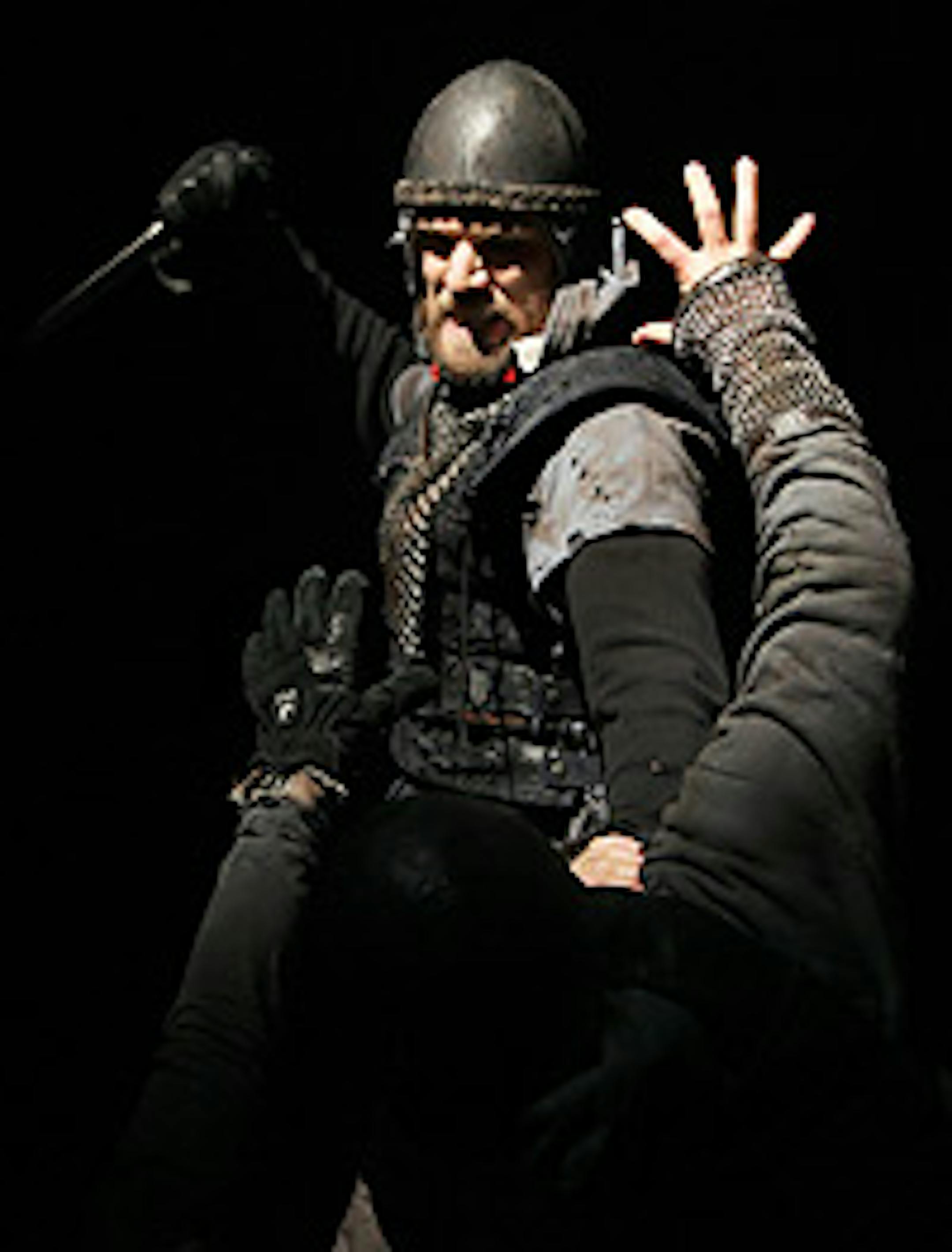
From the start, when soldiers rappel from the rafters amid gunfire, many adults are killed in "Macbeth," which opened Friday at the Guthrie Theater in Minneapolis. But it is the voice of a frightened child that lets the show register as deep heartbreak, not just murder and madness on the thrust stage.
We hear her near the end of one of the many killing sprees in Shakespeare's tragedy. To forestall the prophesies of three witches (the Weird Sisters are played evocatively by Barbara Bryne, Isabell Monk O'Connor and Suzanne Warmanen), Macbeth (macho Erik Heger) dispatches his henchmen to kill those whom he does not trust, including Macduff (Robert Berdahl).
Not finding him, the assassins attack Lady Macduff (Sun Mee Chomet) and her son. As the victims expire, the murderers turn toward Macduff's young daughter, who is whimpering at the lip of the stage. As they approach her, daggers in hand, the lights go out and we are left to imagine the horror. It is perhaps the most riveting moment in Joe Dowling's potent and elegantly restrained staging of this saga of ambition, superstition and regicide.
A brave soldier, Macbeth meets the Weird Sisters in the forest. They predict his ascent to the throne, which soon comes true, thanks partly to the urge to violence by Lady Macbeth (Michelle O'Neill). But there are other parts of their prophecy that Macbeth does not like, so he sets about killing all would-be rivals.
"Macbeth" was brought to Minneapolis in 2005 by London's Out of Joint company in a show that was not so much a production as an experience. Director Max Stafford-Clark set the play in war-torn West Africa and did it in promenade-style at the former Guthrie Lab, with audience members moving among different scenes. His "Macbeth" remains the best I have ever seen.
Dowling's interpretation of the Scottish play, which plays out against Monica Frawley's simple set of dark columns and broken landscape, is also commendable. It captures the play's unrelenting impulses and moves with inexorable dispatch (two hours, with no intermission).
Dowling has first-rate principals in Heger and O'Neill. Heger's Macbeth is all feral muscle when we first see him killing many men in the opening battle scene. That testosterone gives way to crazed limpness as his character is haunted by his actions in the last half of the show. Heger, whose command extends to his line readings, is well matched with O'Neill, whose Lady Macbeth is glamorous, beautiful and powerful, not to mention sexy. Her allure only adds to her character's indelible strength.
Dowling's staging of the dinner party at which the ghost of Banquo shows up is also memorable, and Bill McCallum plays it for all it's worth, his intense silence indicting and exposing Macbeth as a killer and helping to make this production one that elucidates the tragedy. Dowling's "Macbeth" vividly exposes some of the frightening impulses lurking in the human soul.


