

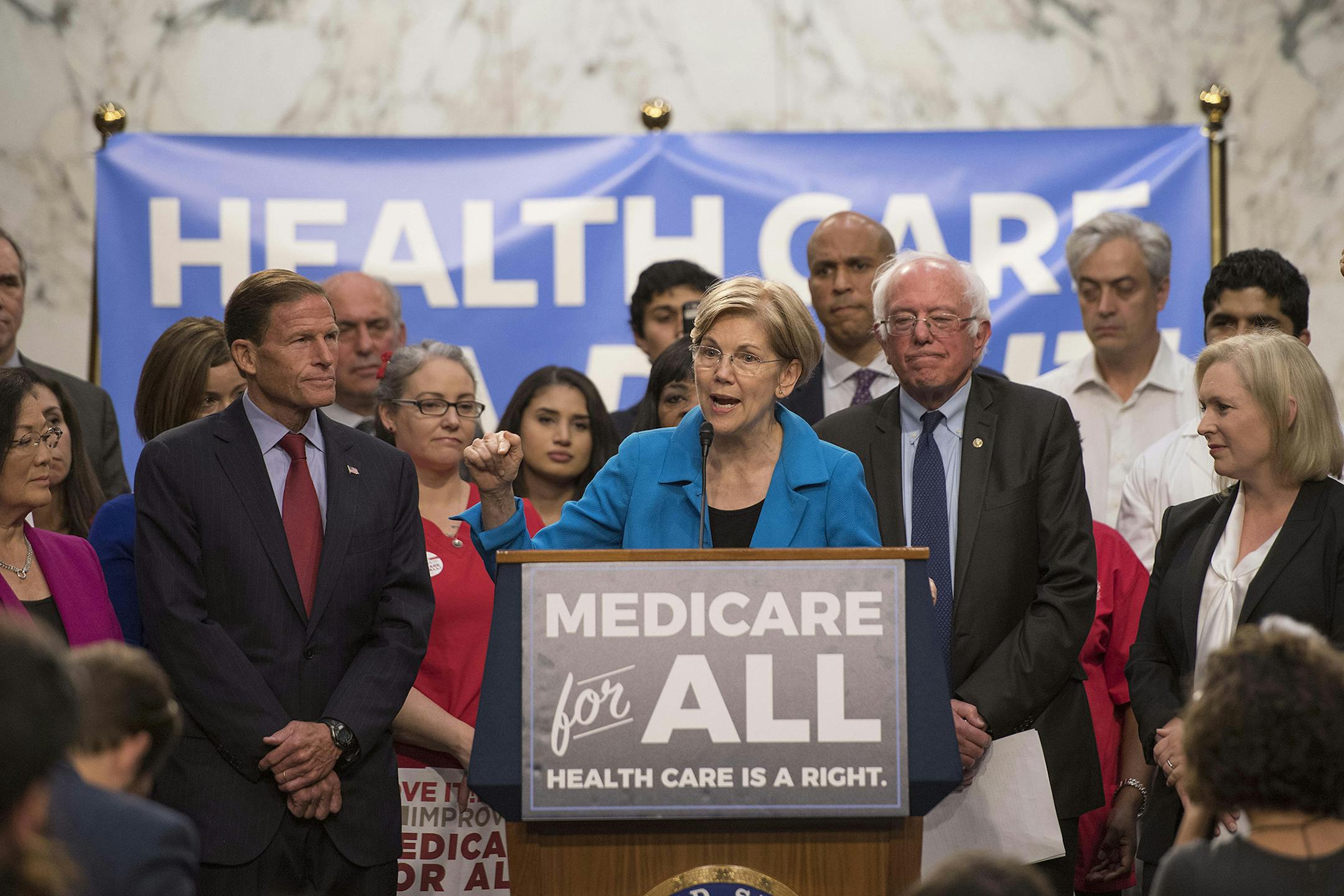
Democratic presidential candidates Elizabeth Warren and Bernie Sanders have struggled to explain how they would pay for Medicare for All.
This is puzzling. A single-payer approach like Medicare for All can reduce overall health spending. Other wealthy countries that have universal coverage spend far less on health care than the United States as a share of their gross domestic product. A lack of money is not the problem. That's why it should not be difficult to devise a way to pay for Medicare for All to benefit the vast majority of us, particularly low- and middle-income earners.
Canada has such a system, which should cast doubt on all the naysayers who claim that it is impossible or ruinous. Canada, with a single-payer system, spends half of what we do on health care and gets better results. Britain, France, Australia and Japan, all with universal health care, also spend less than half of what we spend per capita and get better results.
Medicare for All is widely expected to cost about $3 trillion a year. The government — through Medicare, Medicaid, CHIP and various other programs — already pays more than $1.5 trillion of this health care bill. Private insurance and out-of-pocket costs account for another roughly $1.5 trillion. Going to Medicare for All would increase the budget of the government by about $1.5 trillion a year.
Here are some ideas on how to fund it:
End the cap on payroll taxes and apply payroll taxes to all income, including interest and capital gains. This will not have a significant effect on anyone whose income is less than $132,900, the current cap, and will raise about $1.5 trillion. Those making somewhat above the current cap will end up paying a bit more, but they will not have to pay health insurance premiums or out-of-pocket medical expenses and will come out ahead.
Large employers now pay on average $6,000 per employee for individual health insurance and $14,000 per employee for family health insurance. Many smaller employers pay similar rates, as do the self-employed. Let's suppose that we tax all employers $5,000 per year per employee and relieve them of the burden of providing employee insurance. Most come out way ahead. This raises about $650 billion.
Elizabeth Warren's proposal of a 2% wealth tax on wealth over $50 million would raise another $250 billion a year. Her proposed corporate tax on offshore earnings would raise $100 billion a year by requiring companies like Amazon to pay taxes on their worldwide income.


