

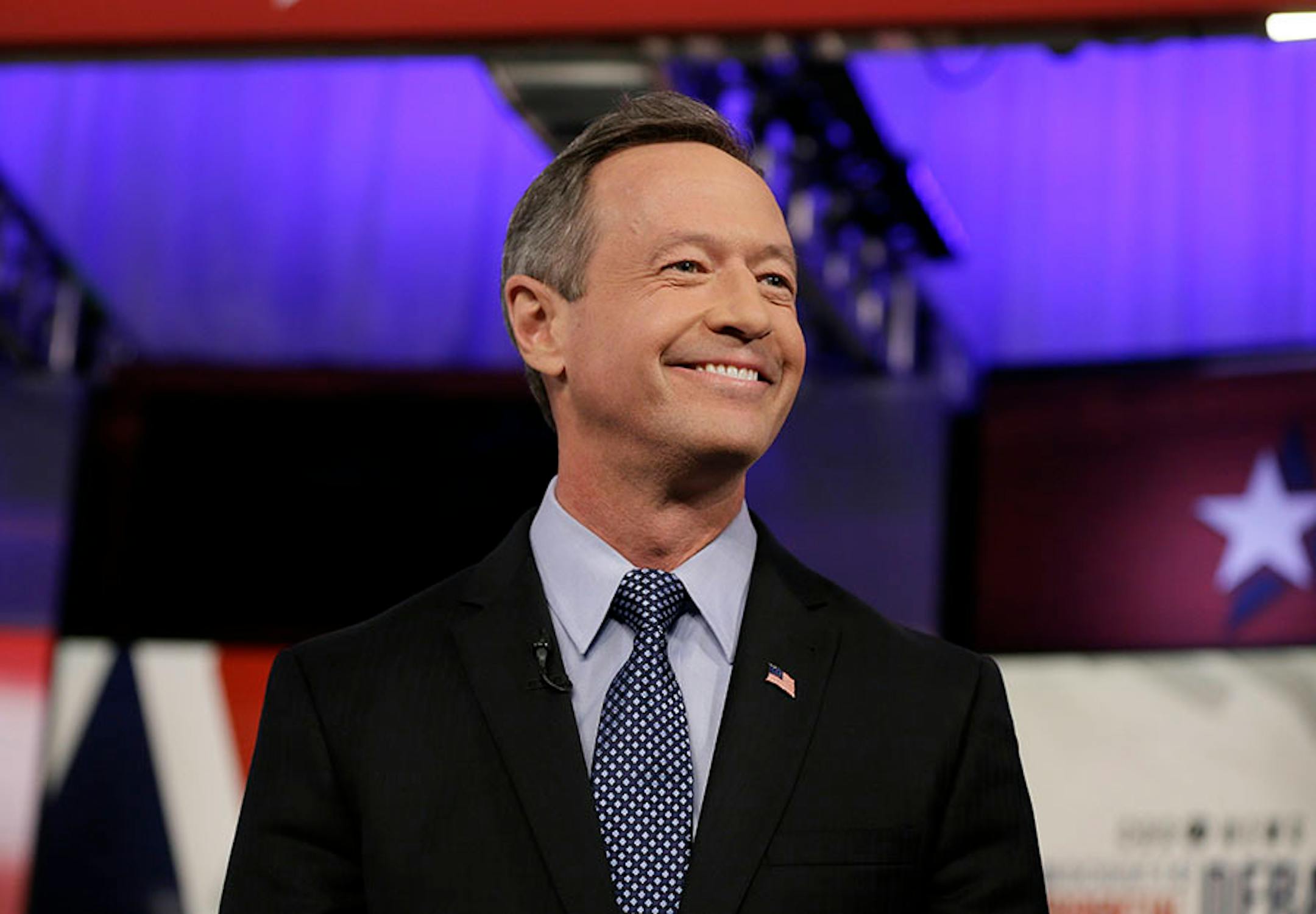
Well, somebody has to do it. Somebody has to write about Martin O'Malley. He's a serious person, with serious things to say, and it's a travesty that he hasn't gotten more coverage.
In this election, two big issues are colliding: broadly diminished economic opportunity and concerns about growing federal power, which in some forms - battles over excessive surveillance, the war on drugs, police violence and the No Child Left Behind Act, for instance - have shaken up long-standing left-right splits. On the surface, wage stagnation and income inequality appear to be Democratic turf, while worries about big government belong to the Republicans. For the latter half of the 20th century, tackling both issues simultaneously would have been like trying to square the circle. The antidote to poverty and inequality was government, requiring more taxes, more programs, just plain more. The antidote on the other side was less. Lower taxes, austerity, sequestration.
If this presidential race had quickly resolved to the candidates we expected to have, Hillary Clinton and Jeb Bush, we'd more or less be getting the usual conversation. But thanks to Sen. Bernie Sanders, I-Vt., Donald Trump and an anti-big- government Republican chorus that has included Sen. Rand Paul (Ky.), we've got something far more interesting in the works.
Republicans are finally waking up to the issues of the working class, even while continuing to decry big government. The editors at National Review last week called on the GOP to "advance a compelling working-class agenda" that doesn't leave the working class vulnerable to a demagogue. If the candidates listen, the pieces are in place to force the party to think through both halves of the dilemma facing the country.
What about the Democrats? Are they ready to face the fact that we have to figure out how to tackle inequality without further feeding the growth of state power? As I've watched the campaign unfold, I've come to the conclusion that O'Malley is the only voice on the Democratic stage with the potential to resolve the dilemma.
In recent years, economists and political scientists have routinely pointed out how municipal and regional decisions about transportation, mobility, housing, communications infrastructure and finance powerfully affect the distribution of opportunity. We often use zoning regulations, housing and transportation policy, and municipal funding structures in ways that generate socioeconomic and ethnic segregation. These policies reduce the likelihood that "bridging ties" - connections between people across demographic cleavages - form within our population. Significant bodies of research suggest that the more a society is characterized by bridging ties, the more egalitarian will be outcomes across economic, health and educational domains. To maximize these ties, we need policies that push in the opposite direction from those we have now.
The good news is that this doesn't require adding services and programs, only smarter choices about the things that governments already do and will always need to do. One can have a dramatic impact on the distribution of opportunity without increasing government's footprint. One just needs to use the existing levers differently.
This, it turns out, is just what O'Malley, the former governor of Maryland, wants to do.


