

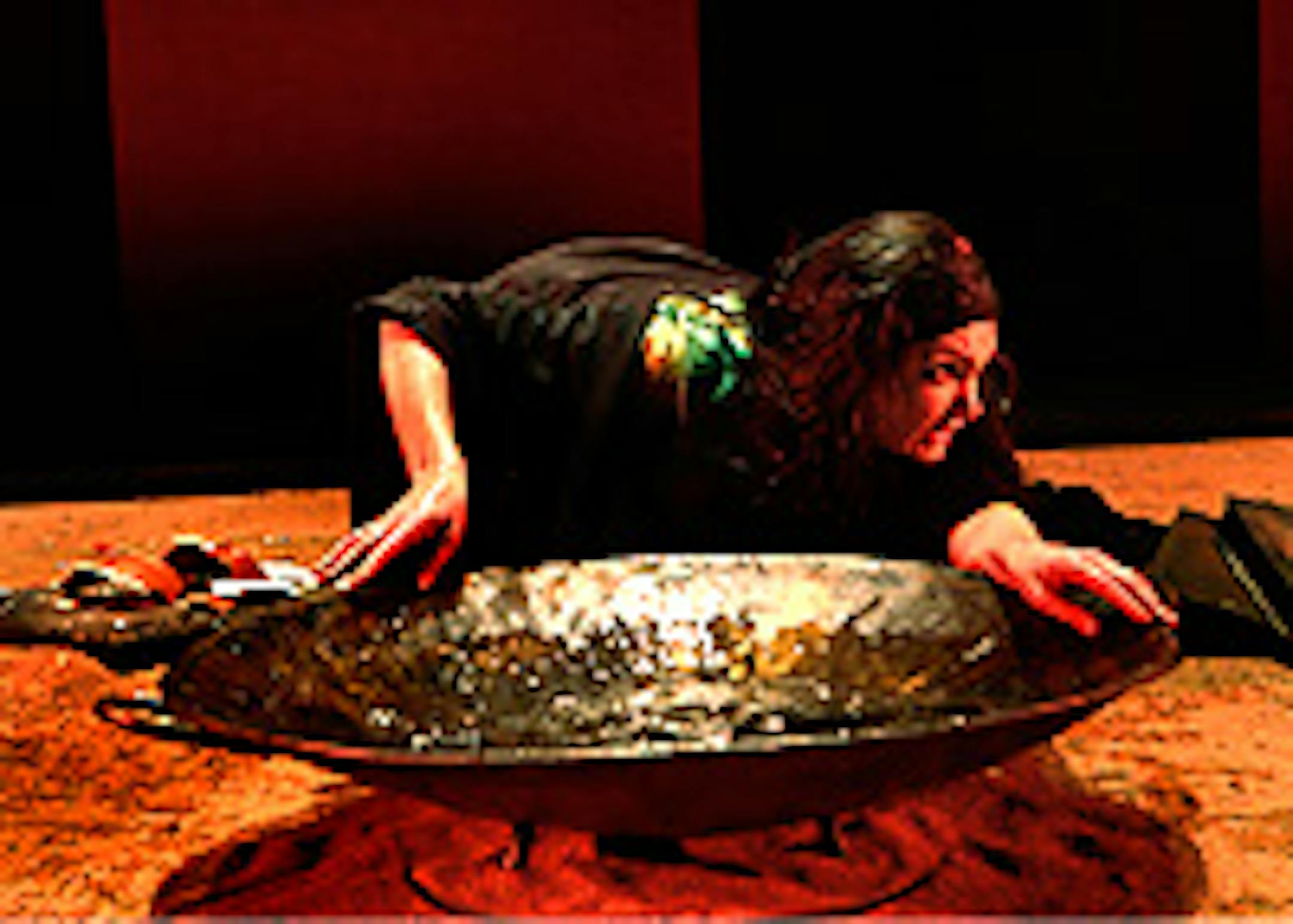
Presidential hopeful Barack Obama has been faulted by some for speaking too eloquently to our dreams. But lyrical language is essential if you are to reach deep into an auditor's heart. Nowhere is that clearer than in Heather Raffo's moving, if shapeless, "9 Parts of Desire" at the Guthrie Theater.
This play about current and past tragedies endured by Iraqi women takes us poetically behind the headlines of a country we now know mostly by body counts. Through cries, moans and testimonies, "Desire" gives us wrenching lessons in humanity and history.
The play begins with actor Kate Eifrig, in a showcase performance, depicting an Iraqi mom wrapped in black from head to toe. She stoops near at the edge of the stage, scooping sand with some worn-out shoes. She drains the sand as she begins to throw the shoes away, talking poignantly about those who have been killed by terrorism and war.
The moment recalls the empty-shoes metaphor often deployed to depict the devastation of the Holocaust. When she speaks, Eifrig's character also creates an unmistakable link between two homonyms -- soles and souls.
"Desire" marks the second one-woman show in town that director Joel Sass has staged in the past few weeks. His Jungle Theater production of "The Syringa Tree" features Sarah Agnew in a breath-taking and virtuosic turn as nearly two dozen South African characters.
As he did with Agnew, Sass also guides Eifrig with a sensitive hand, leading her into all the right places, psychically and emotionally. And her accents are suggestive enough but not distracting.
Donning and taking off Amelia Cheever's costumes, Eifrig moves fluidly between her clearly sketched characters. They include a painter who sublimates her secrets in her work; a worried, scotch-drinking émigré in London; a doctor who must work over open sewers; and a hunched-over housewife, reduced to selling her family's books and paintings on the sidewalk.
Eifrig gives these women strength to speak the unspeakable: a child fed to ravenous cats, people vaporized by bombs, innocents tortured.


