

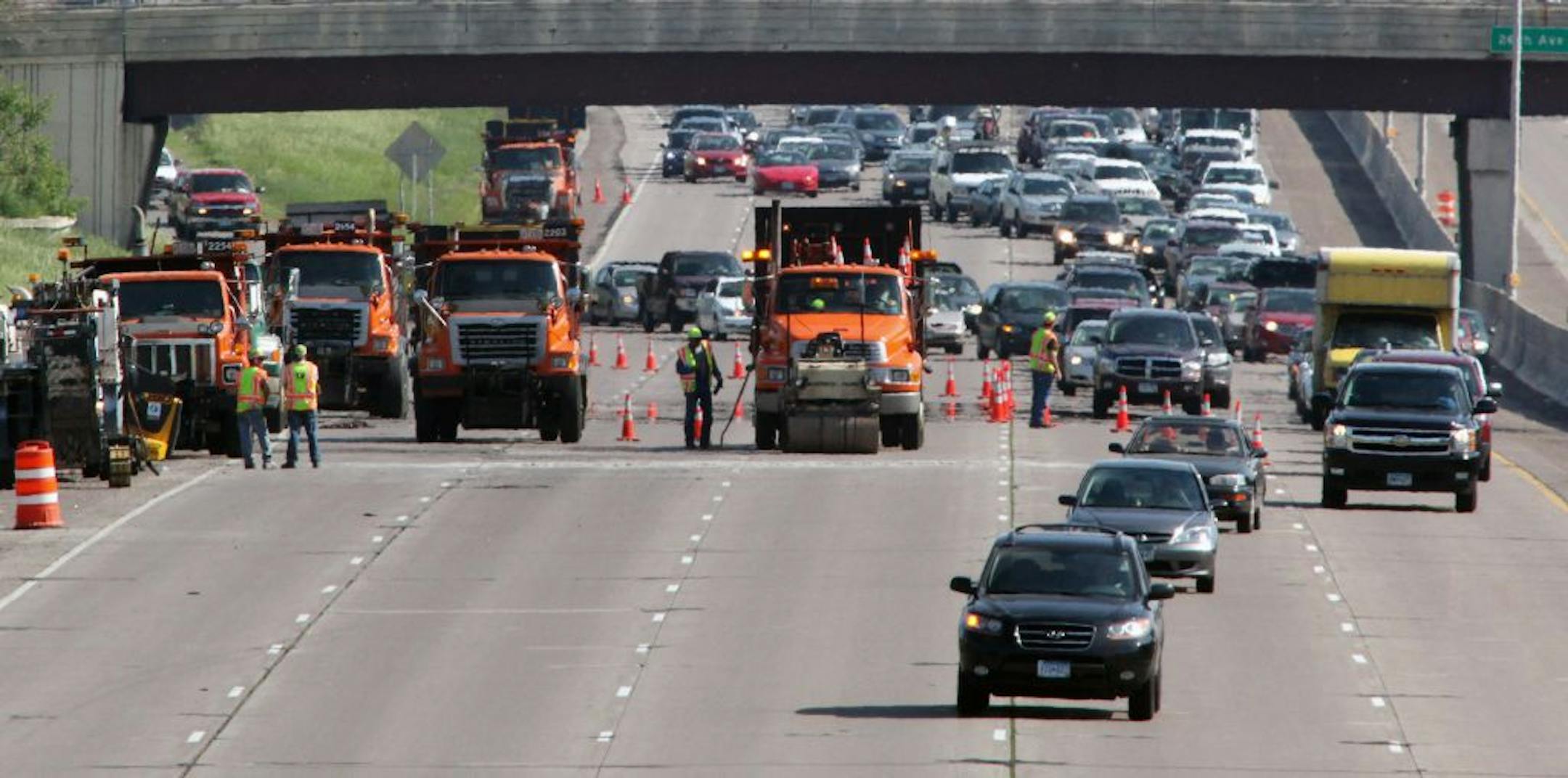
Road crews scrambled to repair 60 cases of heat-related pavement failure last week in the metro area and around Mankato and Rochester, according to transportation officials.
While pavement buckling isn't uncommon during the hottest days of summer, the number of failures during last week's short, intense heat wave was larger than usual. The Twin Cities region alone had 28 instances of it on Monday and 18 on Tuesday.
"We had sort of a bad situation," said Maureen Jensen, road research manager for the Minnesota Department of Transportation. "We had a very wet spring, [a] rapid temperature change and our pavements are continuing to age, so we saw more blowups on pavements that are older."
Matt Zeller, executive director of the Concrete Paving Association of Minnesota, said older roads are more susceptible to heat-buckling because they have fewer expansion joints -- the half-inch separations between concrete sections. He said new highways have them every 15 feet, while older highways have them every 27 feet or more.
The more joints, the more room sections have to expand without butting against each other and buckling, Zeller said.
University of Minnesota civil engineering Prof. Mihai Marasteanu, who has researched how low temperatures affect pavement cracking resistance, said another problem is the failure of the caulking or sealants used to keep moisture and debris out of the joints.
Marasteanu explained that "joints are the weakest link in the system," and if sand and debris fill them, the sections don't have room to expand. They can push against each other and can rise 4 inches or more.
He suggested more regular maintenance and cleaning of joints and added that research is underway to find better sealants.


