
Officials re-create the visual narrative of Boston bombing

Investigators reconstruct scene with methodical dissection of video.

April 18, 2013 at 4:29AM
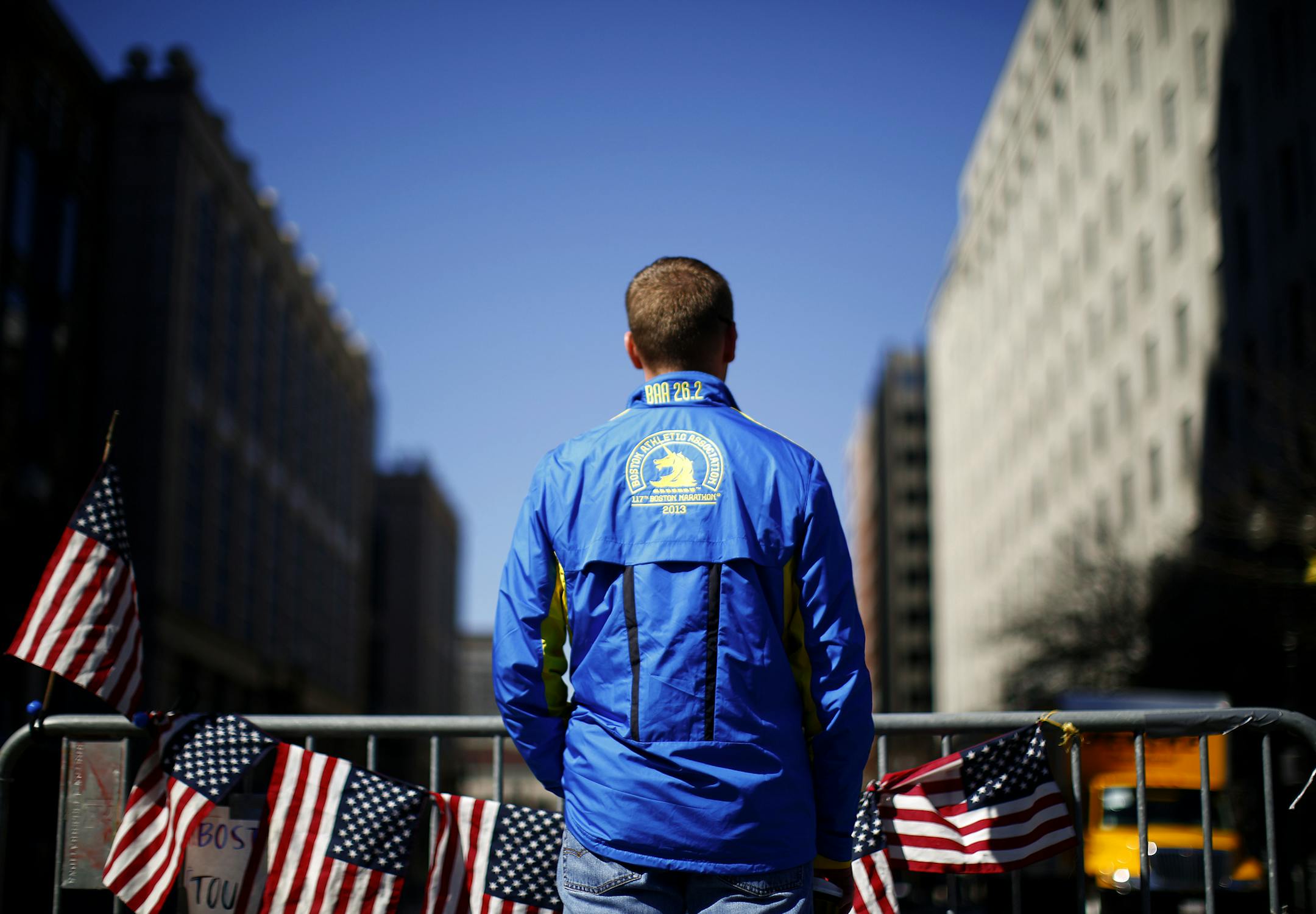
A man with a jacket from the 2013 Boston Marathon visits a makeshift memorial at the corner of Boylston and Berkeley Streets in Boston, April 17, 2013. A lid from one of the pressure cookers that investigators believe were used in the bombings at the Boston Marathon on Monday was found on a rooftop, giving a sense of the force of the blast. (Eric Thayer/The New York Times)
A man with a jacket from the Boston Marathon visited a makeshift memorial on Wednesday at the corner of Boylston and Berkeley streets in Boston as investigators worked to reconstruct the scenes of the explosion. (The Minnesota Star Tribune)

By Peter Finn, Greg Miller and David A. Fahrenthold • Washington Post

Investigators are convinced that the explosive devices that killed three people at the Boston Marathon were not in place before the race began because of security sweeps. And they have focused on increasingly narrow slices of the five-hour window between when the marathon started and the blasts occurred, officials said.

This methodical dissection of terabytes of video, still images and other evidence led the FBI to images of a potential suspect Wednesday. The apparent breakthrough illustrates how private surveillance equipment, in combination with the cellphone cameras used by ordinary citizens, has become an extraordinary resource that allows investigators to re-create the visual narrative of the streetscape surrounding a location in order to scrutinize the hours, minutes and seconds ticking down to a crime.

'Just a matter of finding it'

"There is absolutely going to be video of almost every single inch, for every single second of that day; it's just a matter of finding it," said Andrew Obuchowski, a former Massachusetts police officer who analyzes video evidence for Navigant Consulting, a private firm.

Video has proven crucial to a number of high-profile international investigations in recent years. In Dubai in 2010, the suspected assassins of a senior figure in the Palestinian group Hamas were captured on hallway video cameras in the hotel where the target, Mahmoud al-Mabhouh, was staying. In London in 2006, the city's cameras were used to trace the movements of Alexander Litvinenko, a former Russian agent, on the day he was poisoned.

Along with the forensic examination of residue from the bombs, U.S. officials said, investigators are focusing heavily on the enormous volume of video footage and images taken by security cameras and spectators and turned over to the FBI.

The bureau's website offers instructions on how to submit footage of interest in the investigation, and the effort to gather it is so extensive that security officials at Logan Airport have been asking travelers leaving Boston whether they have data that could be useful.

Officials said they are organizing the video footage and digital images according to precisely where and when they were taken, relying on an array of clues to determine locations along the race route and the time that specific pictures were snapped. The fact that the bombing occurred at a marathon — an event that records runners' finish times in fractions of a second — has aided the effort. Investigators have used the numbers worn by runners to determine their finish times and then extrapolated backward to determine when they crossed key landmarks. Pictures taken by cellphones also typically have time stamps and, in some cases, GPS location data.
"It's like a puzzle, but it's in color and it's four-dimensional because of the time element," said a U.S. intelligence official monitoring the investigation.

Investigators are reconstructing scenes of the explosions from as many angles as possible, seeking to narrow their search to the window during which the devices were placed. One U.S. official compared the effort to the massive endeavor after Osama bin Laden's 2011 killing to sift through the files and computer records recovered from his compound — except that in this case, the FBI, not the CIA, is in the lead role.

Shaking loose information

Often, investigators scrutinizing this kind of video evidence will use software that lets them add specific descriptions of a person they have observed in some of the footage and other data to attempt to find the individual in other videos from the scene, said Grant Fredericks, a forensic video analyst who has taught classes for the FBI.

Philip Mudd, a former senior official at the FBI and the CIA, said investigators are extraordinarily skilled at plowing through huge amounts of data to shake loose one identifying piece of information. Once they have a suspect, investigators start to build a timeline of the person's actions, including the use of cellphones to identify potential accomplices. Search warrants are then issued to obtain call, e-mail and texts, which help fill out the picture.


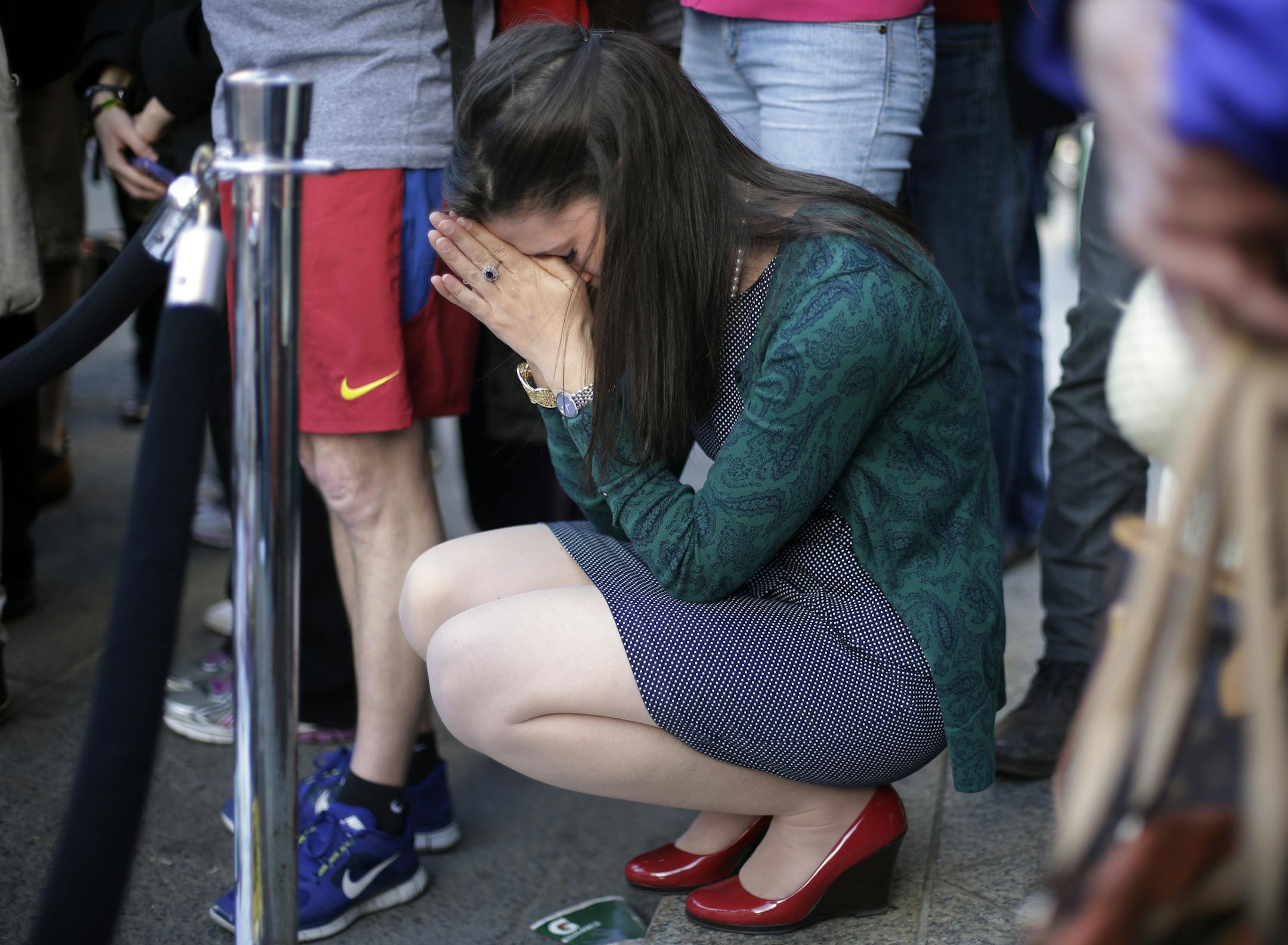
Jennifer Krewalk attends a makeshift memorial on Boylston Street near the finish line of Monday's Boston Marathon explosions, which killed at least three and injured more than 140, Wednesday, April 17, 2013, in Boston. (AP Photo/Matt Rourke)
memorial grows: Jennifer Krewalk attended a makeshift memorial on Boylston Street near the site of Monday’s explosions, which killed three and injured more than 170. By early afternoon, the area was a too-familiar sight of American tragedy, as dozens left bouquets, teddy bears, racing medals, heart-shaped signs crafted by children and, this being Boston, a plethora of Red Sox baseball caps. All day, the crowd grew. Some stood silently, tears welling in their eyes. A Tibetan monk offered a prayer. Said Anne Marder, 56, a Sacramento nurse who ran her fifth Boston Marathon: “We’re all in this together.” (The Minnesota Star Tribune)
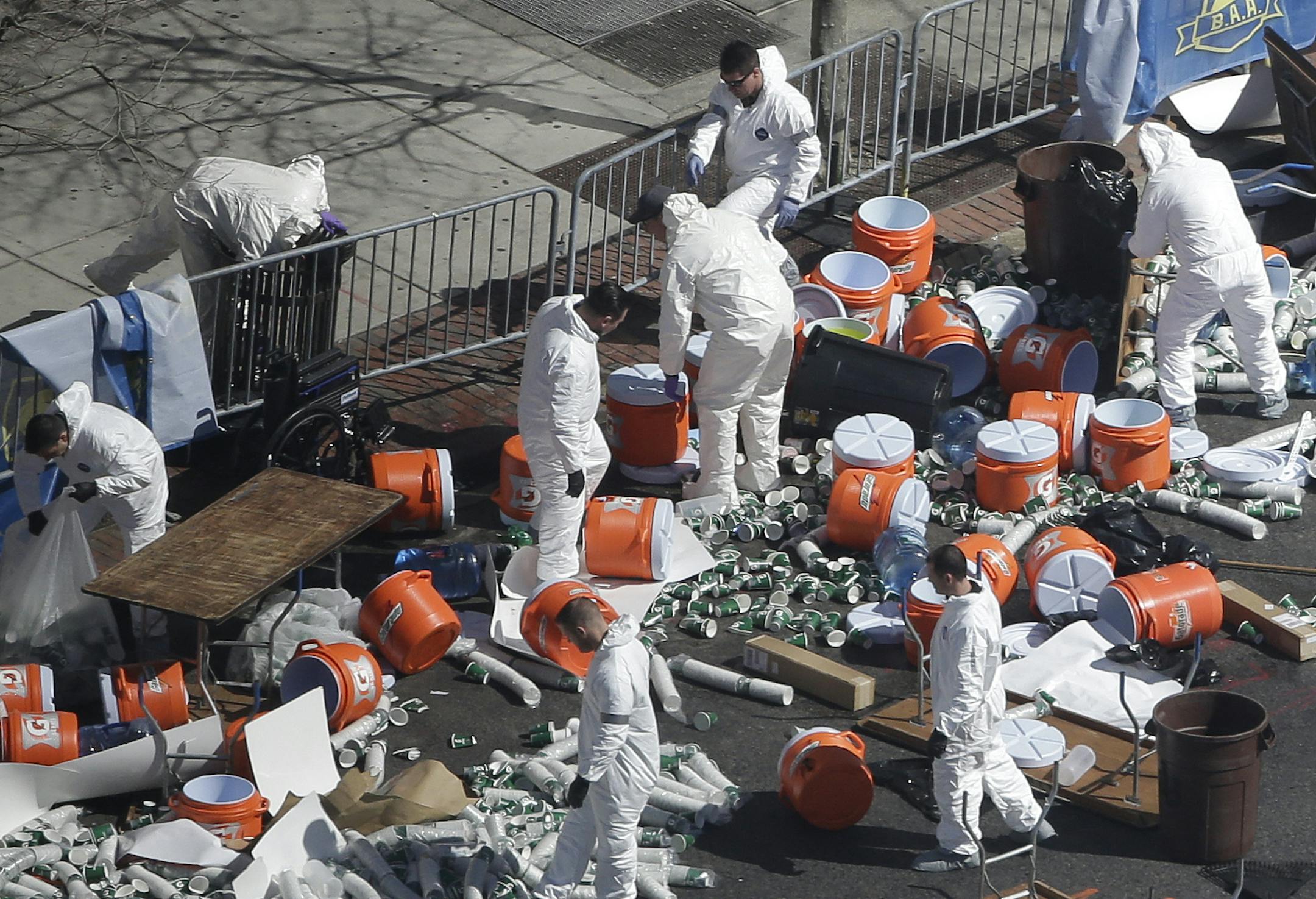
Investigators comb through the post finish line area of the Boston Marathon at Boylston Street, two days after two bombs exploded just before the finish line, Wednesday, April 17, 2013, in Boston. (AP Photo/Julio Cortez)
Investigators on Wednesday combed through the post finish line area of the Boston Marathon. (The Minnesota Star Tribune)
about the writer

about the writer