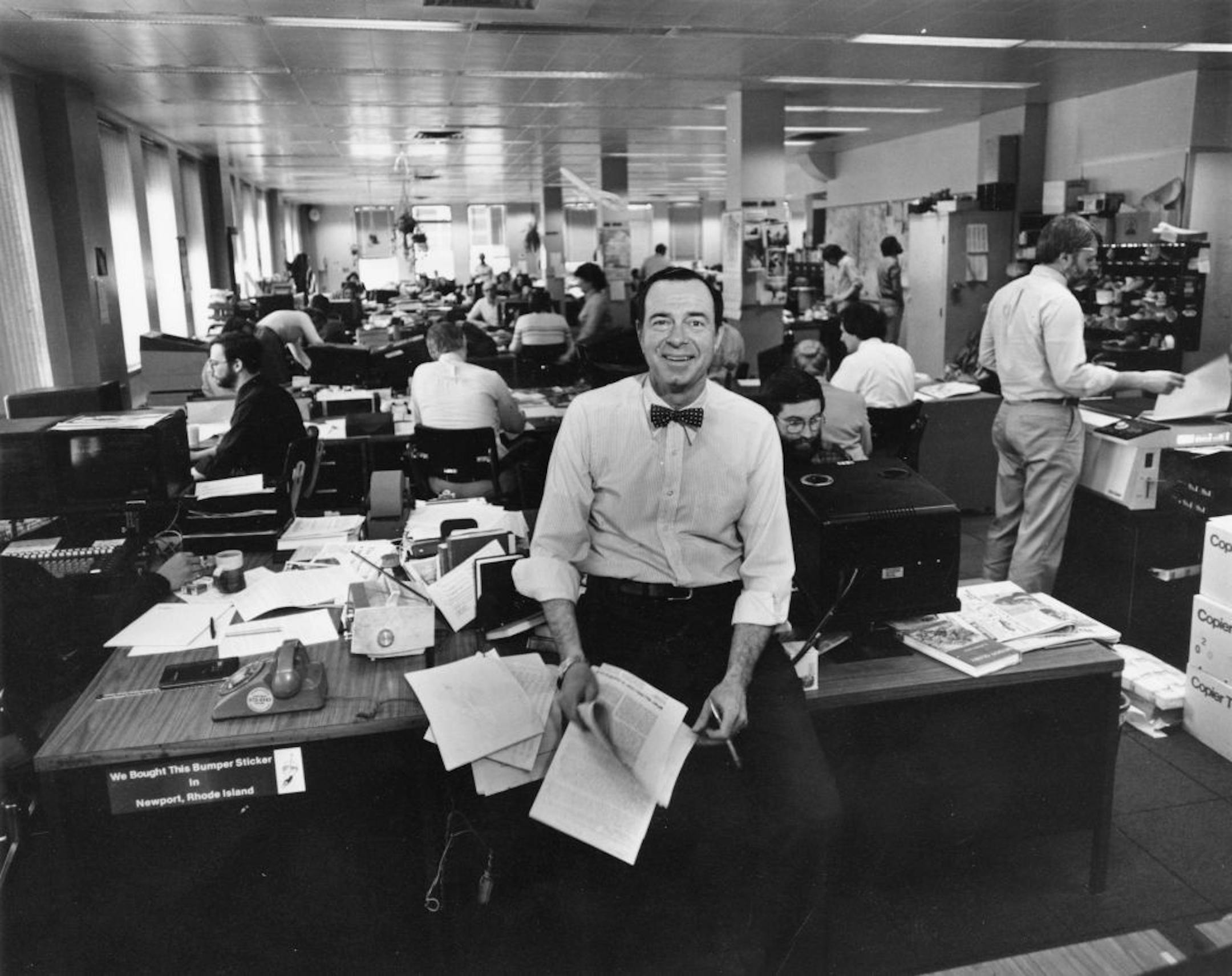
Veteran journalist Charles Waldo Bailey II recorded momentous events in U.S. history, wrote bestselling political novels and ended his newspaper career on a point of principle, resigning as editor of the Minneapolis Star and Tribune to protest staff cuts he said would have "grave consequences" for the paper's quality.
Bailey, who wrote 15 political novels, including the thriller "Seven Days in May," was a consummate newsman whose reporting took him around the globe and within earshot of Robert Kennedy's assassination. He died Tuesday from complications of Parkinson's disease while in a nursing home in Englewood, N.J. He was 82.
"He was deeply committed to the Upper Midwest and the people of Minnesota," said Victoria Bailey, one of his daughters. "He felt it was important for the news in Minneapolis to be reported with the same depth as other parts of the country."
Bailey worked for the Tribune in the nation's capital from 1954 to 1972 and frequently traveled with the nation's top officials, Victoria Bailey said. "He went everywhere [that presidents such as Johnson and Nixon] went. That included going with Nixon to China for his diplomatic breakthrough in 1972, she said.
"He lived and breathed politics," his daughter said. "He was with Bobby Kennedy when Bobby got shot [in 1968]," she said. "He was on the other side of the door."
Bailey was also with President Kennedy in Dallas at the time of his assassination. He stood a few feet away on Air Force One flying back to Washington as a somber-faced Lyndon Johnson was sworn in with Jacqueline Kennedy at the new president's side. A widely disseminated news photograph shows Bailey looking on from a doorway in the rear.
Bailey joined the Minneapolis Tribune in 1950, shortly after graduating from Harvard University. At the outset, he worked as a general assignment, police and City Hall reporter, and as a night rewrite man. In 1954, he was assigned to the Washington bureau, where he covered Congress, agriculture and the White House before being named bureau chief in 1968.
Former Vice President Walter Mondale said Bailey was one of the most respected journalists in Washington, adding that Bailey's passion for politics eventually laid the groundwork for his novels.