

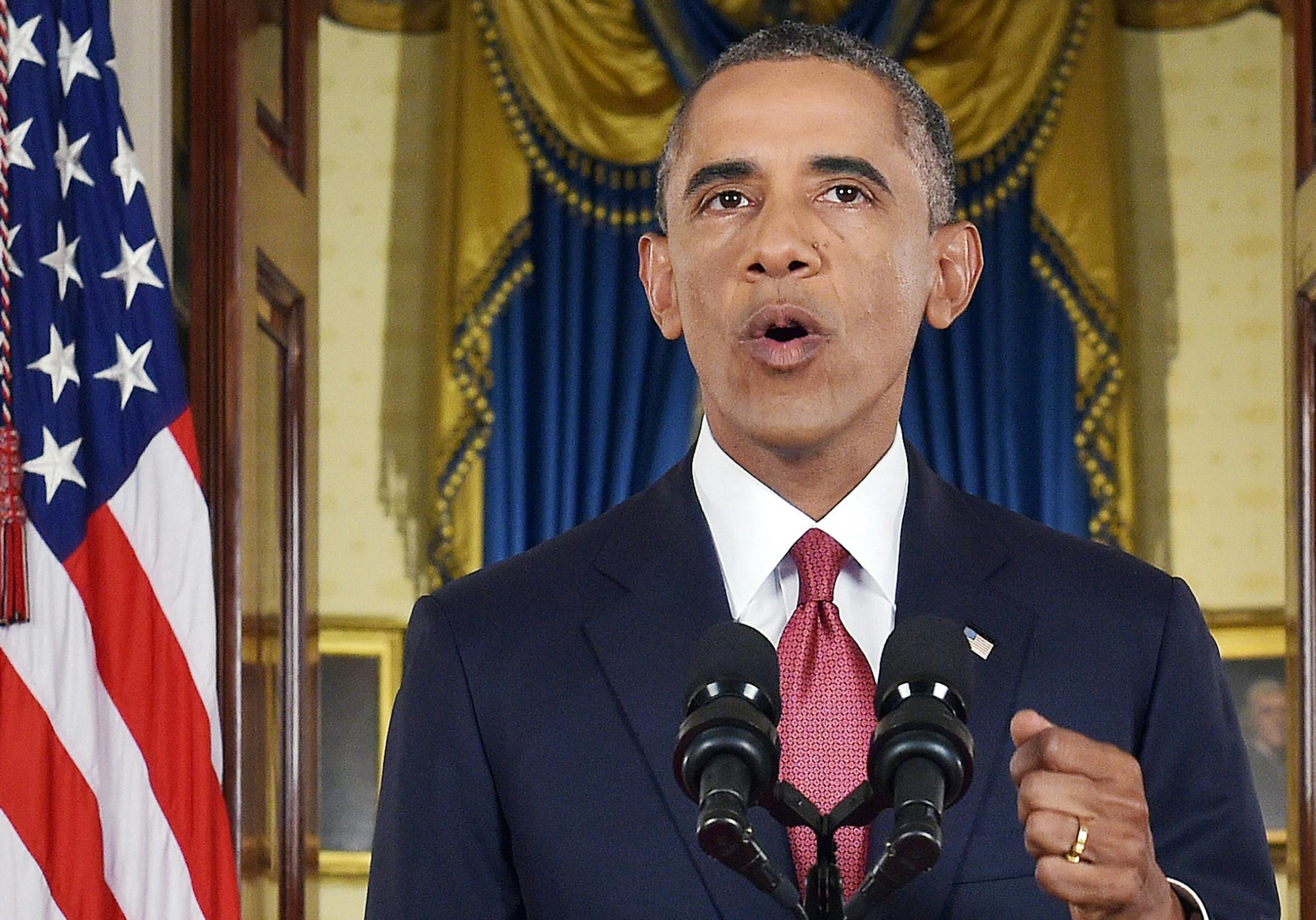
There's an air of tragedy about President Obama. He wants to chart a new course — pivot to the Pacific, end the long decade of war, do nation-building at home — but the old world's most derelict, dysfunctional quarters keep pulling him back in. Now, in the cruelest irony, the gusts are pulling him back to the very land where he least wants to set foot again, the war zone that he spent most of his first term leaving: Iraq.
"We will not get dragged into another ground war in Iraq," he insisted in his televised speech Wednesday night. Instead, this will be a war where others — mainly Iraqi soldiers — fight on the ground, while American advisers devise the battle plans and American pilots pummel the enemy with missiles and bombs.
Still, one could be excused for feeling a spasm of dread as the speech spilled forth. I wouldn't be surprised if the president himself heaved a sigh while he wrote it.
That said, the policy that he outlined — his strategy to "degrade and ultimately destroy" the terrorist group known as the Islamic State in Iraq and the Levant — is as reasonable, and has as much chance of succeeding, as any that might be conceived.
There are two big new elements in this policy: First, airstrikes will no longer be restricted to areas where ISIL poses a threat to U.S. personnel. Instead, they can strafe and bomb ISIL targets anywhere in Iraq, coordinating the strikes with assaults on the ground by Iraqi soldiers, militias, or Kurdish Peshmerga.
Second, these airstrikes will take out ISIL jihadists not only in Iraq but also across the border in Syria. A senior official stressed that this part of the policy is not as open-ended as the speech makes it seem. Obama is well-aware that airstrikes alone don't produce victory. They need to be synchronized with ground assaults. And for now, there are no ground forces in Syria that can beat back ISIL.
So, at least initially, U.S. airstrikes in Syria will be clustered along the Iraqi border, to keep ISIL jihadists from moving back and forth between the countries or from seeking safe haven — in much the same way that drones were fired at northwest Pakistan to deny safe haven to Taliban who had been fighting in Afghanistan.
However, these airstrikes will eventually expand across Syria. Another part of Obama's strategy (and he did outline this in his speech) is to train and equip the Free Syrian Army, the more moderate militiamen currently being squeezed both by ISIL and Syrian President Bashar Assad. (They'll be trained by special forces on a base in Saudi Arabia.) Once they're trained and armed, the FSA will return to Syria and — with the help of U.S. airstrikes — take back their own territory from ISIL.


