

During the debate over a military strike on Syria, the message from most members of Congress, their constituents, the British Parliament and even many allied leaders was clear: Pursue diplomacy first.
President Obama listened. And then he acted, quickly, when an unexpected diplomatic track became available.
He's listening to Iran's new president, too. And what he's hearing is that Hassan Rowhani, seemingly with the support of Iran's supreme leader, Ayatollah Ali Khamenei, is increasingly open to diplomacy designed to diffuse the crisis over the country's potential pursuit of nuclear weapons.
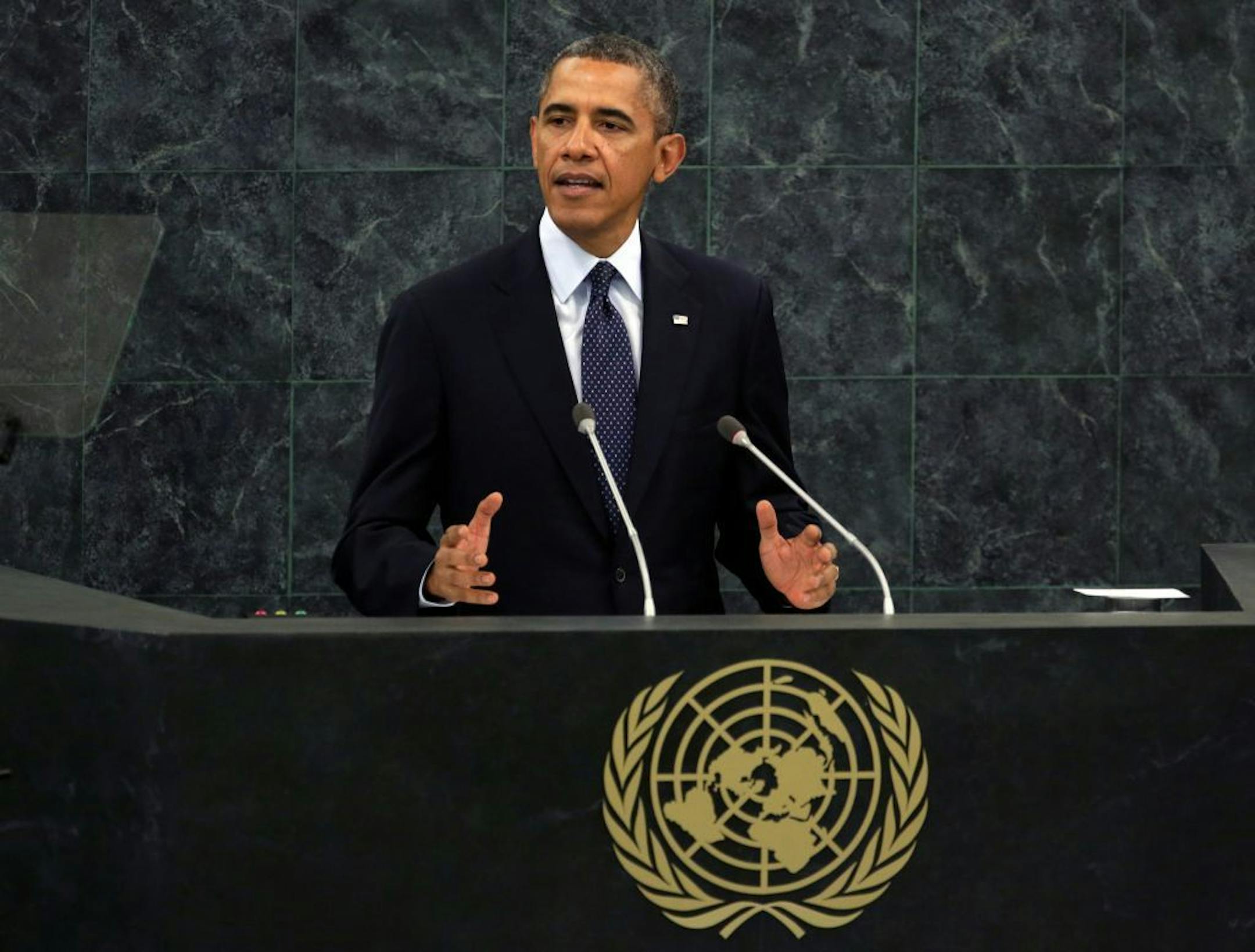
On Tuesday, it was Obama's turn to be heard. Rather than soaring rhetoric, his speech to the United Nations General Assembly offered specifics on U.S. foreign policy objectives and a road map for how the U.N. could help peacefully resolve several vexing world problems. But diplomacy will only work if the U.N. Security Council backs up negotiated settlements with concrete consequences for nations that do not honor them.
With that goal, Obama rightly pressed for a more muscular Security Council resolution on Syria.
"Without a credible military threat, the Security Council had demonstrated no inclination to act at all," Obama said, alluding to the immoral enabling of the homicidal regime of Syrian President Bashar Assad by Russia and China. "If we cannot agree even on this, then it will show that the U.N. is incapable of enforcing the most basic of international laws. On the other hand, if we succeed, it will send a powerful message that the use of chemical weapons has no place in the 21st century, and that this body means what it says."
Russia engineered the settlement with Syria but has continued to oppose the threat of force for noncompliance. And other countries may sense that such a threat is counterintuitive to pursuing peaceful resolutions through the international institution designed to prevent warfare. But it must be remembered that the only reason Russia prodded Syria to disavow and destroy chemical weapons is because of the potential for U.S. military strikes.
Similarly, having "all options on the table," including the most constrictive economic sanctions ever levied, has concentrated minds in Tehran. Rowhani's mandate is to rid Iran of the crippling sanctions. Public pronouncements by Khamenei and Rowhani, as well as an exchange of letters with Obama, indicate that a diplomatic aperture may be possible with Iran, too. Every effort must be made to avoid a military confrontation that could have catastrophic consequences.


