
Rash: The U.S. should recommit to human rights leadership

The Nuremberg trials showed the power of America’s moral force.

Columnist Icon
The Minnesota Star Tribune
October 27, 2025 at 10:00AM
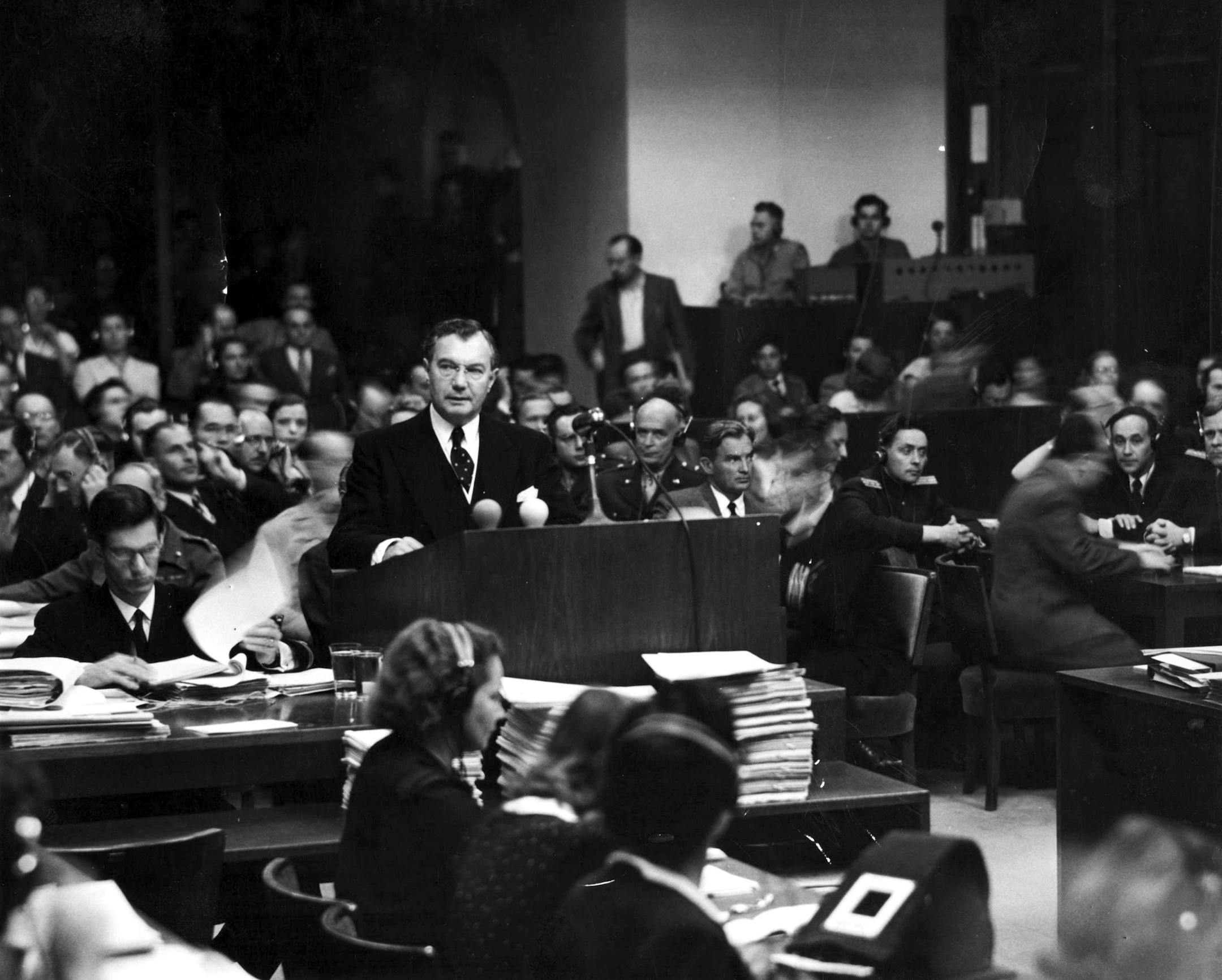
Robert H. Jackson, American chief prosecutor, speaks in court at Nuremberg, 1946.
Robert H. Jackson, American chief prosecutor, speaks in court at Nuremberg, 1946. (National Archives at College Park)

Opinion editor’s note: Strib Voices publishes a mix of commentary online and in print each day. To contribute, click here.

•••

A film about the Nuremberg trials will by definition be disquieting. But the most disturbing images in “Nuremberg” aren’t from the new movie itself, but archival footage of concentration camps that’s shown to the jurists — and by extension, moviegoers — who like the on-screen characters recoiled at scenes of emaciated survivors and skeletal remains of Holocaust victims. Eighty years hence, it still shocks the conscience — as it should.

“I think it’s important to look backwards in order to look forward,” the film’s director and co-writer, James Vanderbilt, told a capacity crowd at an advance screening at the Main Cinema in Minneapolis last week. (“Nuremberg” premieres locally on Nov. 6.) Vanderbilt spoke along with his Minneapolis-based co-writer, Jack El-Hai, whose book “The Nazi and the Psychiatrist” informed and inspired the screenplay.

While overall the International Military Tribunal indicted 199 Nazis, the book’s titular one is Hermann Göring (Russell Crowe), Hitler’s second-in-command. The psychiatrist alternately analyzing and antagonizing him is Douglas Kelley (Rami Malek). But the most compelling character is a man whose character shines through: Associate Supreme Court Justice Robert H. Jackson (Michael Shannon), who led the prosecution of those who persecuted millions across a continent.

“Jackson was a person of tremendous abilities — analytical, oratorical, legal — and he applied them all during his lifetime,” said John Q. Barrett, a St. John’s (N.Y.) University law professor who is writing a biography of Jackson. Barrett, who will speak at a Minnesota History Center event on Tuesday, said that “Jackson really shaped the principled commitment to doing it on the level, to doing it with due process, to doing it based on evidence.” The trials were open, fair, funded by America and “gave all the resources that our Bill of Rights gives to criminal defendants.” A process, Barrett said, that Jackson referred to as one “our children could look back on with pride.”

For very long, “heads of state and government were not held criminally accountable for the human-rights violations they perpetrated against their own populations,” said Carrie Booth Walling, director of the Human Rights Program at the University of Minnesota. “And so this was really a dramatic shift. The idea to put individuals on trial, including individuals who had so grossly violated the rights of other human beings, and to say that they were entitled to the rights they denied other people, was a really important marker in the development of international criminal law and international accountability.”

Walling spoke after moderating a Humphrey School event last week with Mary Lawlor, the U.N.’s special rapporteur on human rights defenders. Reflecting on 50 years of advocacy, including in her native Ireland, Lawlor was unflinching.

“Today, there is an undeniable disillusionment with the international human-rights architecture as it currently exists,” she said. “It has proven largely incapable of protecting the world’s most vulnerable people, including civilians in war, refugees and human-rights defenders exposing abuses, not to mention indigenous peoples and women and LGBT activists and others.” All at a time, she noted, of more conflicts across continents than at any time since World War II.

Lawlor said that those on the front lines of human rights have expressed increasing doubt about how “grave violations are met with silence, double standards or political compromise; defenders begin to question whether the principles of universality and accountability truly apply.” Add to all of this, she said, cuts in funding for such programs, coupled with “countries which have spoken out most and spent the most on developing a supranational human-rights infrastructure are now abandoning or deprioritizing it, choosing instead to direct resources into weapons, security or defense.” While this diagnosis fits several Western countries, U.S. cuts, Lawlor said, will affect most of them negatively.

Human rights “is not linear,” Lawlor said, adding that she fears that postwar protocols are “being torn down.” Building them back up is one of the missions of the U’s Human Rights Program. Its leaders hope to “prepare the next generation of human-rights scholars and practitioners,” Walling said. Add to that effort the force multiplier of Minnesota-based nongovernmental organizations and leadership from elected officials — including Democratic Sen. Amy Klobuchar, who along with Iowa Republican Sen. Charles Grassley recently championed the bipartisan Abducted Ukrainian Children Recovery and Accountability Act legislation, which passed the Senate as part of the National Defense Authorization Act. The bill, which awaits House action, would aid Ukraine as it seeks to recover the more than 19,000 Ukrainian kids kidnapped by Russia.

Over the years, Walling said, America has “been vitally important in accountability work for human-rights violations.” And yet, she added, “the U.S. has consistently been inconsistent in terms of its own human-rights practices as well as the amount that it champions” them worldwide.

El-Hai notices the tempo and tone shift from when “The Nazi and the Psychiatrist” was published in 2013.

“Immediately after the book was published I did feel that it resonated, but in a limited way,” he said. “Because the groups that I thought of when I considered that resonance — extremist groups in this country and in other countries — seemed on the fringes at that time. But now, in 2025, it’s a different situation we face, and I think the book resonates more than it did.”

El-Hai identified two threads from both the book and the movie: One, what motivates authoritarianism and some citizens’ support for it (they’re opportunists, he said, “riding waves of ideology to obtain power”), and two, the long-term impact of the trials, which El-Hai said led to the U.N. convention against genocide (which tragically hasn’t ended the scourge, El-Hai hastily added).

Despite this country’s “consistent inconsistency” on advancing and defending human rights, the U.S. can still be a beacon like it was in the dark days of Nuremberg, when the trials showed the world what a moral force this country can and should be. Indeed, it’s time for a renewed human-rights era that, in Jackson’s words, “our children could look back on with pride.”

about the writer

about the writer

John Rash

Editorial Columnist

John Rash is an editorial writer and columnist. His Rash Report column analyzes media and politics, and his focus on foreign policy has taken him on international reporting trips to China, Japan, Rwanda, Kazakhstan, Turkey, Lithuania, Kuwait and Canada.

See Moreicon

More from Columnists

See More
card image
Wally Skalij/The Associated Press

Americans are seeing a split screen of conflicting imagery on deportations: The Trump administration offers one narrative, and amateur cellphone clips offer another.

Travis Pennings uses a pair of binoculars to look for deer in the early morning hours, Nov. 3, 2018, during opening weekend of the season in Sandstone, Minn.