

Rash: Celebrating Minnesota’s rich heritage, 200 years after Norwegians first docked in the U.S.

On the bicentennial of Norwegian immigration to America, Crown Prince Haakon paid our State Capitol a visit.

Columnist Icon
The Minnesota Star Tribune
October 18, 2025 at 11:00AM
Norwegian Crown Prince Haakon arrives at Norway House in Minneapolis on Oct. 7. (Abbie Parr/The Associated Press)

Opinion editor’s note: Strib Voices publishes a mix of commentary online and in print each day. To contribute, click here.

•••

Two hundred years ago this month, a Norwegian vessel docked in New York, beginning an extraordinary exodus of up to a third of Norway’s population over the next century, creating a diaspora that profoundly affected Norway and America — especially Minnesota.

The craft set sail from Stavanger with 52 people. It arrived with 53. The newborn and the other new Americans, as well as the many émigrés who followed, came “looking for farmland, looking for religious freedom and, of course, a better future,” Norwegian Crown Prince Haakon said at the State Capitol after meeting with Gov. Tim Walz during a trip to the region last week.

The crown prince’s itinerary included several other stops, including Norway House in Minneapolis, where he cut a ribbon at the new Saga Center, which touts “an interactive exhibit utilizing cutting-edge technology for families of all ages to explore connections to Norway.”

Such connections are “foundational to who we are as Minnesotans,” said Walz. “We are incredibly proud of that heritage.”

For his part, the crown prince said, “it makes me proud to see how [Minnesotans with Norwegian heritage] take care of their culture and their history, and I think that it’s something that we can build upon.”

Many have been doing so throughout the last 200 years. In fact, the centennial celebration of Norwegian immigration was considered so significant that a major event was held at the state fairgrounds in 1925, said Caitlin Sackrison, a visiting assistant professor of Norwegian at St. Olaf College in Northfield (which, along with Luther College in Decorah, Iowa, was also among Haakon’s official visits). Many celebrating the centennial were immigrants or first-generation Americans, since Norwegian immigration peaked in 1882.
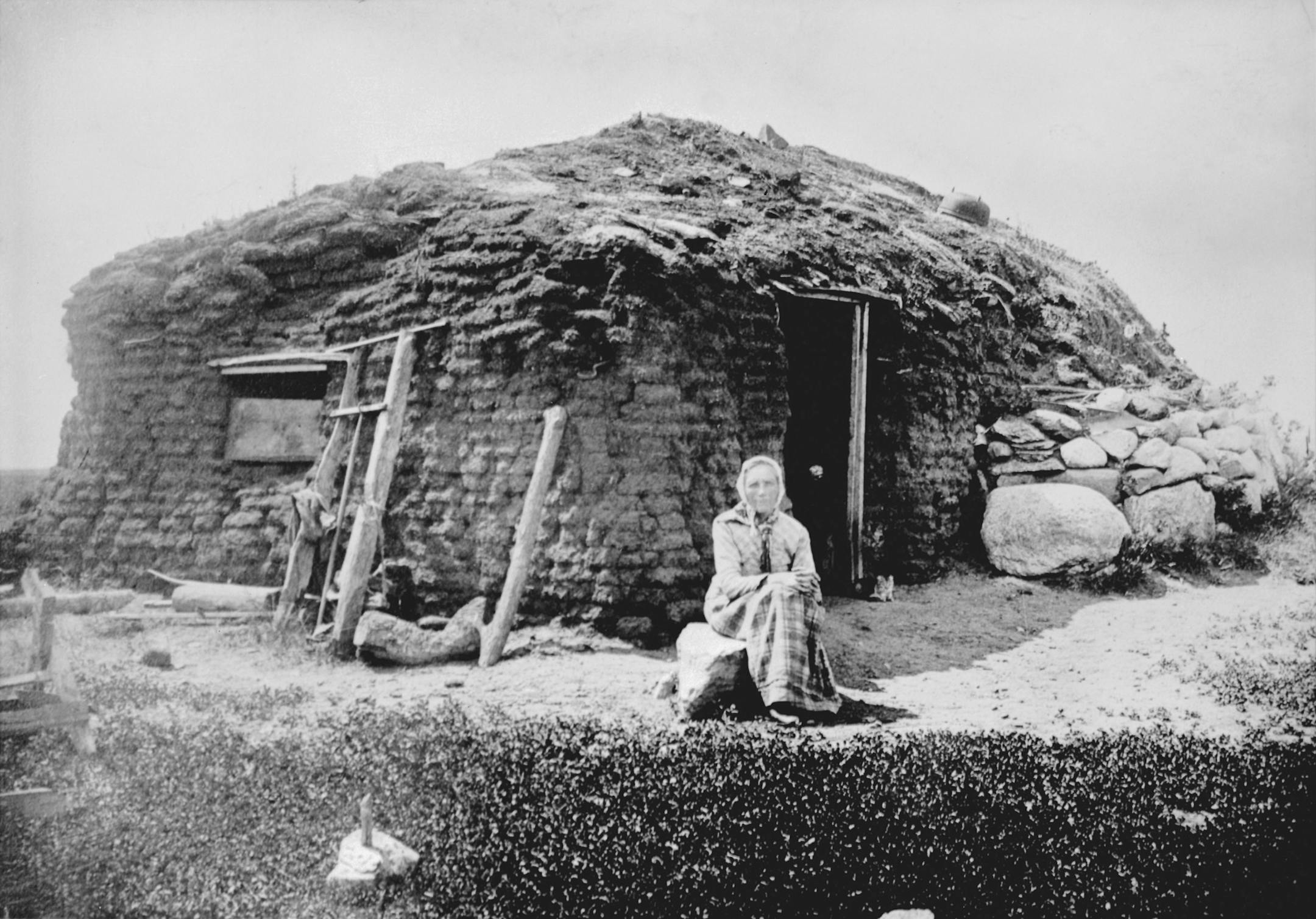
A Norwegian settler named Mrs. Beret Olesdater Hagebak is photographed sitting in front of her sod home in Lac qui Parle County in 1896. (Lac qui Parle Historical Society)

In many ways, the Upper Midwest seemed suited for Norwegians, said Benjamin Bigelow, director of undergraduate studies at the University of Minnesota’s department of German, Nordic, Slavic and Dutch. “It replicated some of those conditions of Scandinavia” — including the sparse population and the cold.

But while it’s often thought that the many Scandinavians — Norwegians, especially — who settled in Minnesota did so because the landscape looked familiar, Sackrison said that land availability, not similarity, disproportionally drove immigration to Minnesota and the Dakotas. Some traditional trades like farming, fishing and logging were similar, she said, but the agricultural scale “was just so different.”

This scale offered opportunity — but also isolation, which was one of the themes of “Giants in the Earth,” a landmark novel of the Norwegian-immigrant experience that is marking its own centennial. First published in Norwegian, the English version, which was once required reading for some Minnesota students, came out two years later.

Written by St. Olaf’s Ole Edvart Rølvaag, himself a Norwegian immigrant, the book made a splash on both sides of the Atlantic as “a very different perspective on the rosier picture that some imagine of the immigrant experience,” said Sackrison.

The novel “was incredibly impactful” for Norwegians and especially Americans, she said, adding that while the reception seemed assured in Norway, it was uncertain if somehow its resonance would be lost in translation.

It wasn’t, and the way it reflected resilience helped mythologize Nordic immigration, albeit in a 19th-century time frame, both Bigelow and Sackrison suggested.

In Scandinavia, the era of moving “away from the countryside gets felt like almost a trauma, like something being lost,” Bigelow said, adding that then “the cultural response is to become fixated on rural folk culture.”

And in America, said Sackrison, “the way we see Norwegian American history and Norwegian American culture in the U.S. is reflective of the 19th century and not the modern moment.”

While honoring that past, Haakon and Walz also pointed to the present, with each emphasizing the kind of tight ties in high-tech business that were the focus of the “USA-Norway Business Summit: Celebrating our Past and Connecting for the Future” event at Norway House.

“We are committed as we go forward,” said Walz, “whether it is around trade, or defense, or honoring our cultural heritage — it is critically important not just in Minnesota and Norway, it’s critical to the rest of the world to see how these relationships matter.”

Haakon noted close cooperation on business as well as defense; previewing his meeting with Minnesota National Guard leaders, he made special mention of the decades of coordination between the National Guard and the Norwegian Home Guard.

The crown prince told the governor that “when we come to Minnesota, we feel a little bit of home as well.”

Reflecting on the landmark anniversary, Haakon said that “bonds between nations are bonds between people, and that is very deeply rooted because of that shared history. So it’s something that’s important to us, and I think it’s important to those with Norwegian heritage here.”

After his visit to Minnesota, Haakon headed to New York. Among his stops was Pier 16, where he greeted a replica of the “Restauration” — the sloop that sailed to America two centuries ago. And while 200 years is a long time, there’s no need for restoration between the two nations. Because for Norwegians and Americans, especially so many Minnesotans, bonds — which Haakon rightly said are not just between nations, but people — remain strong.

about the writer

about the writer

John Rash

Editorial Columnist

John Rash is an editorial writer and columnist. His Rash Report column analyzes media and politics, and his focus on foreign policy has taken him on international reporting trips to China, Japan, Rwanda, Kazakhstan, Turkey, Lithuania, Kuwait and Canada.

See Moreicon