
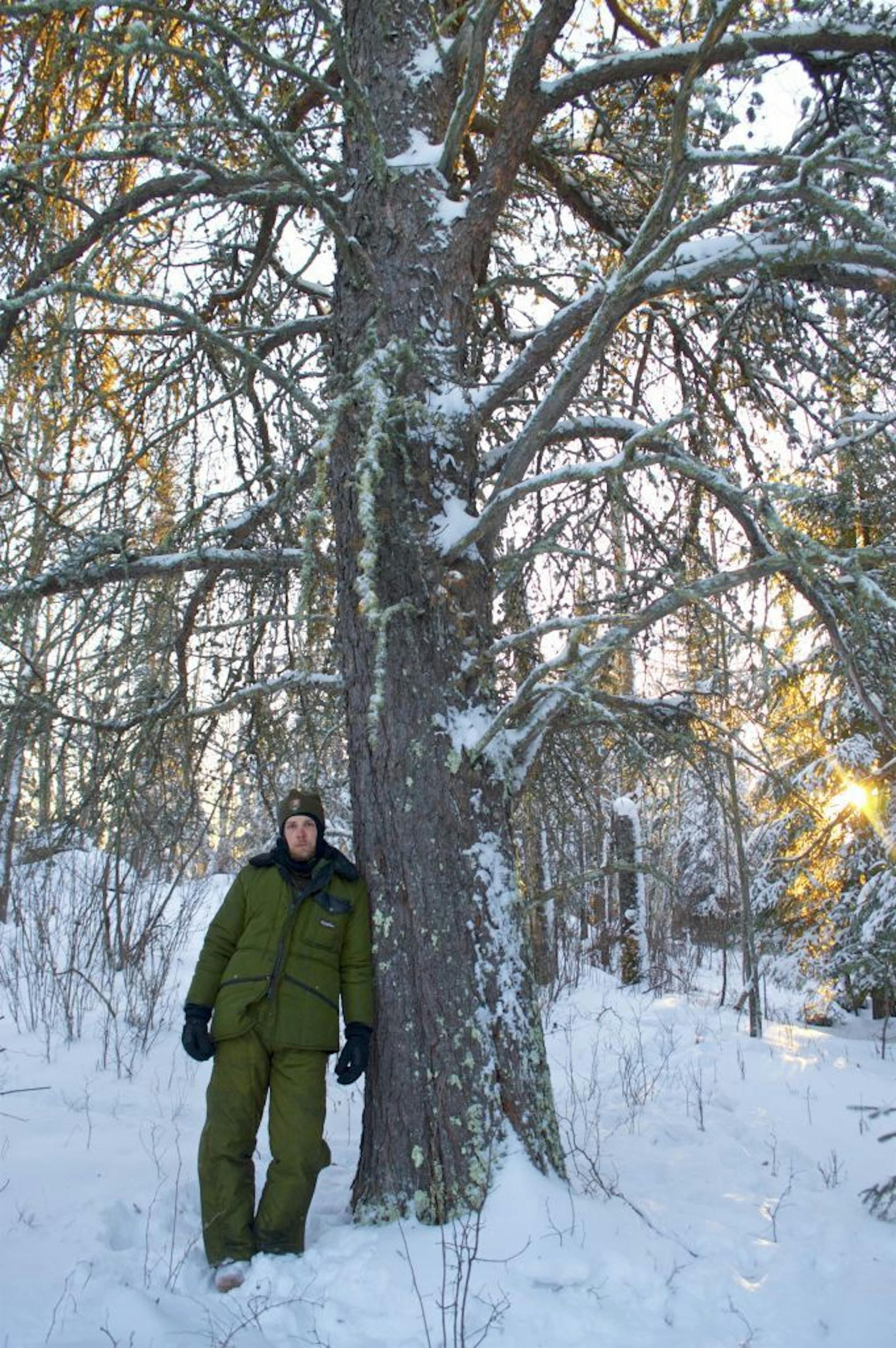
Northern Minnesota jack pine is the largest in the United States

The tree along the Namakan Lake shoreline in Voyageurs National Park makes Minnesota the home to four of the 783 national champions and co-champions.

December 7, 2018 at 4:10AM
Austin Homkes, wolf researcher stands next to the largest Jack pine in the U.S. credit: Tom Gable
Wolf researcher Austin Homkes stood next to the largest jack pine in the United States, which is in Voyageurs National Park along the Namakan Lake shoreline. (The Minnesota Star Tribune)

An old jack pine in northern Minnesota has become a national champion.

Few likely would know that it was special as they whiz by on snowmobiles along the Namakan Lake shoreline in Voyageurs National Park. But two biologists knew it was big — so big that it's the largest in the country and reigns as the national champion of jack pines on the American Forests champion trees register.

That now makes Minnesota home to four of the 783 national champions and co-champions on the register kept by the national conservation organization.

Truth be told, the champion jack pine kind of blends into the rest of the forest, with some of the red and white pines towering 20 feet or more above it.

"It kind of looks like a bump in the tree line," said wildlife biologist Austin Homkes. "But most jack pines look like bushes on a hilltop. … They look like they've been struck by lightning several times."

But for those who know jack pines, this one is almost majestic.

Homkes and fellow biologist Tom Gable are always on the lookout for big trees as they traipse through the woods, tracking GPS-collared wolves.

It was Homkes who first spotted the jack pine in summer 2017. But without his measuring tools, he couldn't tell how large it was. When winter set in, Homkes and Gable were back in the area and tromped about 50 meters into the woods to take a look.

"That's enormous for a jack pine," Gable immediately blurted out to Homkes. "When I saw its big trunk, I knew it was a record."

Sure enough. When all the measuring and verifying by state tree experts was done, it hit the jackpot of jack pines, standing at 73 feet high with a trunk measuring nearly 7 feet around.

That may seem puny compared to the 122-foot-tall national champion red pine in Michigan or the 138-foot-tall champion western white pine in Nevada.

But by nature, jack pines are scrawnier than the more majestic reds and whites.

"They often look battered and worn," Gable said. "It looks like they've taken on the elements over the years and grown up scraggly."

Few people would take notice of such trees or others, but Gable and Homkes are on a mission to find the big ones. They've measured and documented 200 of them.

"They're not all champions, obviously," Gable said. But three, including the jack pine, are state records. They include a black spruce in a bog off the Ash River Trail in Voyageurs National Park and a balsam fir in Voyageurs on Kabetogama Lake.

"If you don't know what you're looking for or not looking at all, you can easily pass by a tree over and over and have no idea it's big," Gable said.

Few people, however, get as deep into the woods as Homkes, Gable and the other researchers working on the Voyageurs Wolf Project, a collaborative effort between the park and the University of Minnesota to study the ecology of the wolves and their prey.

Since 2015, the research teams have logged about 5,000 miles in the back country, said Steve Windels, wildlife biologist at the park. Gable and Homkes are bushwhacking into places most people don't go, and they notice things that others without a trained eye wouldn't, he added.

"When you think about these big trees, they're hiding in plain sight," Windels said. "There are millions of trees here … and probably lots of big ones … but you probably just walk past them."

Gable and Homkes don't. They constantly scan the tree canopy as they tromp through the woods and scour the horizon from rock ledges.

"We have an awareness of what could be out there," Gable said. "People could see the exact same thing and not understand the significance."

The two can't help but be fascinated by the idea that trees germinated a hundred or more years ago are still standing, growing through the decades when caribou and moose were plentiful in northern Minnesota.

"It symbolizes untouched wilderness," Gable said. "There's something about seeing these old trees that takes you back in time and makes me contemplate how much things have changed since then."

Mary Lynn Smith • 612-673-4788

about the writer

about the writer

Mary Lynn Smith

Reporter

Mary Lynn Smith is a general assignment reporter for the Star Tribune. She previously covered St. Paul City Hall and Ramsey County. Before that, she worked in Duluth where she covered local and state government and business. She frequently has written about the outdoors.

See Moreicon