

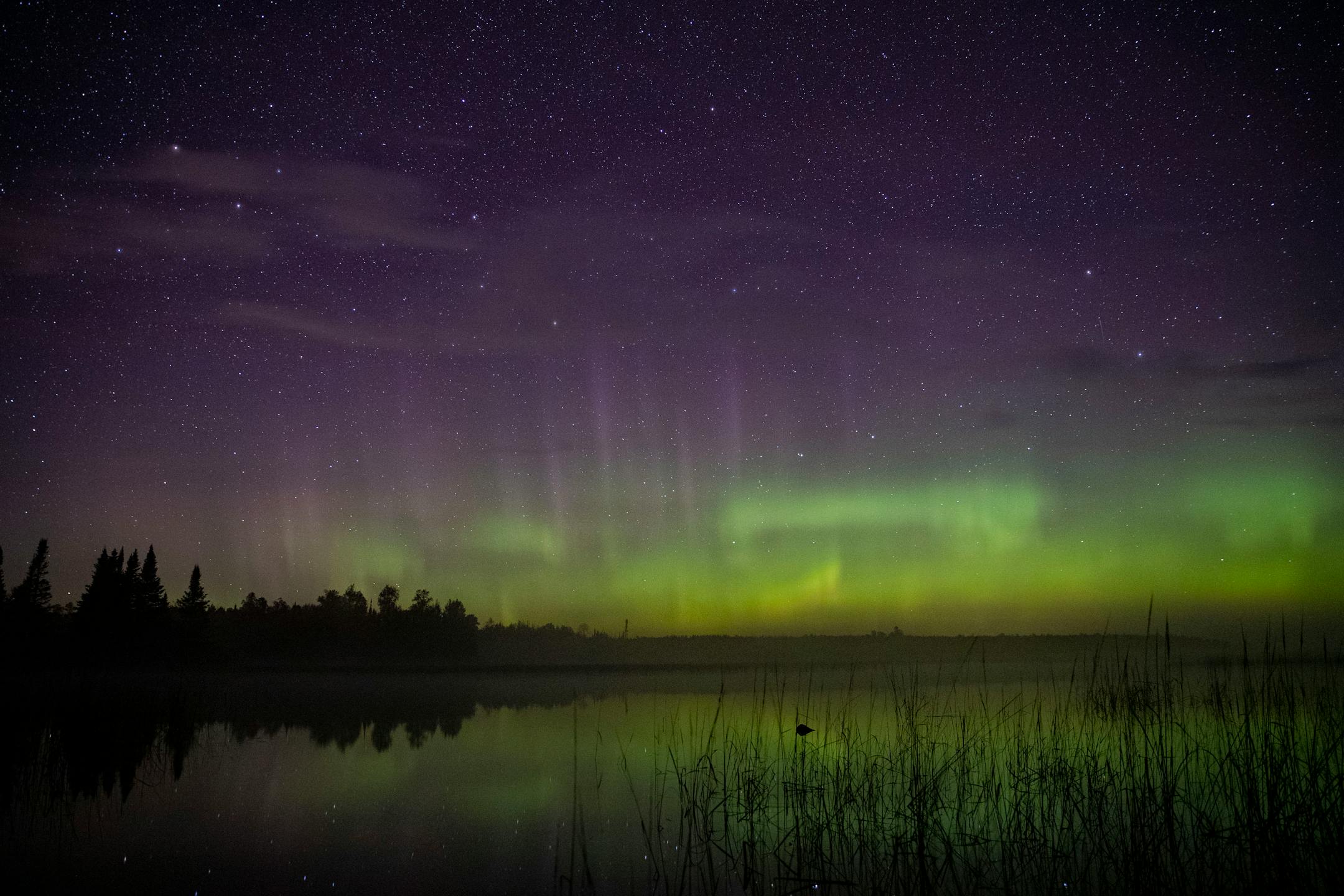
Skygazers in Minnesota could be in for a treat Thursday if everything in the atmosphere aligns to create a visible northern lights display. But just how big, bright and widespread the event will be is unclear.
"There are a lot of variables in play," said Mark Job, an avid aurora borealis chaser with the Minnesota Astronomical Society. "If an active sun spot erupts, we could be in for a great show."
But some are questioning whether we will see anything at all.
A Duluth writer and astronomy buff says don't get too excited about the forecast yet, just in case. "The aurora is like trying to hold onto a fish. Really slippery," said "Astro" Bob King, who writes a column about astronomy for the Duluth News Tribune.
"It can be maddening but that's how easily a forecast can change. I've been burned plenty in the past by reporting an aurora date based on the three-day" forecast from the National Oceanic and Atmospheric Administration,, King said.
National news outlets over the weekend reported that Americans in 17 states are expected to be able to see the celestial light show. The phenomenon — most often seen in Alaska, Canada and Scandinavia — occurs when solar winds collide with the Earth's magnetic field, causing atoms in the upper atmosphere to glow green and gray.
King said he thinks news outlets should have waited before making their predictions of seeing the northern lights.
The Geophysical Institute at the University of Alaska at Fairbanks uses a 9-point scale to forecast when and where auroral displays will be visible. For Thursday, the institute has put cities including Minneapolis, Milwaukee, Toronto and Bay City, Mich., at a 6, meaning viewing odds are good. Cities farther south, including Lincoln, Neb., Indianapolis and Annapolis, Md., could get a good view low on the horizon, the institute said.


