

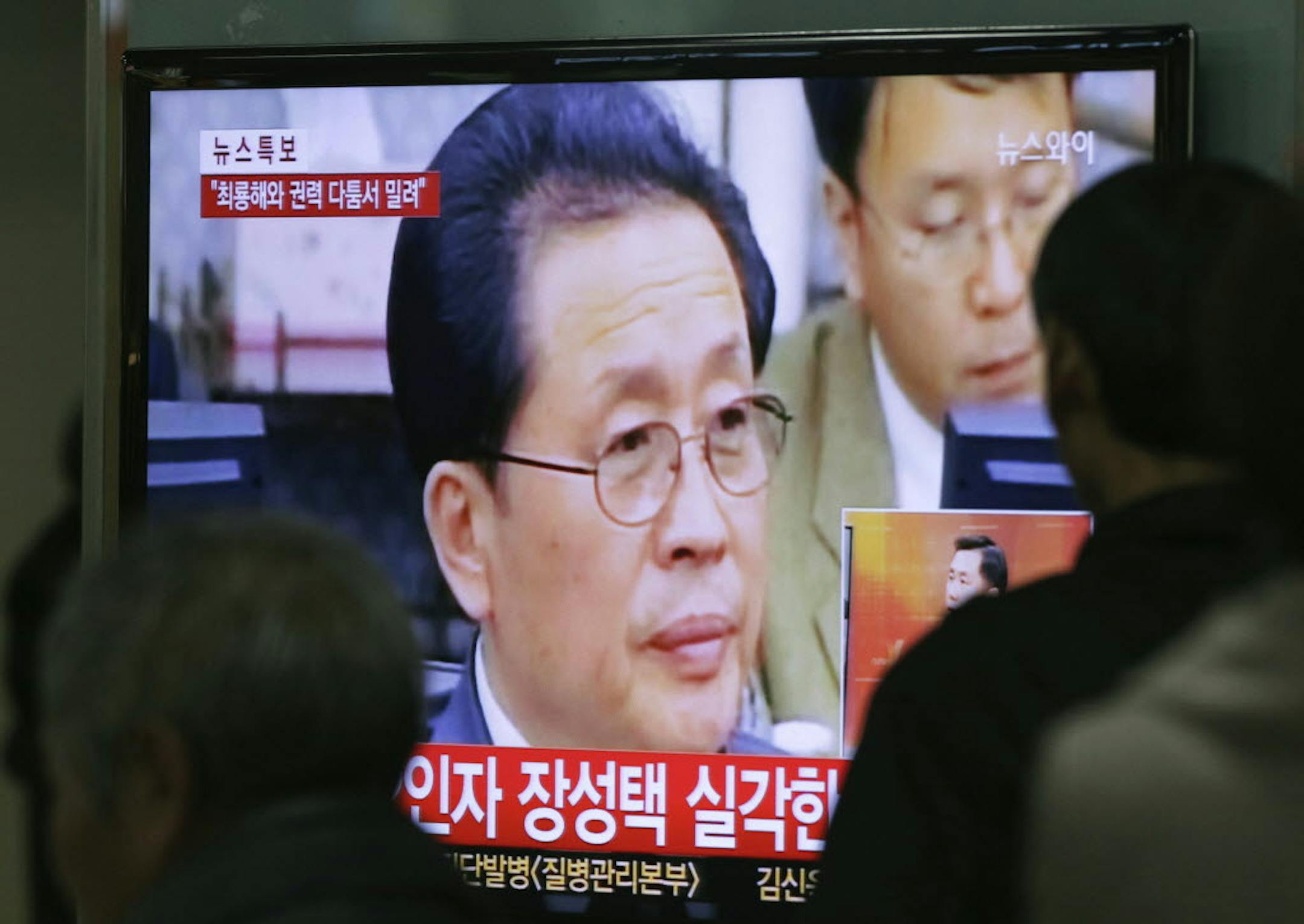
PYONGYANG, North Korea — North Korea said Friday that it executed Kim Jong Un's uncle as a traitor for trying to seize supreme power, a stunning end for the leader's former mentor, long considered the country's No. 2.
In a sharp reversal of the popular image of Jang Song Thaek as a kindly uncle guiding young leader Kim Jong Un as he consolidated power, the North's official Korean Central News Agency indicated that Jang instead saw the death of Kim's father, Kim Jong Il, in December 2011 as an opportunity to challenge his nephew and win power.
Just days ago, North Korea accused Jang of corruption, womanizing, gambling and taking drugs, and said he'd been "eliminated" from all his posts. But Friday's allegations, which couldn't be independently confirmed, were linked to a claim that he tried "to overthrow the state by all sorts of intrigues and despicable methods with a wild ambition to grab the supreme power of our party and state."
Pyongyang's statement called him a "traitor to the nation for all ages," "worse than a dog" and "despicable human scum" — rhetoric often reserved in state propaganda for South Korean leaders.
In the North Korean capital, dozens of people crowded around billboards displaying the morning paper. The execution was the top story, which said Jang's actions had created an explosion of outrage in the nation.
The news was also broadcast on the radio, which was piped into the subway. People sat quietly and listened as the announcer listed Jang's crimes.
During his two years in power, Kim Jong Un has overseen nuclear and missile tests, other high-profile purges and a barrage of threats this spring, including vows of nuclear strikes against Washington and Seoul. In contrast, his father, Kim Jong Il, took a much lower public profile when he rose to power after the death of his father, Kim Il Sung, in 1994.
It's not clear what the execution and Kim Jong Un's very public approach to leadership says about the future of the country, which is difficult for outsiders to interpret. Some analysts see the public pillorying of such a senior official, and one related to the leader, as a sign of Kim Jong Un coming into his own, the final consolidation of power that began with his father's death.

