

No quick fix for Flint's water, Michigan governor says

Tests and science needed to end crisis, Snyder said.

January 30, 2016 at 1:25AM
In this Thursday, Jan. 28, 2016 photo, Porshe Loyd, uses bottled water to wash her three-week-old son, LeAndrew, in a baby bather in the kitchen sink at their home in Flint, Mich. At home she has cases of bottled water that she bought or received from the Flint Fire Department or Michigan State Police troopers stored along a wall. Improperly treated water leached lead from pipes into drinking water after Flint switched from Detroit's water system to the Flint River in 2014 to save money while un
Porshe Loyd used bottled water to wash her 3-week-old son, LeAndrew, in the kitchen sink at their home in Flint, Mich. (The Minnesota Star Tribune)

GRAND RAPIDS, Mich. – Michigan Gov. Rick Snyder said Friday that he hopes the water in Flint might be safe to drink again in three months, but it's impossible to predict because it's not a question of time, but of science.

"It's not based on time," Snyder said during a question-and-answer session following a luncheon speech.

"It's going to be based on tests and science and people believing, including outside experts, that it's safe to drink." He added: "We would all hope sooner rather than later; but it's not based on time, it's based on science, facts and caution."

Snyder said comments he made earlier Friday, in which he said he hoped the Flint water could be safe to drink in three months, may have been taken out of context.

State lawmakers joined Snyder at the luncheon to watch him sign a $28 million supplemental appropriation bill for Flint from the state's 2015-16 budget, which Snyder has described as only one step in addressing the public health and infrastructure catastrophe resulting from lead contamination of city drinking water.

Snyder was scheduled to be on a trade mission to Israel and the Middle East this week, but scrubbed the trip to focus on Flint.

Flint's water became contaminated with lead in April 2014 after the city, while under the control of a state-appointed emergency manager, temporarily switched its source from Lake Huron water treated by the Detroit Water and Sewerage Department to water from the Flint River, treated at the Flint water treatment plant.

Department of Environmental Quality Director Dan Wyant resigned in December after acknowledging the department failed to require the addition of needed corrosion-control chemicals to the corrosive Flint River water.
As a result, lead leached from pipes, joints and fixtures, contaminating the drinking water for Flint households. Lead causes permanent brain damage in children and other problems.

For months, state officials downplayed reports of lead in the water and a spike in the lead levels in the blood of Flint children before acknowledging a problem Oct. 1. Since then, Snyder has faced repeated questions about when he first knew there was too much lead in Flint's drinking water.

Snyder has said the buck stops with him on the Flint water issue, but said again Friday the disaster happened because of mistakes at the local, state and federal level and his focus is on fixing things, not assessing blame.

"Mistakes were made; problems happened," he said. "We're going to solve them; we're going to fix them."

Snyder said he hopes the Flint tragedy can be used as a wake-up call for Michigan to address other problems with underground infrastructure.

Some critics have linked the Flint problem with a lack of transparency in the Snyder administration, since Flint residents who were drinking the contaminated water were not aware of e-mails and reports that were being sent back and forth between state departments and the U.S. Environmental Protection Association on the issue.

Snyder made no commitments when asked if he favored extending the state Freedom of Information Act to cover records in the governor's office and the Legislature. "That is an active topic," Snyder said. "We're going to be working on how to enhance transparency."

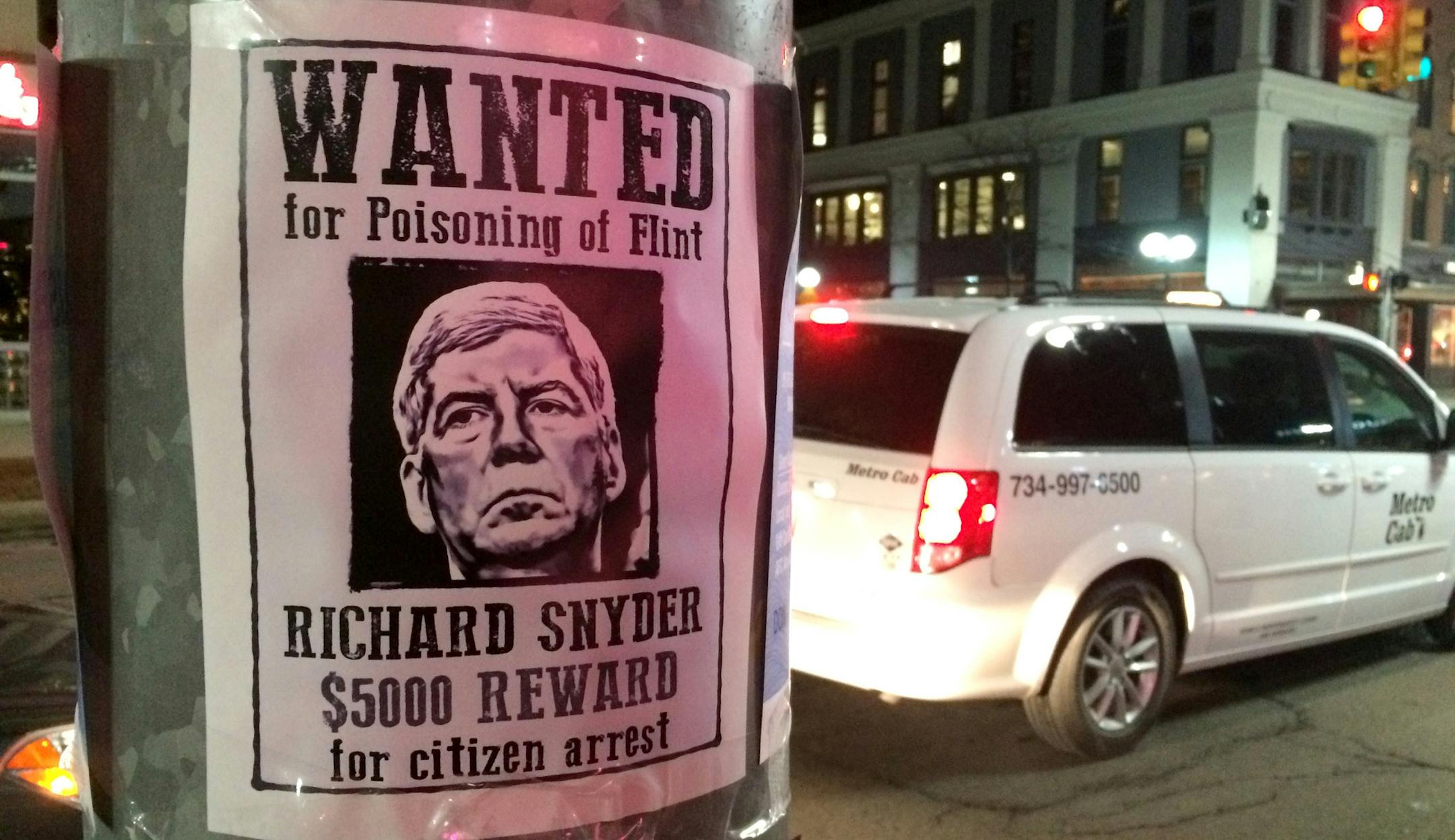
In this photo taken on Wednesday, Jan. 27, 2016, a poster offering a $5,000 reward for "citizen arrest" of Michigan Gov. Rick Snyder is displayed in downtown Ann Arbor, Mich. The posters were among messages criticizing Snyder, including ones written in chalk on sidewalks, over his handling of the water crisis in Flint, Michigan. (Ryan Stanton /The Ann Arbor News via AP) LOCAL TELEVISION OUT; LOCAL INTERNET OUT; MANDATORY CREDIT
A poster in Ann Arbor offered a reward for the “citizen arrest” of Michigan Gov. Rick Snyder. (The Minnesota Star Tribune)
about the writer

about the writer

Paul Egan, Detroit Free Press

More from No Section

See More
FILE -- A rent deposit slot at an apartment complex in Tucker, Ga., on July 21, 2020. As an eviction crisis has seemed increasingly likely this summer, everyone in the housing market has made the same plea to Washington: Send money — lots of it — that would keep renters in their homes and landlords afloat. (Melissa Golden/The New York Times) ORG XMIT: XNYT58
Melissa Golden/The New York Times

It’s too soon to tell how much the immigration crackdown is to blame.