

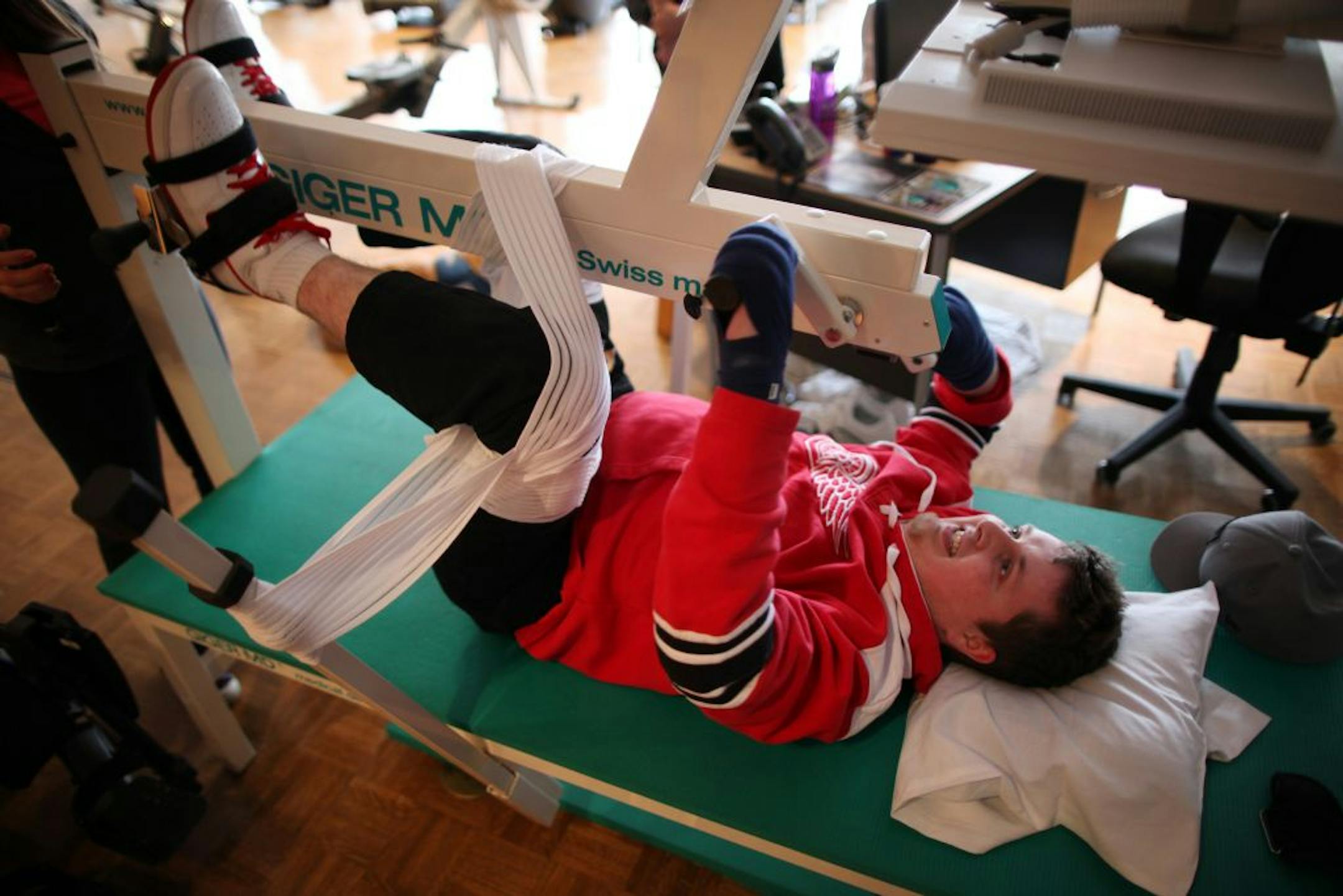
Brendan Loney can't move his legs, but once a week, he sure does run.
Suspended by a harness from the ceiling at Courage Center in Golden Valley, the 23-year stares ahead at a mirror while two therapists move his stocky legs across a treadmill. A third therapist straddles the treadmill and keeps Loney balanced. A fourth controls the machine and rotates in when the others get tired.
For Loney, who was paralyzed from the neck down in a 2009 diving accident, the exhausting "locomotor" therapy serves several purposes. It helps his body fight infections. It keeps his muscles strong.
And maybe, just maybe, it will keep his body ready for a breakthrough spine medicine that can give him back lost mobility.
"I'm trying to stay as fit as I can," the former hockey player said, "and hopefully be a good contestant when they do come up with something."
Hope like that was once drummed out of spine injury patients -- especially for those with the most severe injuries -- in part because doctors saw the despair that set in when patients clung to the notion of a recovery that never came.
But at some point between the paralyzing injuries to actor Christopher Reeve in 1995 and teen hockey player Jack Jablonski in December, that philosophy changed.
"We used to always say we're working around this [injury]," said Dr. Karl Sandin, physician-in-chief at the Sister Kenny Rehabilitation Institute in Minneapolis. "Now, it's more nuanced."


