

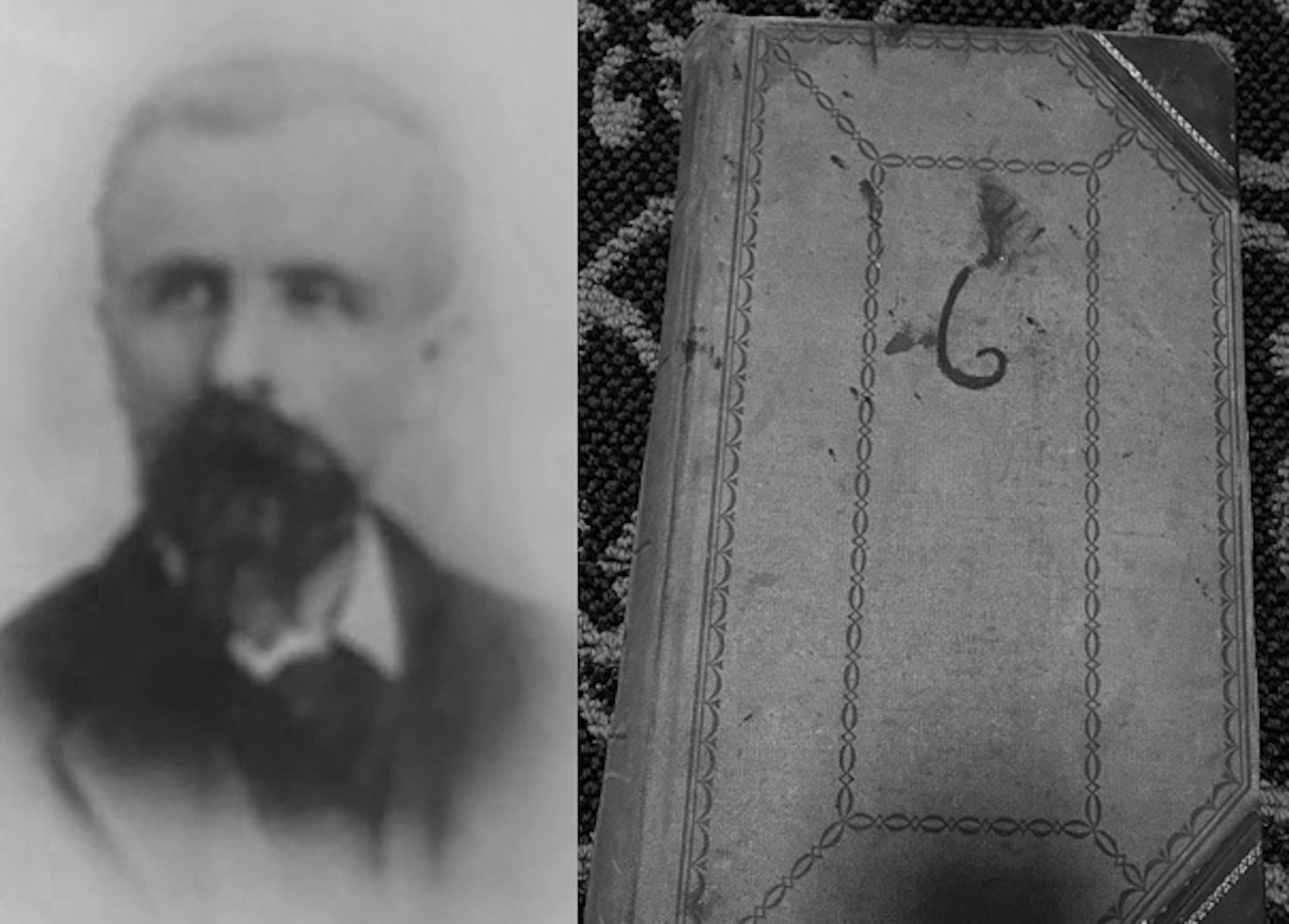
Dr. Nancy Ott-Pinckaers keeps a gray ledger from an 1890s-era Minneapolis grocery store tucked in a fabric bag in her Edina den.
The 130-year-old relic belonged to her husband's French Canadian great-grandfather, Zephirin DeMeules, who arrived in Minnesota at 17 in 1855 and became a prominent merchant and civic leader. A cousin cleaning out her mother's south Minneapolis house unearthed it a few years ago and gave it to Ott-Pinckaers, an allergist and genealogy buff.
She found out that DeMeules' general stores, selling hardware and groceries in 19th-century Osseo and Minneapolis, "went in and out of business" due to his generosity in extending credit. When scouring the ledger, she said, she laughed "because most of the entries are for purchases and very few payments. No wonder he went broke."
The old ledger is a portal of sorts, illuminating the largely forgotten life of an early Minnesotan and fervent Francophile who became an influential politician and published Echo de l'Ouest (Echo of the West), a French-language Minneapolis newspaper, from 1883 to 1929. DeMeules ran the paper for 15 years before his son, Augustin, took over upon his death in 1898.
By then, more than 70,000 French Canadian immigrants had migrated to Minnesota and neighboring states. Many lived in Little Canada, Dayton and Osseo, originally known as Bottineau Prairie, and some 5,000 of them subscribed to Echo de l'Ouest, which fought to sustain a distinctive French Canadian community.
DeMeules was born in Quebec in 1837. His father died when he was 12, but he nevertheless made his way to Montreal for a college education. After moving to Minnesota, he spent six years working for Capt. Louis Robert (pronounced Roh-bare), a French Canadian fur trader and riverboat pilot in early St. Paul and the namesake of Robert Street in downtown St. Paul and the West Side.
DeMeules worked at Robert's trading posts in New Ulm and Osseo. The historical record is mixed on whether he played a role in the 1862 U.S.-Dakota War; his 1898 obituary says he "took a prominent part in the fighting," but the Minnesota Historical Society says he left New Ulm in 1861 just before the war erupted in the area.
DeMeules opened his own Osseo store in 1861 and moved operations to Minneapolis a decade later. He fathered eight children with his first wife, Marguerite. When she died after childbirth at 40 in 1876, DeMeules wasted no time in marrying his Belgian-born, French-speaking housekeeper, Alphonsine Julia Haulot. She gave birth to the first of their six children 10 months later, and their youngest child, Yvonne, was born just before he turned 60.


