
New year could bring new phase to war

Negotiations are definitely possible — outcome wholly uncertain.

Bloomberg Opinion
January 4, 2023 at 11:35PM
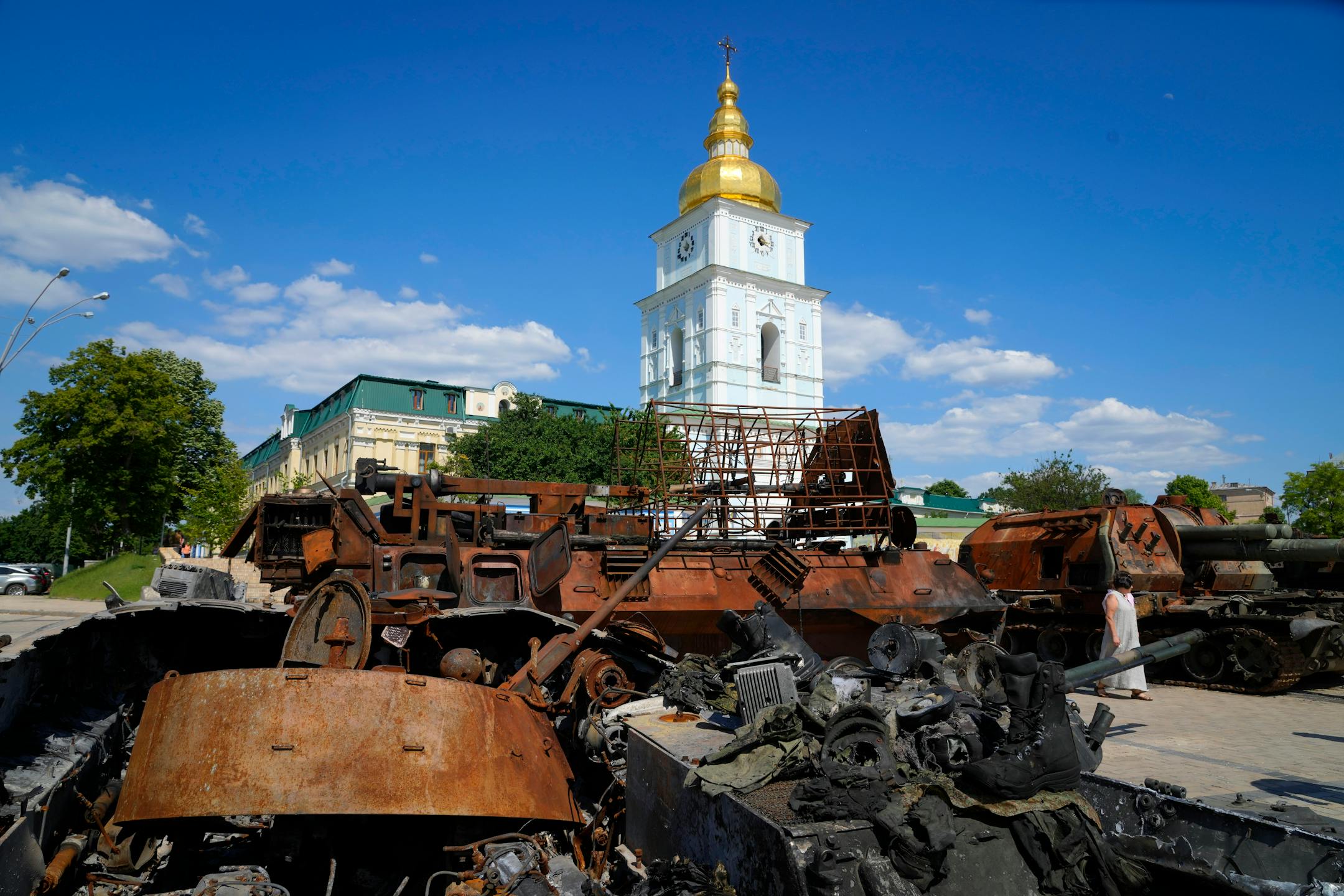
A woman walks by destroyed Russian tanks installed as a symbol of war in front of St. Michael cathedral, in central Kyiv, Ukraine, June 7, 2022. (Efrem Lukatsky, Associated Press/The Minnesota Star Tribune)

Opinion editor's note: Star Tribune Opinion publishes a mix of national and local commentaries online and in print each day. To contribute, click here.

•••

As Russia's invasion of Ukraine nears its first anniversary, what's next? In some ways, the Kremlin and Kyiv both seem to be signaling a new openness to begin peace negotiations. In other ways, they appear to be ruling out talks by setting implausibly maximalist preconditions, while simultaneously girding for a climactic military showdown.

It can't be both at the same time, can it? Oh yes, it can.

It's naive to think that wars are settled by either diplomacy or fighting, and that either route implies a failure of the other. The actual dynamic between jaw-jaw and shooting was better captured by Frederick the Great, the 18th-century king of Prussia: "Diplomacy without arms is like music without instruments."

In the early days of the Russian invasion, Ukraine had few instruments. The country was clinging to survival, and "negotiation" would have been tantamount to capitulation. At one point last spring, President Volodymyr Zelenskyy in effect offered his Russian counterpart, Vladimir Putin, a deal that included Ukraine becoming permanently neutral — that is, forever forgoing ties with NATO. Putin, still thinking that he could subjugate all of Ukraine, wasn't interested.

Much has changed. The military momentum now seems to favor Ukraine. The country is receiving a steady flow of state-of-the-art weapons, ammunition and other kit from its Western friends, and its soldiers are learning in record time how to use all that gear to lethal effect. Ukraine no longer needs to fear national extinction; it can even hope for a victory of sorts.

If negotiations were to start this year, Ukraine would be in a much stronger bargaining position. Moreover, Putin's troops have committed such vile — and indeed genocidal — atrocities in Ukraine that Zelenskyy is no longer able or willing to make drastic concessions, and must insist on some form of restitution.

In a video message to leaders of the Group of 20 in November, he proposed a 10-point peace plan. It includes Russia's complete withdrawal from all of Ukraine, including the Donbas and Crimea. It also envisions trying Russia for war crimes before an international tribunal, getting back all the Ukrainians Russia has deported or imprisoned, and more.

Ukraine's foreign minister, Dmytro Kuleba, has now refined that proposal, suggesting an international peace summit under the aegis of the United Nations, perhaps starting in February. Zelenskyy himself will probably elaborate on that idea when he addresses the World Economic Forum in Davos this month.

None of this implies that Kyiv thinks it will succeed with its opening bid verbatim — just that it's ready to play the instrumental music of diplomacy again.

Putin, too, claims that he's open to negotiations, while laying down terms that he knows will sound like a sick joke to Kyiv and the world. He demands that not only Crimea but also four other Ukrainian regions he claims to have annexed be recognized as Russian. He'll ask for much more besides, including a NATO withdrawal from Eastern Europe and other things he would spin as validating his propaganda lies that Russia has really been acting all along in self-defense.

While both sides are putting out these talking points, they're also reloading, just as Old Fritz would be doing. Zelenskyy just returned from Washington, D.C. — his first foreign trip since Putin's invasion — with new American pledges of support, including the vaunted Patriot missile-defense system. That in turn could sway the debate in NATO countries such as Germany, which is still dithering about sending the Leopard 2 tanks that the Ukrainians need to retake their territories.

Putin in turn is stepping up his terror campaign against civilians, raining missiles and Iranian-made drones on cities in an attempt to starve, freeze and bomb Ukrainians into submission. Having drafted some 300,000 additional Russian soldiers in recent months, he's bragging that he has the reserves in manpower and willpower to go on indefinitely.

The reality on the ground and in the wider world looks different. First, both combatants have bled too much already — an estimate is being bandied about in Western capitals of 100,000 casualties on each side. Second, the conflict is being internationalized, as Zelenskyy is winning and Putin is losing friends among formerly neutral or Russian-leaning countries, from India to Kazakhstan and even China.

When Putin started threatening nuclear escalation last year, the fear was that internationalization could widen the conflict into World War III. Instead, the increasing diplomatic activity by outside powers — Beijing, New Delhi, Ankara, Jakarta and others — has in effect shown Putin his limits and constricted his room for maneuver. He appears to have understood that the world wouldn't tolerate his use of nukes — and would punish him with assured defeat.

This war may yet drag on for a decade — as the Soviet invasion of Afghanistan did. Or it could end sooner. It may freeze in an informal armistice, as the Korean War did, or culminate in protracted international peace negotiations reminiscent of the 1815 Congress of Vienna or the 1648 Peace of Westphalia.

But even as the diplomats begin drafting seating plans around bargaining tables — as they tune the instruments in their section of the orchestra — the guns will keep booming on the battlefield, in the fiercest crescendos yet.

Andreas Kluth is a former editor in chief of Handelsblatt Global and a writer for the Economist. He is author of "Hannibal and Me."

about the writer

about the writer

Andreas Kluth

More from Commentaries

See More
card image
Emilio Morenatti/The Associated Press

There are counterarguments to the criticisms about the decision.

card image
card image