

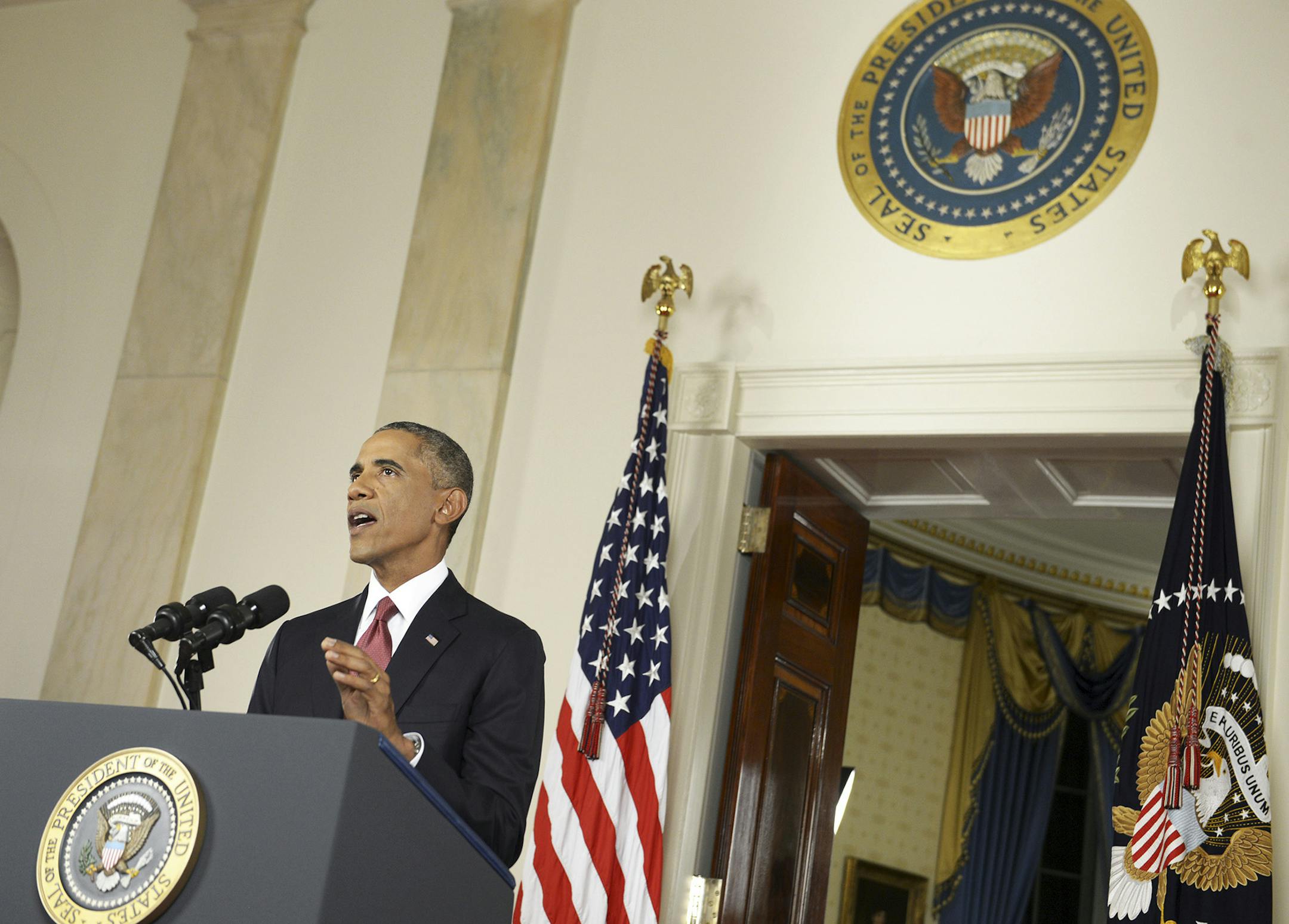
After President Obama addressed the nation on Wednesday, it was hard to argue with his characterization of the Islamic State in Iraq and the Levant, or ISIL. The group is not Islamic and not a state, and it is a terrorist organization "unique in its brutality." Among its victims are other Muslims, Christians, Yazidis and members of other sects, as well as brutally murdered American journalists James Foley and Steven Sotloff.
ISIL's blitzkrieg over a broad swath of Syria and Iraq has created an immediate threat to the region and a long-term one for the West — particularly from foreign fighters who may melt back into European or U.S. society. As Obama correctly emphasized, it is in the national, and indeed international, interest to defeat ISIL.
He also rightly acknowledged that the fight is likely to last beyond his presidency. The duration is just one reason why Obama should seek, and Congress should grant, authorization for what is essentially a war. This is in keeping with our democracy, and sends a constructive signal internationally that even beyond Obama's tenure the American people, their elected representatives and the commander-in-chief are united.
But what Obama said the campaign to destroy ISIL would not be — as well as issues he did not specifically address — are concerns that deserve a full vetting.
The fight against ISIL will be "different from the wars in Iraq and Afghanistan," he said. "It will not involve American combat troops fighting on foreign soil." This may be technically true: It certainly will not be akin to the 2003 invasion of Iraq. But soon more than 1,000 U.S. troops will be in Iraq, and the number is likely to grow. By definition, they are "boots on the ground," in harm's way.
The ground troops that will be fighting ISIL — the Iraqi Armed Forces and Kurdish Peshmerga forces — do not inspire confidence. Their initial ineffective defense of their country has only emboldened ISIL. And despite recent gains made possible by U.S. air power, they do not appear to be ready to roll back ISIL's territorial gains. And Obama accurately pointed out that winning this war is ultimately up to Iraqis.
Meanwhile, the more moderate forces opposed to the brutal rule of the Syrian regime have neither the training nor armaments to effectively capitalize on Obama's willingness to take the air war to Syria. Obama said U.S. tactics against ISIL would be similar to those used in Somalia and Yemen. Given the current chaos in both countries, it's concerning that they were held up as a template.
A stronger global coalition with a much more robust response commensurate to ISIL's threat is needed. Cabinet officials are fanned out throughout the region to shore up alliances. Thursday's "Jeddah Communique," representing the states of the Gulf Cooperation Council in addition to Egypt, Iraq, Jordan, Lebanon and the United States, was encouraging, but longer on diplomatic rhetoric than concrete commitments on military matters.


