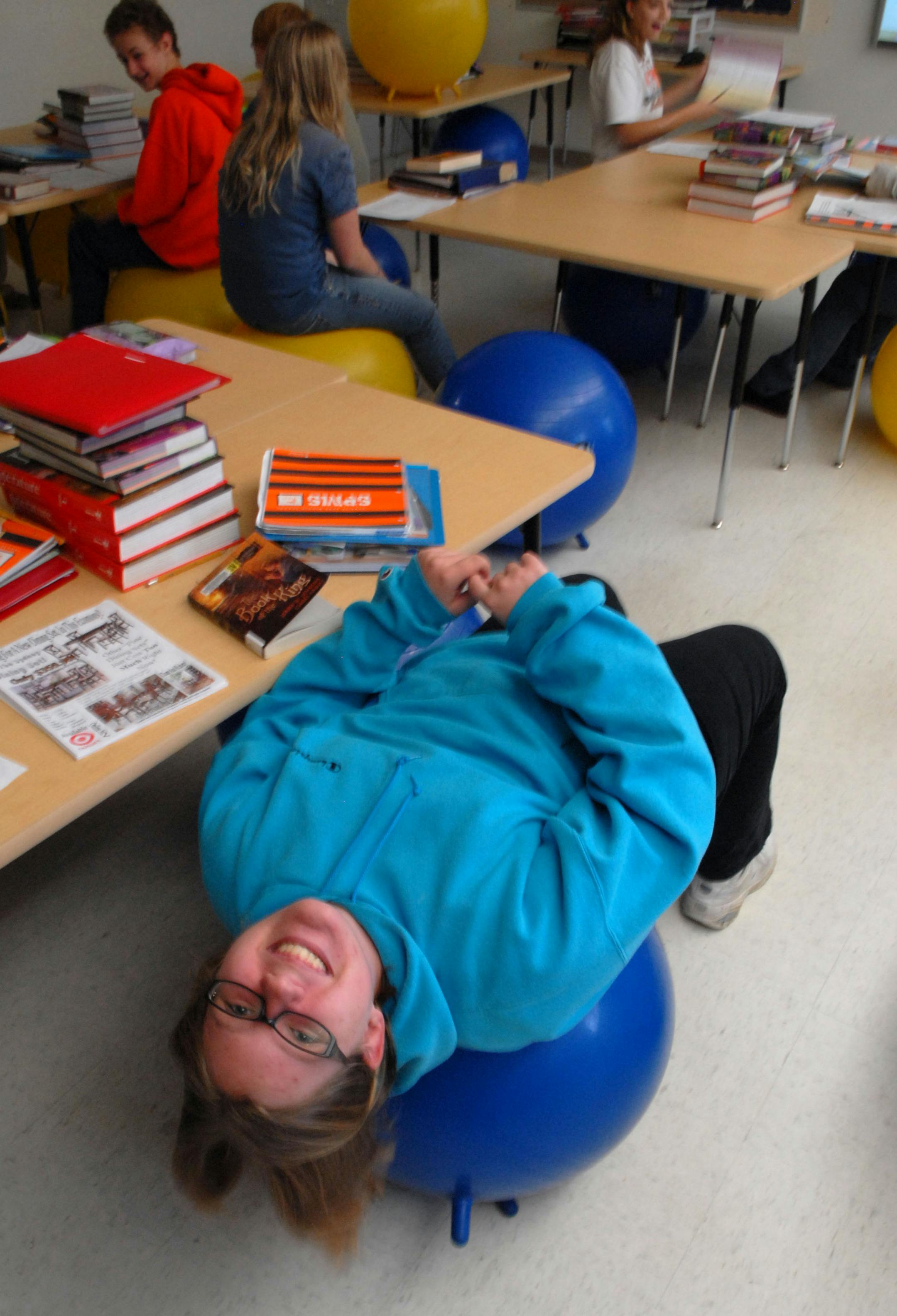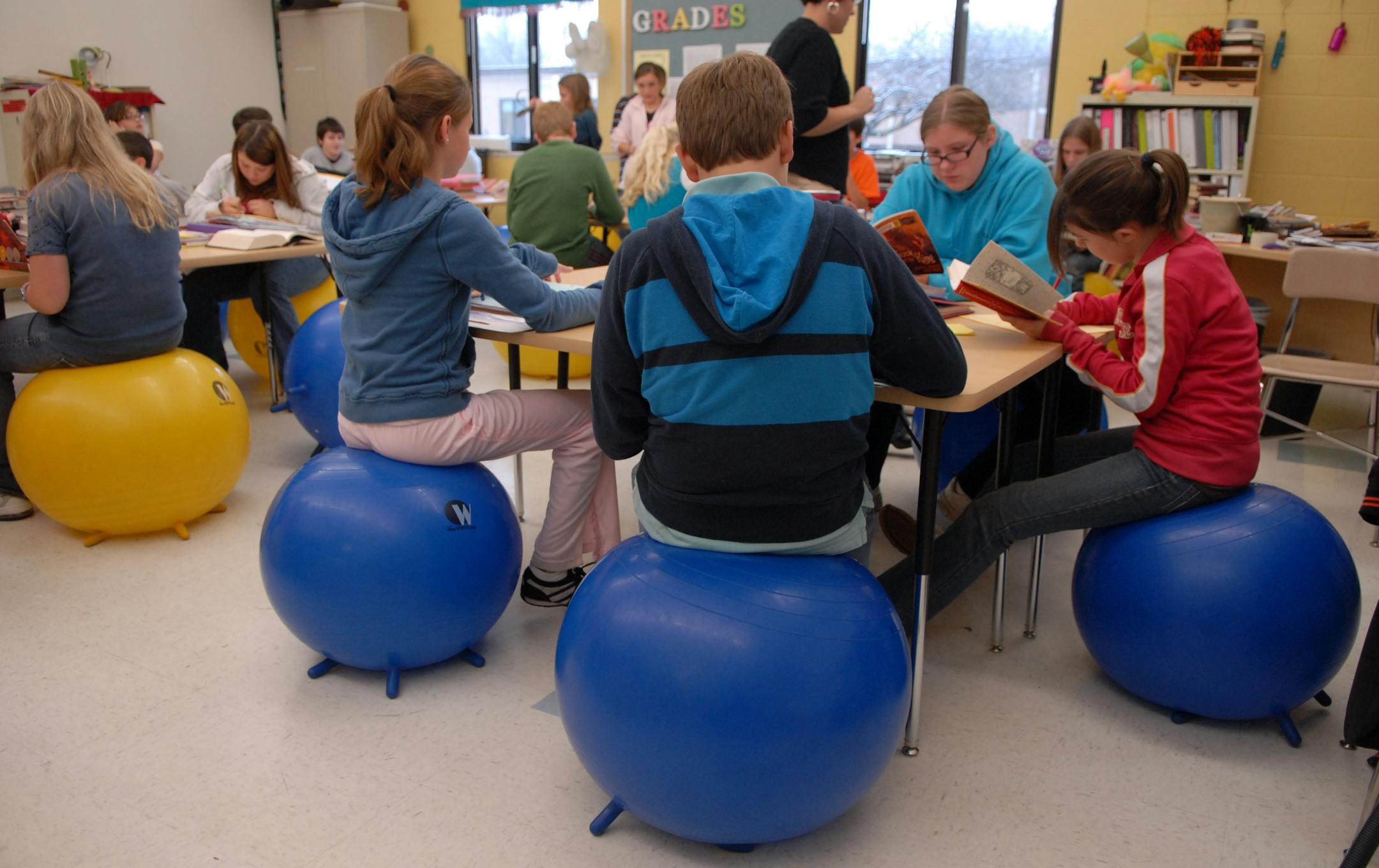
The first thing that strikes you about Melisa Tennant's seventh-grade language arts class at Sunrise Park Middle School in White Bear Lake, even before walking into the room, is a low rumbling sound overlaid by a constant gentle patter. Once inside, more striking is the incessant bobbing of heads of most of the 32 students.
The kids are sitting at their desks atop balance balls and using their feet to rock up and down. All that background noise and movement may be disorienting to a casual observer, but for Tennant it's a perfect storm for learning and teaching.
Research shows that students have better memory and retention when they have movement, Tennant said.
"I'm seeing a lot of movement. I've seen rocking and bouncing during classes, and that is what I want. In addition to that, I am seeing attention." Tennant teaches five sections of language arts each day, 140 students in all, and they all sit on balance balls.
Elementary schools had positive results when using balance balls for children who have attention deficit hyperactivity disorder (ADHD), Tennant said. Mayo Clinic researchers found balance balls enhanced attention spans of younger students. "But no one had been brave enough to try it on middle school kids," Tennant said.
That "no one" includes Eric Jensen, an international author and expert on how the brain learns. Jensen acknowledges that ADHD children often do better with balance balls and that it is unclear what will happen with normal children.
"The real proof is how the kids learn and behave over a period of weeks and months," after the novelty of the balance balls wears off, Jensen said.
A similar experiment is going on at Marine Elementary School in Washington County's Marine on St. Croix, where students have stand-up workstations instead of desks.