
New school ratings hold promise, south metro educators say

South-of-the-river educators say Minnesota's new system of rating public schools will help teachers tailor their instruction to the needs of their students.

May 30, 2012 at 4:11AM
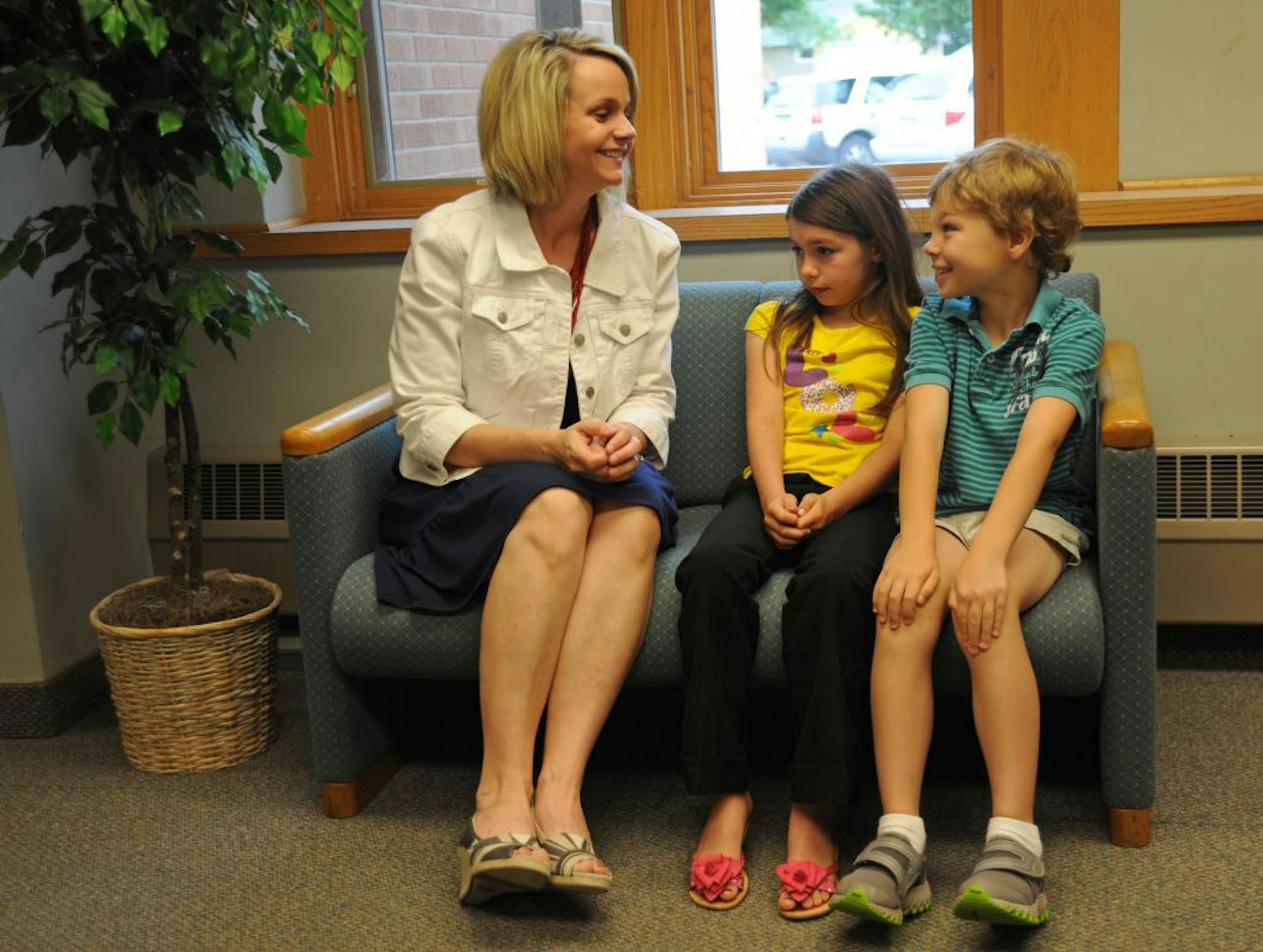
One of the tactics used at Farmington Elementary to improve student performance is "staff buddies," where staff members are "buddies" with students, giving those students an additional "positive adult contact." Increasing the number of these positive adult contacts has been shown to help children do better in school. Angela Nguyen is an ELL teacher and was visiting on this hallway couch with 2 of her buddies, Juliana Salisbury and Quincy Aaron who are both second graders at Farmington Elementary
Teacher Angela Nguyen visited with two of her buddies, Juliana Salisbury and Quincy Aaron, who are both second-graders at Farmington Elementary School. The school’s “staff buddies” system is aimed at giving students one more positive relationship with an adult. (Star Tribune/The Minnesota Star Tribune)

Signs of change at Farmington Elementary School are stuck to lockers.

Colorful Post-It notes from "staff buddies" carry friendly reminders and encouragement, helping children make choices that lead to success in school.

The notes are part of an effort to improve instruction and performance that is finding traction across the south metro as the state begins a new era of rating and ranking public schools.

Educators say the new system, known as MMR, or Multiple Measurement Rating, gives teachers greater ability to tailor instruction to the needs of their students.

"Our belief is there's always room for improvement," said Jason Molesky, assessment and accountability coordinator in Lakeville public schools. "For us the MMR is really just a starting point to dig ... a little bit deeper and better understand how our students are performing."

Under a waiver to No Child Left Behind, the federal focus on test scores is out. Under that system, nearly half of Minnesota's schools were labeled as failures.

Instead, the state is assessing schools by supplementing test scores with information on achievement gains, progress in closing the achievement gap between whites and minorities, and high school graduation rates.

The first ratings under the new system were released last week.

Seven south-of-the-river schools, including Farmington Elementary, were recognized as "Reward" schools, ranking in the top 15 percent statewide among schools with high poverty rates.

Strategies for success

Sally Soliday, principal since 1997 at Echo Park Elementary, also a Reward school, said there's a "clear focus on what we expect students to know and be able to do."

The Burnsville school, part of the Rosemount-Apple Valley-Eagan district, has about 710 children in grades K through 5. Nearly half are minorities and 40.5 percent qualify for a free or reduced-price lunch.

"We're not just teaching them and hoping that they're learning," Soliday said. She said teachers get time to assess test results and share strategies that produce gains: "We're talking about the data and where the kids are at and what we have to do to push them to the next level."

The first ratings under the state's new system used test data from 2010 and 2011 to measure achievement.

Broadening measures of school success beyond test scores helps schools see how they compare, Molesky said.

"It lets us look beyond our district to other schools in the state," he said.

Staff buddies

Ben Januschka, in his fifth year as principal at Farmington Elementary, said the deeper well of data in the new ratings will help teachers better understand how well children are learning.

Farmington Elementary has about 625 students in kindergarten through grade 5. The percentage of children qualifying for free and reduced-price lunch and movement in and out of the attendance area are on the rise. It was singled out for failing to make adequate progress under previous measures.

Staff buddies, with its colorful Post-Its, started recently and pairs students with a staff member outside their usual routine. Research shows a child needs three to four positive adult relationships to succeed, Januschka said. Staff buddies gives each child one more.

The idea: "Instill the instinct to learn; keep that excitement going and make it relevant to them," Januschka said.

"There's a lot of assessing going on," he said. "It is stressful for the kids; the high-stakes tests, they do know how important those are." But he said he would "like to think that test scores don't drive what we're doing."

"The test scores don't measure citizenship and how they get along with each other and how they're going to do once they graduate."

William C. Crum • 612-673-7215

about the writer

about the writer

WILLIAM C. CRUM, Star Tribune

More from No Section

See More
FILE -- A rent deposit slot at an apartment complex in Tucker, Ga., on July 21, 2020. As an eviction crisis has seemed increasingly likely this summer, everyone in the housing market has made the same plea to Washington: Send money — lots of it — that would keep renters in their homes and landlords afloat. (Melissa Golden/The New York Times) ORG XMIT: XNYT58
Melissa Golden/The New York Times

It’s too soon to tell how much the immigration crackdown is to blame.