

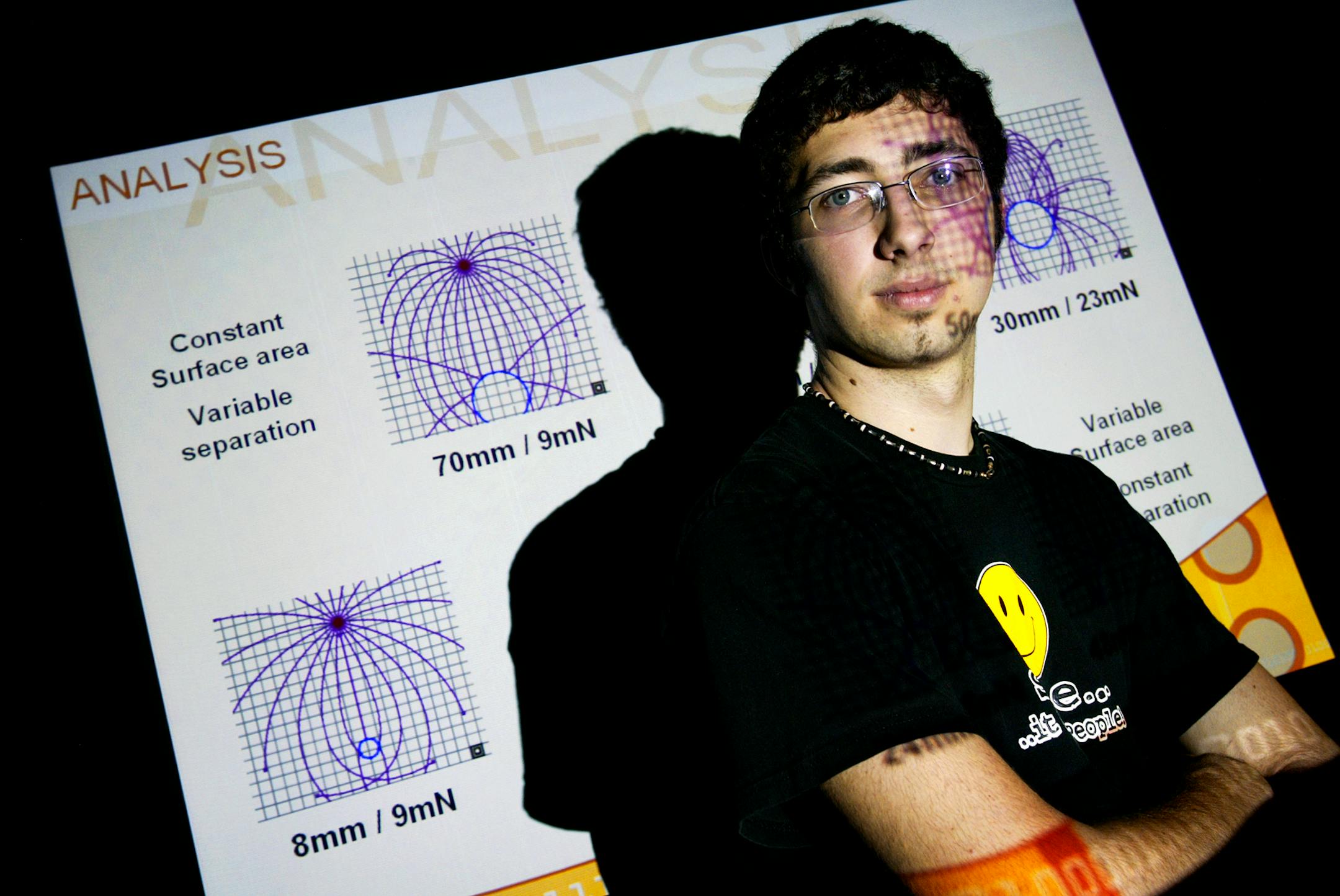
One of the happiest moments of Stephen Trettel's young life came in November 2006. He was in the basement of his family's Jordan home, surrounded by wire, aluminum foil and toothpicks, looking at a graph.
"I had turned my basement into a lab," Trettel said. "I built 7,300 configurations of this thing and tested them one by one. After 200 tests were completed, I put all the data points on a graph, and they all lined up perfect. I thought, 'This is sweet!' I ran upstairs to tell my dad, 'Dad, it actually works.' "
"This thing" that Trettel talks about is an asymmetrical capacitor. Rarely studied by scientists and built mostly by hobbyists in their basements, an asymmetrical capacitor is a device that levitates when a huge amount of electricity is applied, though in the 90 years since the effect was first documented, nobody has had a working theoretical explanation of why.
Trettel, a senior at New Prague High School, is the only two-time winner of the National Junior Science and Humanities Symposium, sponsored by the U.S. Army, Navy and Air Force. In May, he won first place in the engineering division of the International Science and Engineering Fair.
And he knows why it works.
"That's crazy"
The effect of the asymmetrical capacitor levitating seems to fly in the face of reason, as if someone sitting in a desk chair pulled up on its arms and the chair launched into the air.
Trettel's answer is this: When electricity is pumped into the capacitor, the ions -- or charged particles in the air around it -- start moving. The motion creates a downward force, like that created by the main rotor of a helicopter. Newton's third law of motion says every action has an equal and opposite reaction, so the opposite reaction to the downward force is that the device lifts off the ground.


