


In the end, rank falls away.
Across the acreage of a national cemetery, identical headstones stand in mesmerizing formation. Placed with the precision that defines military service, whether in the angle of a hat or the corner of a bedsheet, the markers create their own geometry. From any angle, they resemble a taut line of soldiers hearing their first "Ten-hut!" echo across camp.
As service to country began, so its legacy ends.
At Fort Snelling National Cemetery in the Twin Cities, more than 180,000 veterans and family members lie in a landscape whose consistent simplicity sets it apart from private cemeteries with more personalized gravestones.
Its appearance follows the view of noted landscape architect Frederick Law Olmsted (he designed Central Park) that national cemeteries ought to be "studiously simple," with the main goal "to establish permanent dignity and tranquility … a sacred grove."
"It's an orderly way of doing things, but then anything with the military is very orderly," said Joe Sporko, managing principal of the LA Group, a firm in Saratoga Springs, N.Y., known for designing national cemeteries.
One goal is efficiency: "With the grid pattern, it's easier to locate graves," he said. "But they also wanted that universal look, that equality, so no one soldier buried there is favored."
Donn Christy began working years ago at Fort Snelling National Cemetery as a janitor. Now he's assistant director. He can't say enough about the caretakers, most of them veterans, who keep the grass trimmed to crewcut precision among the marble grave markers, each 42 inches long, 13 inches wide and 4 inches thick.
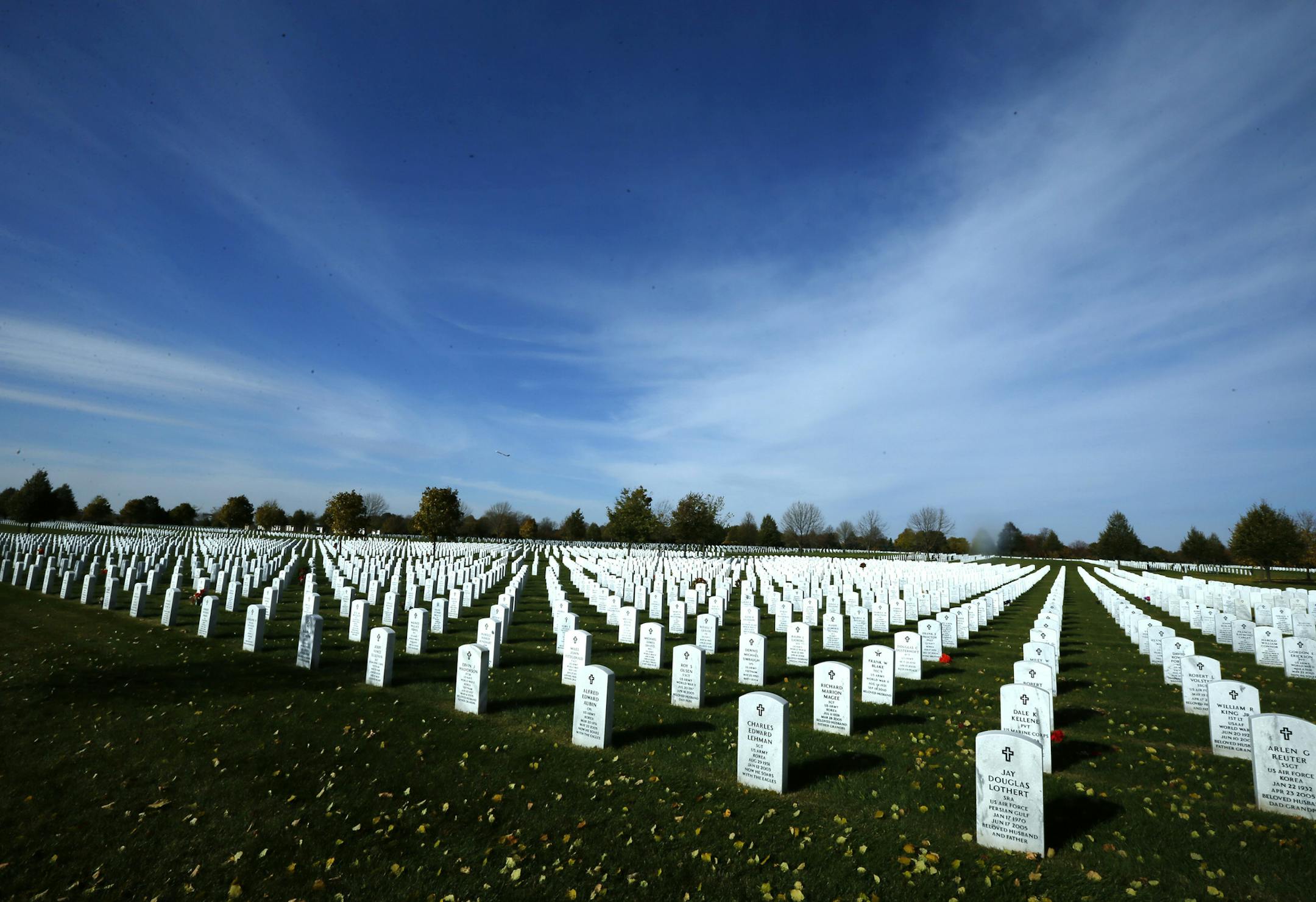
![Lines and lines of headstone at Ft Snelling Snelling Cemetery Sunday November 3, 2013 in Bloomington, MN. 2012 Looking into the backstory behind the distinctive look of veterans' cemeteries, how the perfect symmetry came to be and what it represents. some other vet cemetery history as well ] JERRY HOLT • jerry.holt@startribune.com](https://arc.stimg.co/startribunemedia/KNHQ6BPXYD54OW7IH6SUACL7PU.jpg?&w=1080)


