

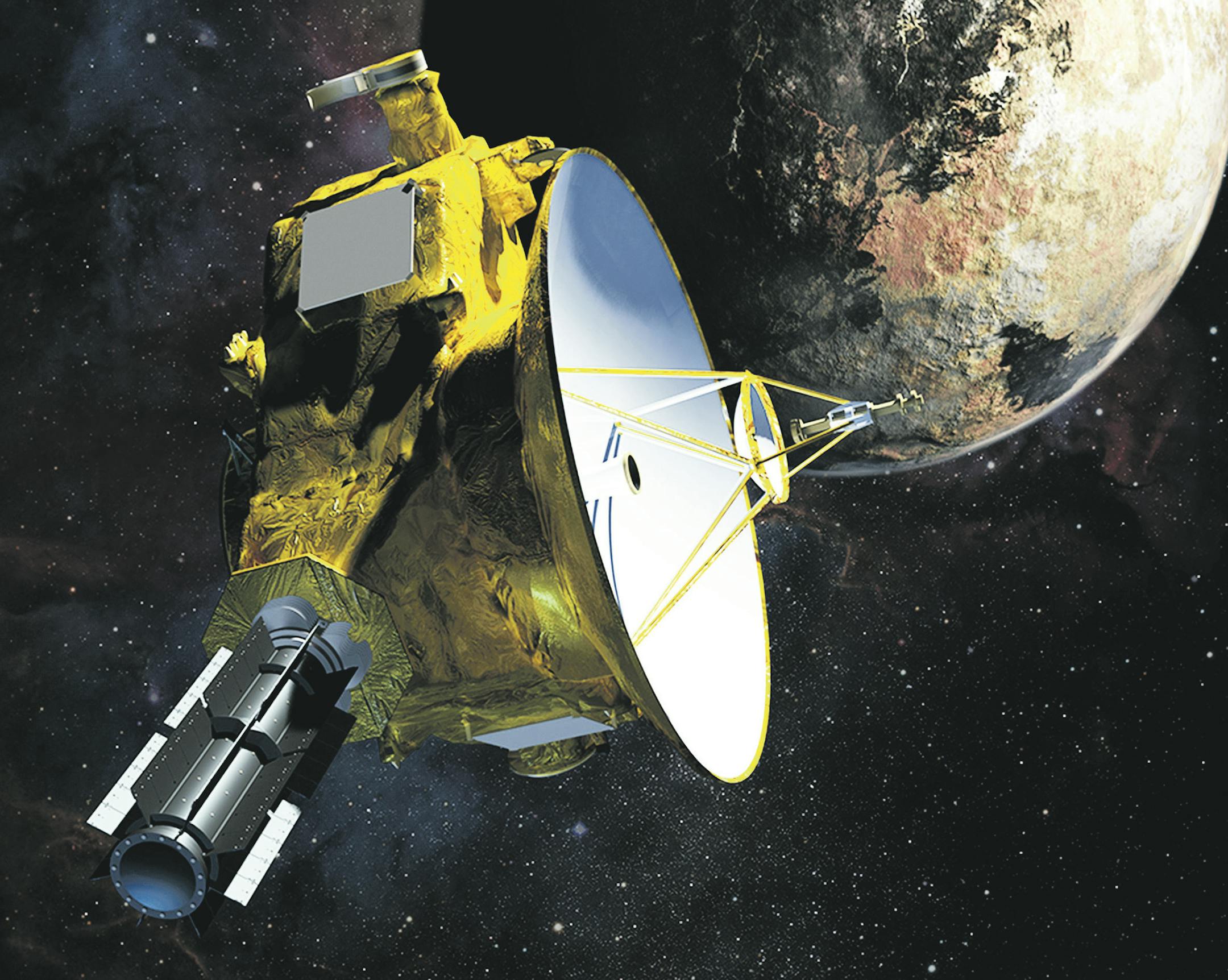
With each passing day, mankind gets a better look at Pluto. And each day, Pluto is showing mankind it has a lot to learn. First, Pluto revealed itself in a mix of beige and orange, while Charon, its largest moon, appeared gray when NASA's New Horizons spacecraft captured color images of the dwarf planet in early June. Then, scientists at the Johns Hopkins Applied Physics Laboratory in Laurel, Md., spotted unusual dark poles on Charon. In late June, they saw mysterious dark streaks spaced evenly along half of Pluto's equator.
New Horizons will pass within 7,800 miles of Pluto on Tuesday after a nearly decadelong, 3 billion-mile journey. "We are running the anchor leg in a 50-year exploration of the planets," said Alan Stern, the principal investigator — the leader — of the $700 million mission. "I tell people, this is it, it's the last picture show, it's the last train to Clarksville. Better watch!"
As the spacecraft — which is bearing down on the dwarf planet at 32,000 miles per hour — nears that close encounter, the scientists are getting never-before-seen images of Pluto.
"A few weeks ago, the faucet hadn't turned on," Stern said. "Now it's dripping a little every day. Soon it'll be a rush."
The scientists behind New Horizons say the mission will help us understand the origin and evolution of the solar system. Already, the little spaceship's long-range camera has detected intriguing patterns on the surface of Pluto that scientists cannot easily explain. The tiny world may have mountains and valleys, possibly frozen methane lakes or even a liquid water ocean far beneath the frozen surface. Or maybe Pluto has no topography at all and is just a smooth ball covered in a deep layer of nitrogen slush.
Stern said he began pushing for a Pluto mission in 1988. NASA considered numerous proposals before deciding in 2001 to go with the New Horizons mission, which called for a relatively inexpensive, no-frills spacecraft using off-the-shelf technology.
The probe rode into space one afternoon in 2006 atop an Atlas V rocket, reaching record-breaking velocity. Before the day was out, it had already flown past the orbit of the moon.
A gravity boost from Jupiter shortened the trip to Pluto by three years. "You had to hit a little keyhole in space near Jupiter," said project scientist Hal Weaver.


