

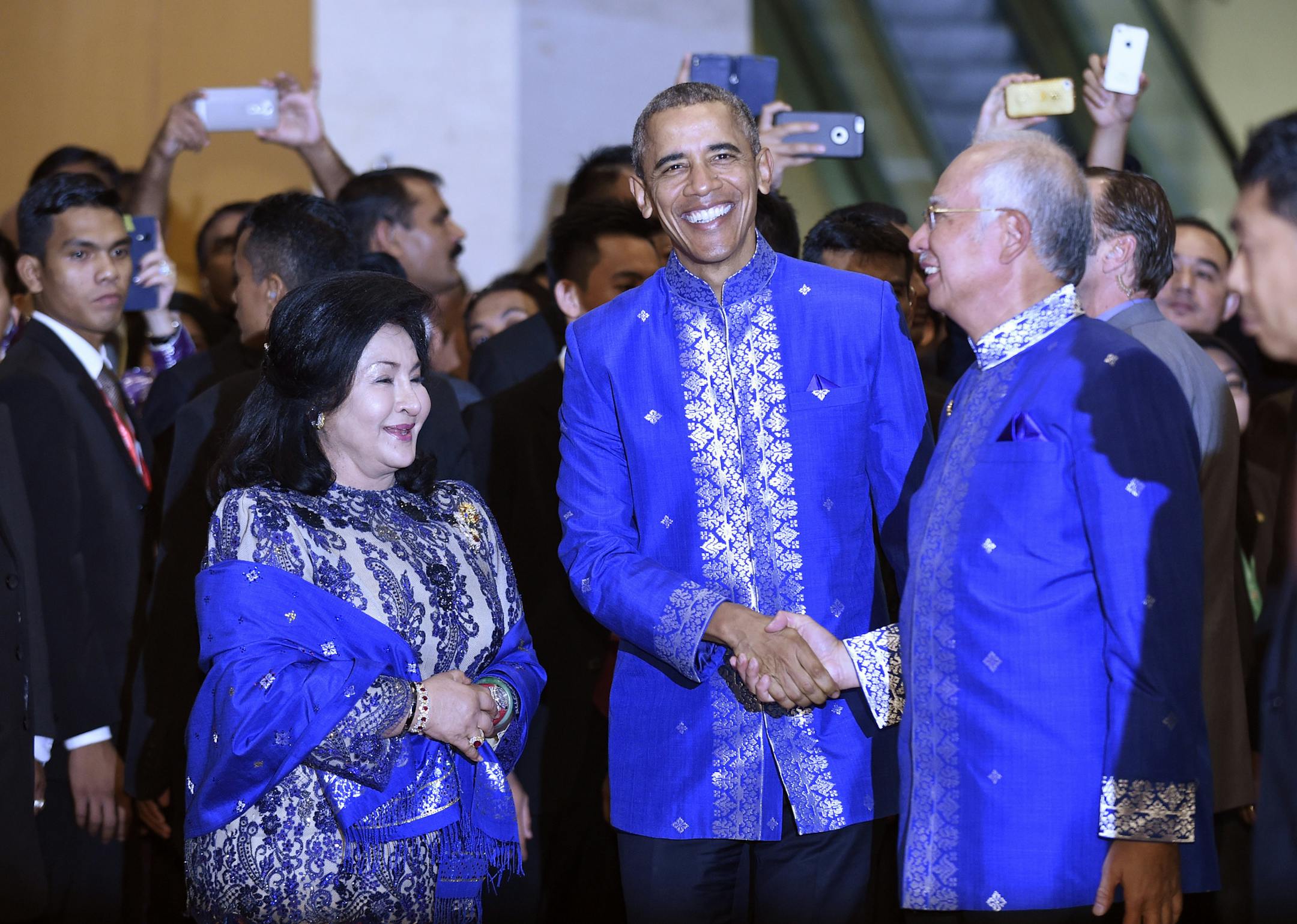
KUALA LUMPUR, Malaysia — Thirteen years after the idea was mooted, Southeast Asian leaders on Sunday formally created a unified economic community in a region more populous and diverse than the European Union or North America, and with hopes of competing with China and India.
The 10 leaders in the Association of Southeast Asian Nations signed a declaration during their summit establishing the ASEAN Economic Community, as part of a larger ASEAN Community that aims for political, security, cultural and social integration.
Summit host Prime Minister Najib Razak of Malaysia hailed the ASEAN Community as a "landmark achievement," and urged members to accelerate integration. "The region is primed to expand exponentially," he said.
The community, known by its acronym AEC, is already a reality and many of its fundamentals have been applied in the region such as removal of tariff barriers and visa restrictions among others. It has also led to greater political and cultural cooperation.
AEC will bolster income and employment, and provide the region with stronger economic muscle in facing the other giants, said Michael G. Plummer, a professor of international economics at the Europe Center of Johns Hopkins University, based in Bologna, Italy.
"ASEAN integration will help balance the economic power of China and India. Individually, ASEAN countries are, perhaps, too small to be important players in the economic and security game, but as an integrated group of more than half a billion people, they would be in the major league," Plummer said.
But there is a long way to go before the AEC becomes fully functional after becoming a legal entity on Dec. 31. The region's diversity can be a hindrance sometimes. ASEAN has 630 million people, speaking different languages, following various faiths and governed by various systems, including rambunctious democracies, a military dictatorship, quasi-civilian, authoritarian, monarchy and communism.
"The AEC is arguably the most ambitious economic integration program in the developing world. But implementation of the AEC is increasingly uphill. Much remains to be done and the region faces many challenges in finishing. The AEC is a process," Plummer said.


