

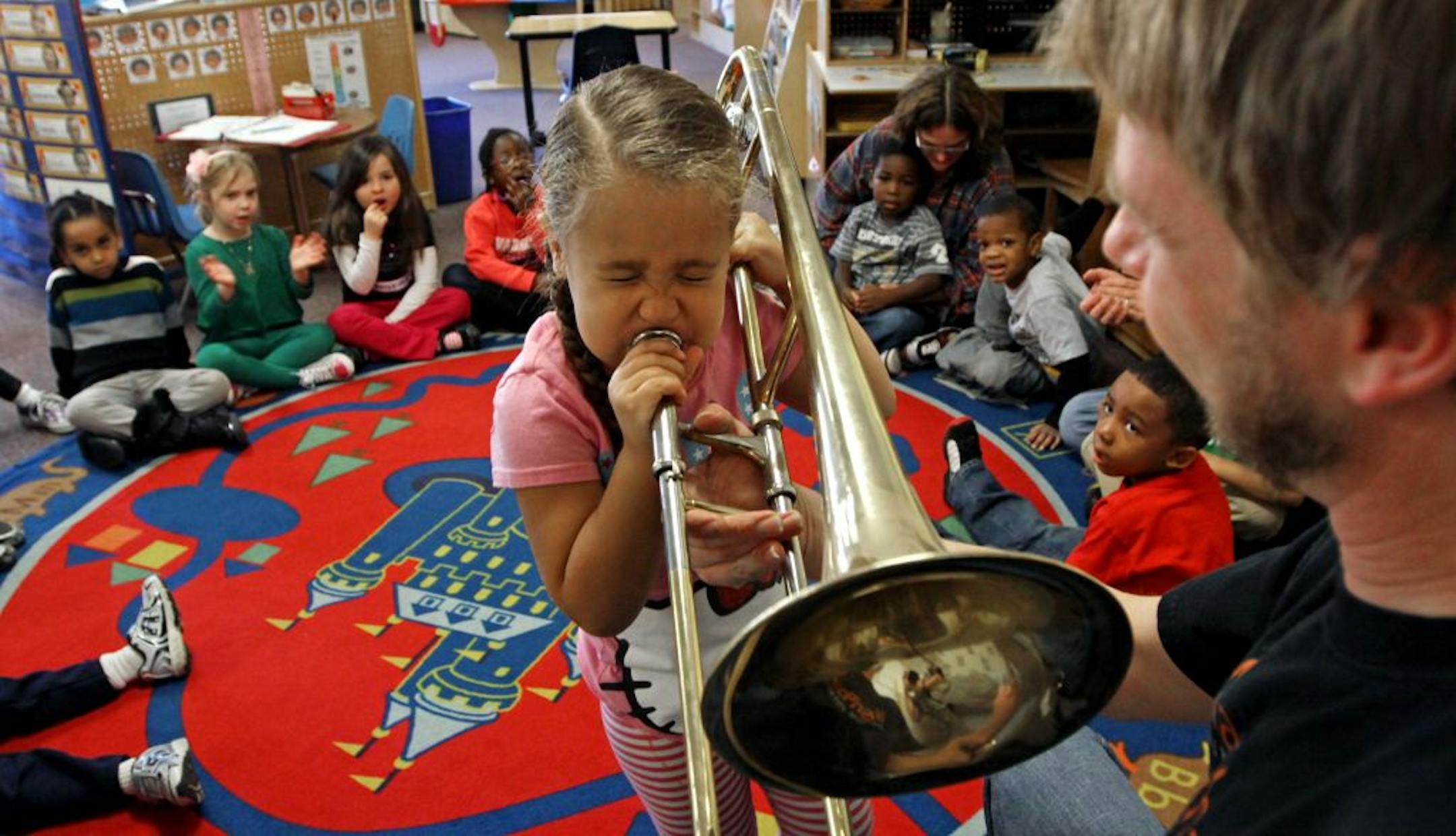
Lessons are absorbed so much more easily when you put a little lilt in them.
Maria von Trapp of "The Sound of Music" knew this. So do the teachers at the Wilder Child Development Center in St. Paul. They've teamed up with MacPhail Center for Music on a program that uses rhythm, melody and hands-on practice with instruments to teach alphabet, counting, vocabulary and social skills to pre-kindergartners.
Most preschool classes incorporate a song session into daily activities, but at Wilder, music is a part of lessons all day long, with teachers singing instructions and asking the kids to sing back. Even naptime includes exposure to music; the radio is tuned to MPR's classical station.
How many 4-year-olds know what "staccato" and "legato" mean? The Wilder kids do, thanks to the lively teaching style of MacPhail's Nick Johnson.
"Lay-GAH-toooh," he drawls, rolling a pair of rhythm sticks along the floor. "Stah-CAH-to!" he barks, rapping the sticks sharply. As the children imitate his sounds and movements, they seem to grasp quickly that legato is smooth and slow, staccato fast and sharp.
Many studies have shown that teaching with music not only improves children's ability to master reading and math skills, but also helps them to focus better and retain what they've learned longer. One 2009 study on music's effect on brain activity in young children found that their attention, anticipation and expectation processes were enhanced by music training.
Most important to the children, however, is that what they're doing is fun.
"What family does this belong to?" Johnson asks, hoisting a slide trombone.


