

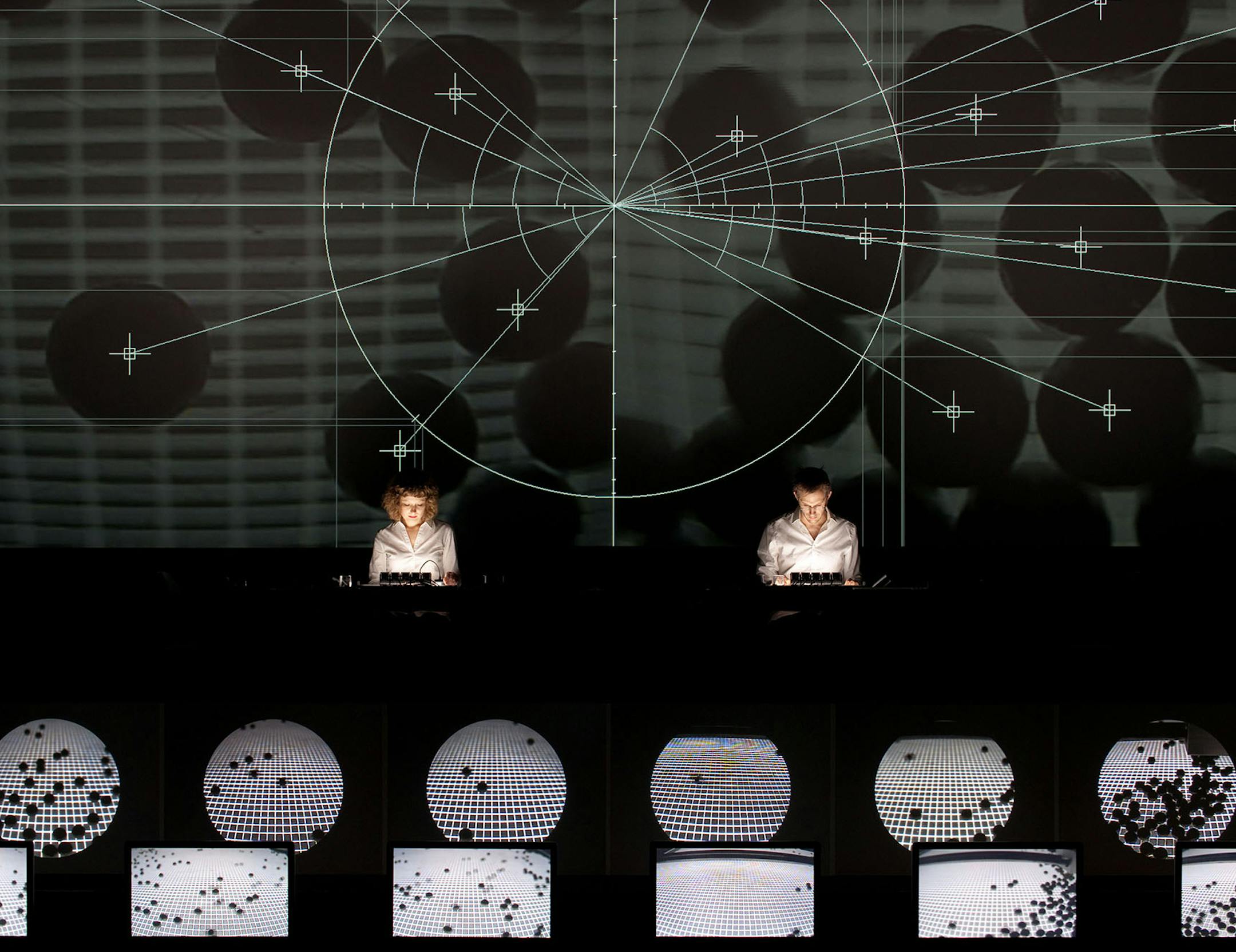
Phil Spector may be famous for his densely layered Wall of Sound, but Ryoji Ikeda has taken the concept into full-immersion territory, creating an intense audiovisual experience that might be extra-thrilling for math and science geeks.
The Japanese minimalist brings his latest multimedia creation, "superposition," to the Walker this weekend. It combines ambient noise and electronic music at wide-ranging decibels with 21 superimposed screens of flickering, digitally inspired stimuli.
Known for his preoccupation with precision, Ikeda adds a less perfectly predictable element this time — two human actors who tap out coded messages, place crossword puzzles over key-punch cards and roll around marbles that become fixed points on a computer-generated axis.
Asked to explain the impetus behind "superposition," a title taken from quantum mechanics, he's at a loss for words.
"It's quite hard to describe," he said in an interview this week. "I never give people a destination. I just create my work."
Here's how Ben Ratliff of the New York Times put it after seeing the show last weekend at the Metropolitan Museum of Art: "The sound and visuals, for the most part, were representations of digital data: sine waves, visualizations of code in black and white, or sometimes primary colors. It was high-contrast, high-resolution, pointedly loud or carefully soft, rhythmic, with intermittent puffs of white noise."
Blogger Angus Finlayson, who left an Amsterdam performance of the work "reeling," wrote that "sonic and visual events, sparsely distributed, built steadily to a retina-scorching peak, like some kind of firmware glitch writ large."
Although this is the first time humans have been tossed into the mix of one of his multimedia projects, Ikeda pointed out that he comes from a live-theater background. (His high-tech performance collective Dumb Type appeared at the Walker in 1999 and 2001.)


