
Advertisement

Moving observances' destination is reconciliation

A desire to face the past and heal the pain unites strangers at a Mankato ceremony marking the 1862 hanging of 38 Dakota men.

December 29, 2009 at 4:53AM
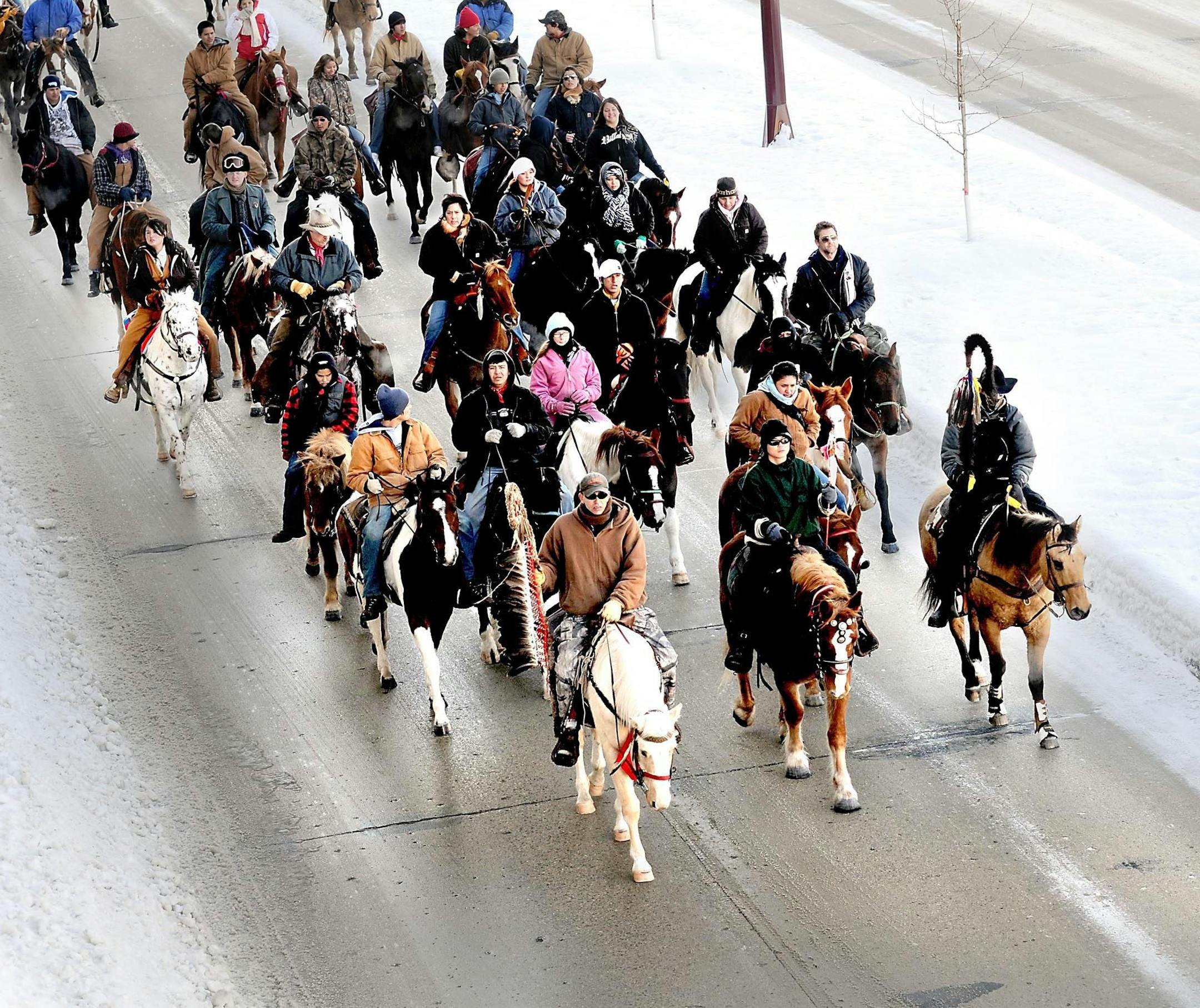
About two dozen horses and riders participating in the fifth annual Dakota 38 Memorial Ride, which began in Brule, S.D., arrived in Mankato on Saturday.
About two dozen horses and riders participating in the fifth annual Dakota 38 Memorial Ride, which began in Brule, S.D., arrived in Mankato on Saturday. (Stan Schmidt — Mankato Free Press via Associated Press/The Minnesota Star Tribune)
Advertisement

MANKATO

An emotional embrace between two strangers captured the spirit of reconciliation a Dakota leader and Mankato businessman first envisioned nearly 40 years ago.

Both Peter Lengkeek and Mary Herbst had ancestors standing roughly where the Blue Earth County Library now stands in downtown Mankato on Dec. 26, 1862.

Lengkeek tells a story about an 8-year-old boy -- his great-great-great-grandfather Joe St. John -- who was watching that day as his grandfather was hanged with 37 other men during the largest mass execution in U.S. history.

Herbst's great-grandfather, John Wesley Latourelle, was there, too, she said. He and his brother, Washington Latourelle, were soldiers in the U.S. Army. They were standing guard, surrounded by about 3,000 spectators who gathered to see the gallows lined with men who had been sentenced to death as a result of the Dakota War.

A long ride on horseback, spanning more than 300 miles, and a desire to heal the "tremendous pain and suffering" still felt by many Dakota people brought Lengkeek to Reconciliation Park this past weekend. He led the fifth annual Dakota 38 Memorial Ride from Lower Brule, S.D., to Mankato, capped by a ceremony near the park's buffalo statue.

The ceremony takes place each year at about 10 a.m., the same time the 38 men were simultaneously hanged. Herbst traveled to Mankato from her home in St. Peter. Her only desire was to tell someone at the ceremony that she understood what they were doing. That someone became Lengkeek after she heard the inspirational words he shared with the crowd gathered at the park.

'I told her to be strong'

Advertisement

When Lengkeek was done, Herbst waited for the crowd to disperse. Then she embraced him. Through tears, she whispered her connection to that painful event 147 years ago.

"I told her to be strong -- what happened, happened," Lengkeek said later. "We can't hold that against each other. Then we cried. It was beautiful.

"That's what this is all about -- to bring races together and begin the healing."

He was echoing the same hope that Amos Owen, a Dakota elder, and Bud Lawrence, a Mankato businessman, envisioned when their long friendship led to the idea of reconciliation. That vision first took shape with what has become the Mahkato Wacipi, a three-day traditional powwow that has honored the 38 Dakota each September since 1972.

Owen, who died in 1990, also started the Memorial Relay Run from Fort Snelling to Mankato in 1986. That run also takes place each year on Dec. 26, starting at Fort Snelling at midnight the night before and ending in Mankato around 10 a.m..

Runners take turns, running a mile at a time, during the 80-mile trek south.

Advertisement

It's a run that has never been canceled, even when temperatures have dipped way below zero. But a winter storm that dumped a thick, heavy layer of snow across Minnesota and South Dakota late last week did cause some problems this year.

Only about a dozen runners were able to make it to Fort Snelling, said Wayne Wells, one of the run's organizers. Usually more than 30 runners turn out.

Many young runners from South Dakota, counted on to carry the load when older runners are tired, were snowed in, Wells said. Narrow lanes and snow on the shoulders of Highway 169 also created a challenge. "They were talking about canceling it, and we might have if we got like 2 feet of snow," he said. "Our runners were pretty pumped up."

For Ian Cook, who was participating in his third run, the day was about pride. He said he only has a basic knowledge about the broken treaties, withheld land payments and long marches to reservations that created the fuel for the regional war so many years ago.

'You just feel good'

Cook, 21, said he runs because his mother has been involved with the event for many years, and he's proud of his heritage. It also gives him a chance to connect with other American Indians he wouldn't meet at home in Duluth, he added.

Advertisement

"You just feel good after a good run," he said. "It's a tradition with good people and good friends."

The original plan was to have the riders and runners meet at Land of Memories Park, site of the annual powwow, and make the trip together to the ceremony at the hanging site. Weather and delays for both groups kept that from happening this year, but Lengkeek said he hopes the events will be joined in the future.

"The runners have been doing this for almost 30 years and we're trying to make this one big circle," he said. "It's about love, friendship, compassion and the memory of our relatives who were killed."

Information from the Free Press, www.mankatofreepress.com.

about the writer

about the writer

DAN NIENABER, Mankato Free Press

Advertisement