

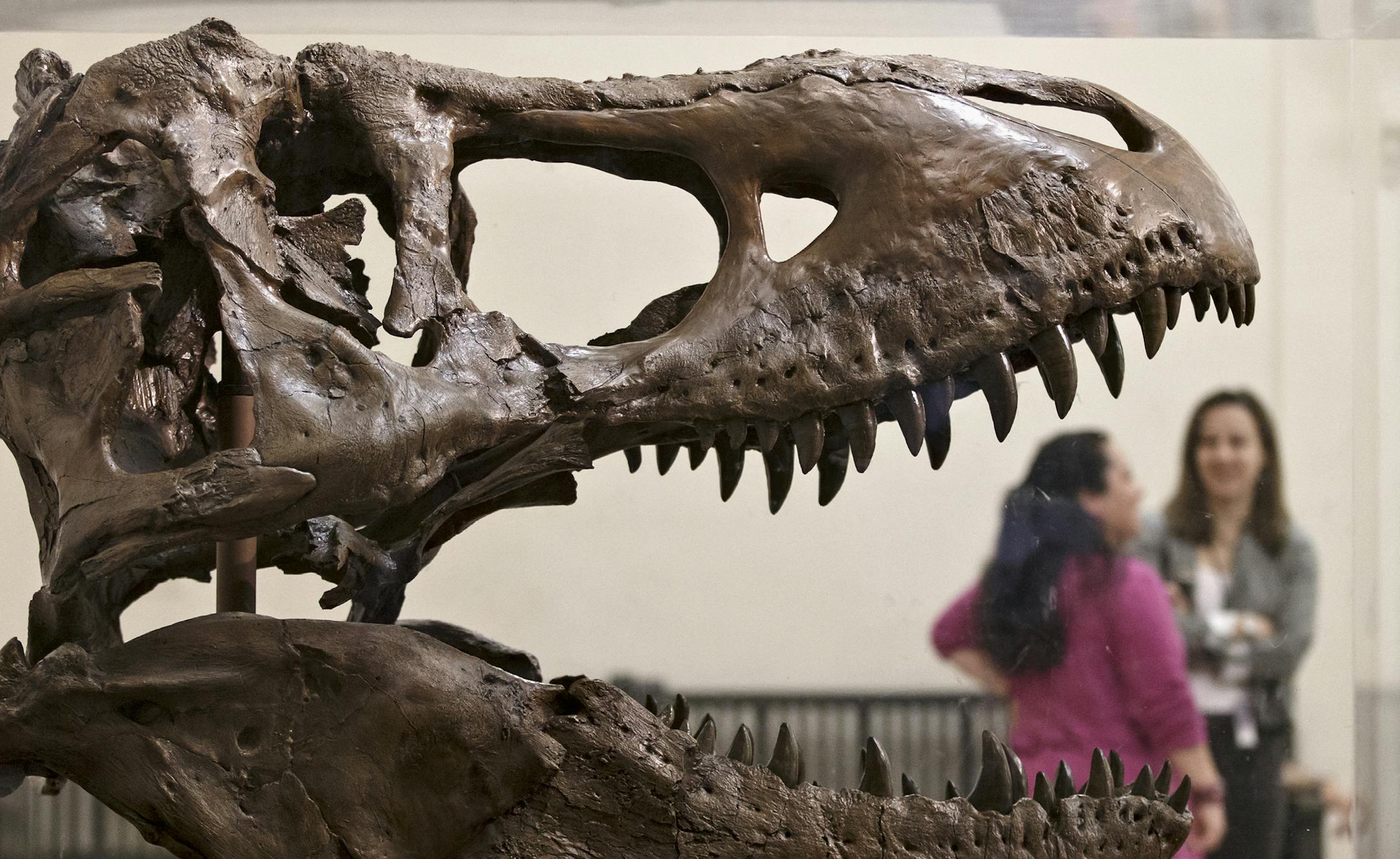
WASHINGTON - After a grueling 48-hour drive from Montana, the capital's latest transplant — a 38-foot-long, 66-million-year-old Tyrannosaurus rex skeleton — got to rest Tuesday at the Smithsonian's National Museum of Natural History.
The Smithsonian's newest acquisition is one of the largest and most complete specimen in the world, and it will be the museum's first real T. rex skeleton on display.
"What could be more fabulous than welcoming a Tyrannosaurus rex to Washington, D.C.?" museum director Kirk Johnson said at a ceremony. The skeleton is here on a 50-year loan agreement with the U.S. Army Corps of Engineers.
Johnson opened the first two boxes of bones, revealing teeth the size of bananas and a right femur bone about as tall as the gaggle of children gathered around the skeleton to watch the unveiling. The fossils will be displayed at the Museum of Natural History until National Fossil Day on Oct. 15.
The skeleton, originally called the Wankel T. rex, was first discovered on federal land in Montana in 1988. While hiking with her husband near the Fort Peck reservoir, rancher Kathy Wankel found an odd shape jutting out of the ground.
After some perfunctory digging with a garden shovel and a jackknife, she unearthed the first complete T. rex arm that had ever been found.
Montana's crown jewel
Museum of the Rockies curator Jack Horner led the mission to excavate the rest. It remained the Montana museum's crown jewel for decades.
In June, the Corps of Engineers, which oversees federal land where the skeleton was discovered, agreed to transfer the T. rex to the National Museum of Natural History, the second-most visited museum in the world. The move was originally scheduled for the fall but was delayed by the 2013 government shutdown.


