

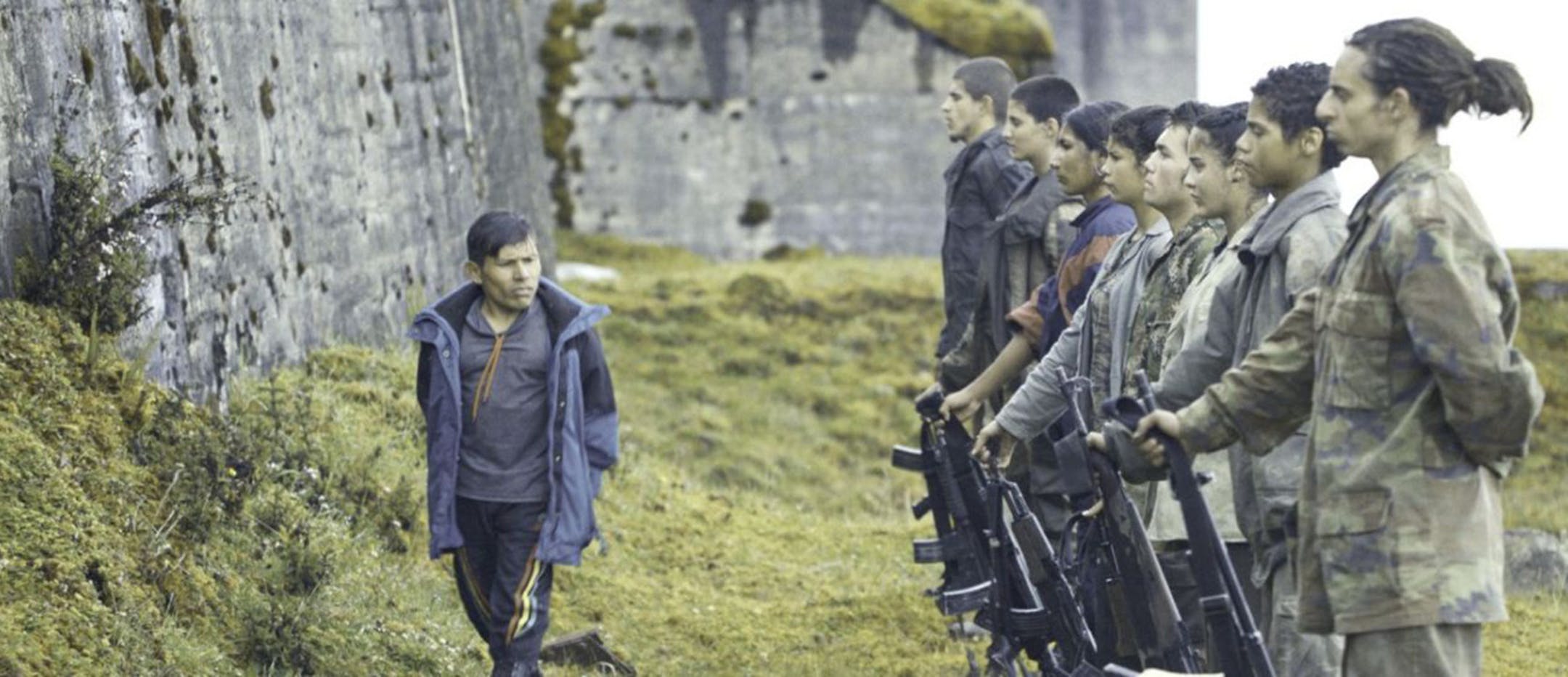
The colors of "Monos" are rust and blue: rust like the earth, like the steady, but harsh mountains; like the mud smeared on the skin of young warriors creeping through the jungle, not with spears, but machine guns. Rust like dried blood streaking the face of a battered hostage; rust like an old bruise. Blue like the clouds that crown the rust-colored mountain; blue like bubbles tumbling in a rushing river; water in air, air in water. Green is foreboding: a trap, or a disguise. These are the earthy, ethereal and effervescent textures of Alejandro Landes' astonishing "Monos," an existential exploration of the id in isolation.
"Monos" refers to the idea of the singular entity. We're born alone, we die alone. But "Monos" also refers to a group. The Monos are a band of South American misfit teen revolutionaries, or so we can surmise. These eight bandits live and train and play and fight and flirt together in a remote mountain camp, where they take orders from a short, muscular sergeant called "The Messenger" (Wilson Salazar). Wolf (Julián Giraldo), Bigfoot (Moisés Arias), Lady (Karen Quintero), Swede (Laura Castrillón), Rambo (Sofia Buenaventura), Boom Boom (Sneider Castro), Dog (Paul Cubides) and Smurf (Deiby Rueda) have a few crucial responsibilities: the care of Shakira, a black-and-white milk cow, as well as Doctora (Julianne Nicholson), their American hostage, of whom they have to make proof of life videos and drag from camp to camp. But they have less interest in their duties than they do in their own bodies and each others', whether in violence or in ecstasy.
While there is no shortage of violence and mayhem on the mountain, when they travel to the jungle, it becomes "Lord of the Flies" by way of "Aguirre, The Wrath of God," with the addition of one bewildered white lady. Arias and Nicholson, two American actors making their Spanish language debuts, give transformed, deeply instinctual performances as two opposing forces: the cunning, scheming de facto leader Bigfoot, and an American engineer who dives into the darkest depths of her soul for survival.
The rest of the group stretches along the tension between these two, as the group starts to simmer and break down, in opposition to their programming by the Organization, a shadowy paramilitary group. Their solidarity fractures, as each member becomes one with the earth, air and sky; the water, trees and mud. Things turn feral, savage, animalistic, and the camera simply observes their movements, following tumbles and jumbles of limbs and leaves.
Landes' film feels distinctly, utterly South American, capturing the unique landscape of misty mountains and damp jungles, each as brutally punishing as they are beautiful. Against this grounding is a sense of abstract surrealism in a score by Mica Levi that whistles, whooshes and thumps, at times not even musically, but mythologically, tapping into ancient, biological rhythms.
Landes says that he wanted to make a film about war, the kinds of guerrilla, shadow wars that play out for decades on end. His film is philosophically, and physically, occupied with violence and conflict, but on an intimate, human scale, symbolically rendered in each of the Monos' fates. Will they end up a victim or a victor? A despot, a henchman, a whore? Can anyone opt out, and what are the consequences? These questions boil and bubble in this wild, anarchic film, which rips civilization apart at the seams to examine the messy darkness inside.


