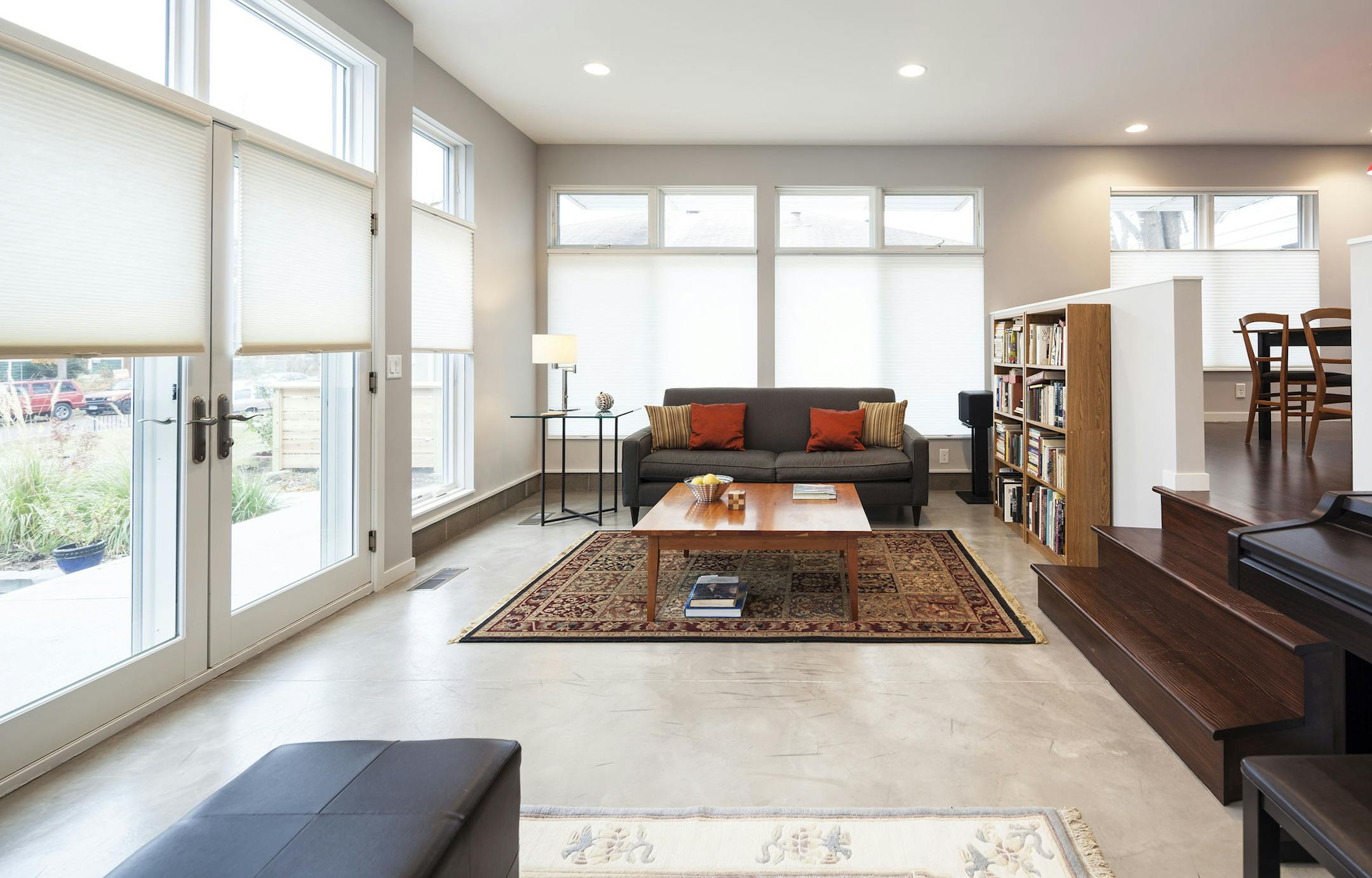
You don't need the house number to find Jan Kleinman and Fadil Santosa's new house in the Seward neighborhood of Minneapolis.
Their home's simple, boxy modern shape is a sharp contrast to the gabled bungalows and Tudors on its block. The house has a flat roof and protruding sunshades that look like eyebrows over the windows. And there's a sunken terrace in the front of the house, not the back.
The Kleinman/Santosa home certainly doesn't look like anything else in the neighborhood. But architect Gar Hargens and the homeowners made sure it didn't express itself as a futuristic cube among the prevalent early 1900s architecture.
Hargens positioned the home — and attached rear garage — at the back of the narrow city lot to minimize massing of the two-story structure. And the flat roof ensures it doesn't visually compete, but instead blends with the 1 ½-story bungalows on the block, said Hargens. "The home doesn't shout at you, because it's pulled back from the street."
The new Hargens-designed home changed the architectural makeup of its Seward block — and also dramatically changed the lives of Kleinman and Santosa.
In 2010, their two sons were in college, and the couple were ready to sell their older Cape Cod in St. Louis Park. Like many of today's baby boomers, they planned to leave the 'burbs for the city.
"We wanted a smaller house and a neighborhood where we could walk and bike everywhere," said Kleinman. "It was a new adventure for us."
Kleinman and Santosa had dreamed about building a custom home, but discovered that desirable empty city lots were rare. Finally, they found the perfect property in the Seward neighborhood, close to the Grand Rounds Scenic Byway bike trail. Santosa could bike to work at the University of Minnesota, and they could shop at nearby Seward Co-op. The property included a small, rundown house — a contractor confirmed it wasn't salvageable.