
Opinion | Why monarch butterflies recently descended on this part of downtown St. Paul

Their population has nosedived over the years, so seeing them everywhere in the courtyard of my condo building was a pleasant surprise.

October 5, 2025 at 11:00AM
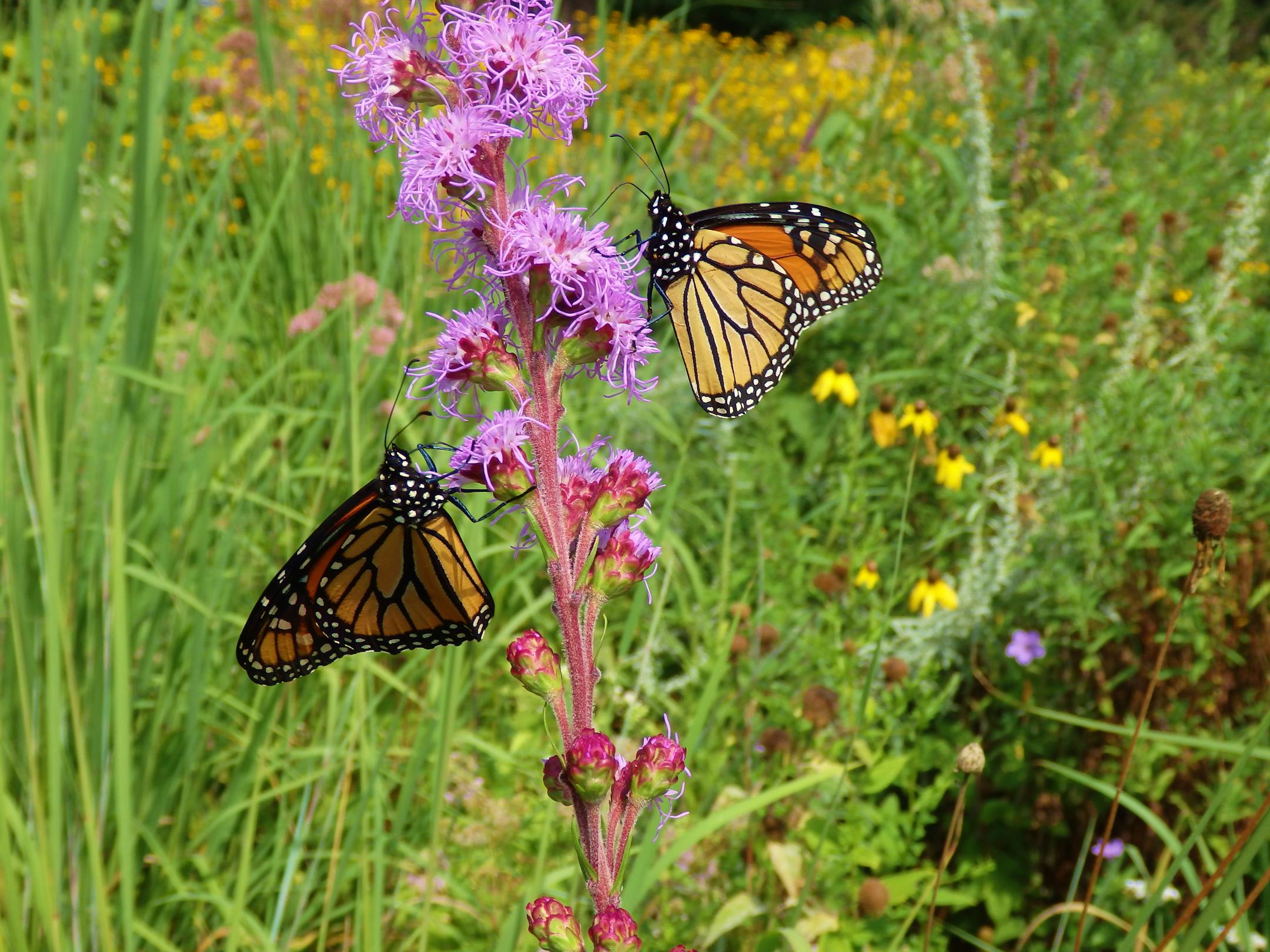
Meadow blazing star with two monarch butterflies: Robin Washington writes that the plant serves as a significant fuel stop for migrating monarchs. (The Minnesota Star Tribune)

Opinion editor’s note: Strib Voices publishes a mix of guest commentaries online and in print each day. To contribute, click here.

•••

Despite a nearly $800 monthly HOA fee, my Lowertown condo isn’t big on amenities. No exercise room. No pool. No game room. Forget pickleball or half-court basketball. When I suggested a patio table and chairs at a sunny end of a hallway so that neighbors could get to know one another (there’s no social room either), the reply was: “Fire marshal won’t allow it!”

So I stopped making suggestions and shelved a fantasy of a weed-pulling party with residents of the adjacent apartments sharing our courtyard in downtown St. Paul. Then in mid-August, the garden exploded with activity I hadn’t imagined.

Monarch butterflies — scores of them (they wouldn’t stay still long enough to be counted) — flitted from flower to flower, sharing the space with healthy-sized bees.

“Come quick!” I called to my wife, worried they’d vanish before she arrived.

They didn’t. Out of nowhere, we had a butterfly garden.

Or so it seemed to me. I knew about milkweed, the only plant on which monarchs lay their eggs. My late mother — an environmentalist born on April 22, before it became Earth Day — was zealous about it. “It’s for the monarchs!” she’d scold anyone who pulled the plants, even those growing under the L tracks across from her Chicago home.

Yet this courtyard had no milkweed. My plant app identified the flowers attracting them as meadow blazing star, another native species. It didn’t get there by accident. After a couple of calls, I learned my neighbor, Tom Peterson, and the building’s landscaper, Abbey Endert of Home Sown Gardens, had both suggested growing pollinator-friendly plants in what for the past few years had been a messy tangle of weeds.

“We planted them late season last year,” Endert said. “Blazing star is one of the monarchs’ favorites.”

She stopped short of adding milkweed, however. “I didn’t plant it because milkweed are often pretty aggressive spreaders. And with the level of shade, I didn’t know how well we’d get nice clumps.”

The blazing star alone worked fine, and the monarchs showed up almost to the day the guidebooks say they will, according to Wendy Caldwell, executive director of the Minnesota-based Monarch Joint Venture. Their change in diet comes as they switch from breeding to migration.

Beginning in the spring, “There are between four to five generations of monarchs every year,” she explained. “Those are breeding generations. They will live on average about a month. And they’re looking for milkweed and laying eggs.

“Then, starting around Aug. 15, a generation emerges in a state called reproductive diapause that delays maturing to create the migratory generation. Those live about nine months. So at that point, they’re not really looking for milkweed, they’re looking for other kinds of wildflowers to store up fat reserves for their migration to Mexico.”

I checked my photos. The first was dated Aug. 19. They were still here in late September, though migration — about a two-month journey — had already begun.

Monarchs are the state butterflies of Minnesota and a handful of other states. They’re majestic even without the title. Yet their population has nosedived. They’re counted by measuring the acreage of Mexican forests occupied by hibernating monarchs, with the long-term average hovering around 12 acres. It’s rarely hit half of that in recent years.

Last December, in the final days of the Biden administration, the U.S. Fish and Wildlife Service recommended listing them as “threatened” under the Endangered Species Act, a rule that typically would take effect the following year.

That now puts it before the Trump administration, which favors human enterprises like oil fields over animal habitat. But monarchs may sidestep that fight because milkweed, their main food source, grows anywhere, like around train tracks.

So instead of pleading with the Environmental Protection Agency to protect milkweed growing in oil reservoirs, we can all plant it ourselves — anywhere.

As for meadow blazing star, I can vouch it draws them. But since monarchs don’t reproduce on it, did my building’s experiment just borrow a horde from elsewhere, rather than increase their numbers?

“It’s more of a fueling stop than chrysalis,” said Endert, whose job as a landscaper was more focused on adding color to our garden by attracting full-grown monarchs, rather than operating a caterpillar nursery.

And, added Caldwell, “Monarchs aren’t tied to a single patch of wildflowers. What matters most is how often they encounter additional habitat — milkweed if they are reproducing, and nectar-rich flowers if they are migrating. Even if the blazing star in your garden didn’t produce those monarchs, it likely played an important role in nourishing them and helping them survive.

“In short,” she concluded, “both milkweed and a diversity of nectar plants are essential for monarchs to thrive.”

Caldwell added that some milkweed varieties have colorful blooms, so maybe Endert could plant those too. Or I could take matters into my own hands. I know some vacant lots nearby where a little clandestine seeding would go unnoticed among the brush.

Just don’t tell the fire marshal.

Robin Washington is a producer-host for Wisconsin Public Radio and a former editor-in-chief of the Duluth News Tribune. He lives in Duluth and St. Paul and can be reached at robin@robinwashington.com.

about the writer

about the writer

Robin Washington

More from Commentaries

See More
card image
card image