
Opinion | A comet, a wolf, an owl

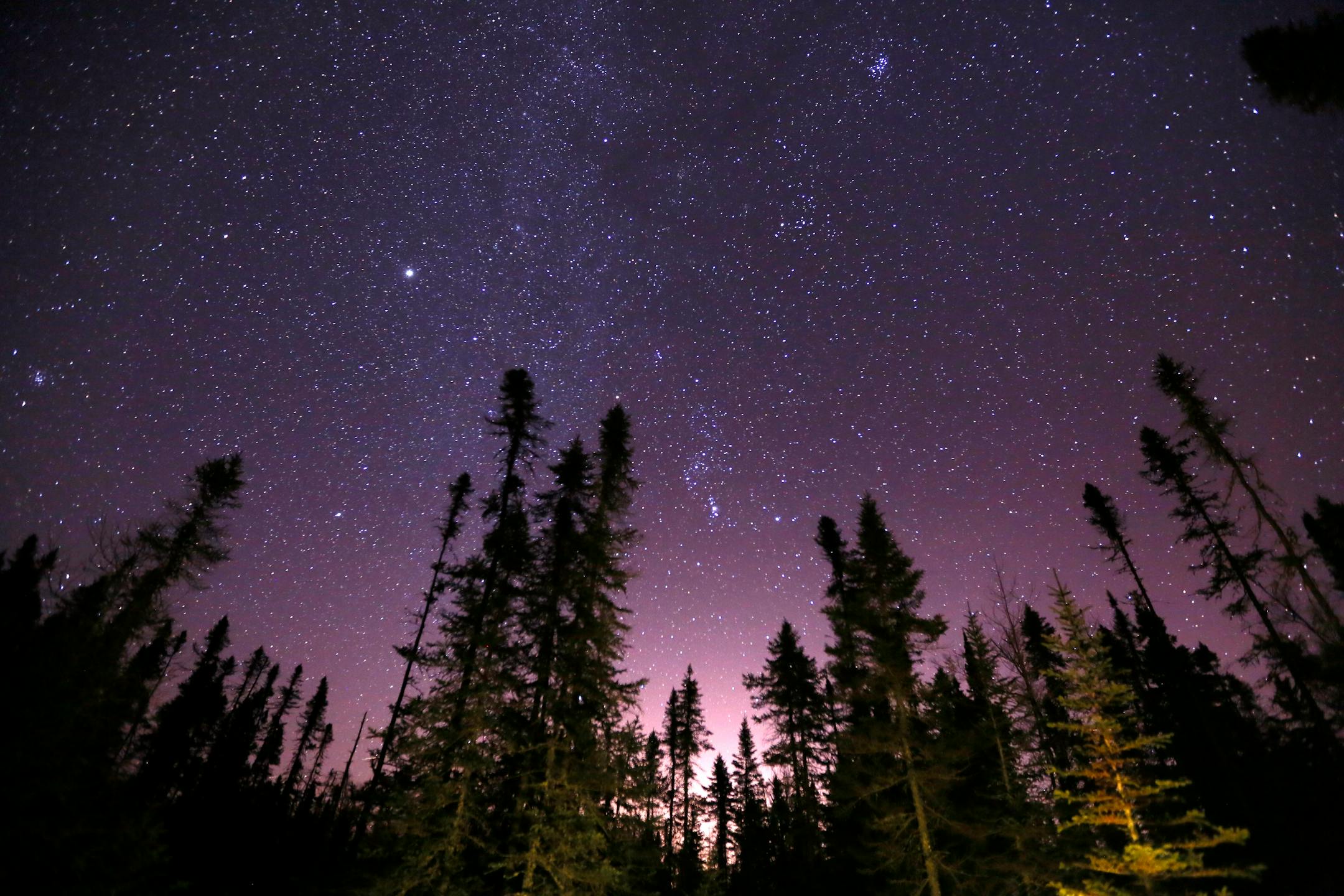
One can feel grounded out under the stars. If it’s an identity you seek, you could do worse than asterism, a word I’ve whimsically given a double meaning.

November 28, 2025 at 11:00AM
"I learned the patterns of the constellations as a teenager, and once mapped out in your mind they are indelible, more familiar than the proverbial backyard because unlike trees, gardens and grass, they don’t change — at least not on a human time-scale," Peter M. Leschak writes. (Brian Mark Peterson/The Minnesota Star Tribune)

Opinion editor’s note: Strib Voices publishes a mix of guest commentaries online and in print each day. To contribute, click here.

•••

Antares winked at me through conifer tops from across Secret Lake in northern Minnesota. The bright crimson star in the constellation Scorpius was setting southwest an hour after the sun.

In my 15x70 binoculars Antares was a coruscating pinwheel of light — red yes, but also flaunting glints of blue and white. Given the shallow arc of its descent the star eased behind two Norway pine crowns before sinking — from my viewpoint — into the forest. I used that as a cue to launch the hunt.

It was relatively mild for the second week in October, but I’d bundled up enough to be comfortable on the bench in my “blind.” Though there’d been a dozen ring-necked ducks on the lake that morning, I wasn’t hunting waterfowl but a comet.

This wasn’t fated to be a spectacular, hysteria-inducing event. Comet 2025 R2 Swan was estimated to be at 5.7 magnitude brightness — that is, just at the threshold of naked-eye visibility in a backwoods sky with clear, steady air. I had that, and rated the observing conditions as “very good,” but didn’t expect to see the comet without optical aid. It was predicted to be only 5 degrees above the horizon at dark, so there’d likely be at least a smear of haze, plus the natural thickening of the atmosphere at that low angle.

Starting along the horizon from Scorpius, I panned with the binoculars to the constellation Libra and just beyond. At the end of the slow sweep past dim stars I raised the lenses a couple of degrees and tracked back east, repeating the process up to 10 degrees above the tree line. Nothing.

I took a break, focusing on M13, a globular star cluster in Hercules, then did another sweep. No comet. Fifteen minutes later, on my third scan of the low southwest, I whispered “yes!” As often happens with dim targets, the comet abruptly popped into view.

It was a fuzzy white patch of light about 6 or 7 degrees above the horizon, with no discernible tail — a modest apparition that only an astronomy buff would relish, but like all hunters I was pleased to have “bagged” my quarry. To underscore the vibe I heard two other hunters almost simultaneously — a wolf howling far to the north, barely audible but distinct; and a barred owl, loud and nearby. I smiled, savoring their nocturnal voices, grateful for the privilege of being at that precise spot on the Earth at that precise moment. The unruffled surface of Secret Lake was a mirror for the stars, and I could look down between my boots to see the sky.

I learned the patterns of the constellations as a teenager, and once mapped out in your mind they are indelible, more familiar than the proverbial backyard because unlike trees, gardens and grass, they don’t change — at least not on a human time-scale. Sure, 50,000 years from now the Big Dipper will have a different shape because all stars are in motion, but no one’s holding their breath.

Because of this stellar constancy, I was never more disoriented — and enthralled — than one night on a remote Brazilian beach 13 degrees south of the equator. First, I saw “alien” constellations not visible from the mid-latitudes of the Northern Hemisphere — the magnificent Southern Cross, for example. Second, familiar star patterns were in the “wrong” place. Orion at the zenith — straight overhead — was shocking, like gazing up from the surface of a different planet. Indeed, in a familiar science fiction trope, a protagonist realizes they’re “not in Kansas anymore” when the local star patterns are unrecognizable.

Sitting outside in the backcountry night, alone and silent, is both a balm and a challenge. A rural starscape is like the dome of a cathedral sanctuary. If you’re in the mood for veneration, a vault of star-clotted sky will provide solace rooted in beauty and light, or perhaps in a bit of fantasy. “For my part,“ said artist Vincent van Gogh, “I know nothing with any certainty, but the sight of the stars makes me dream.” In my youth such musings, engendered by the Space Race and the novels of Isaac Asimov, Robert Heinlein, Ray Bradbury and others, might consist of imaginary galactic empires, or a desire to be an astronaut, or a wish for a bigger telescope than the humble 60mm refractor from the J.C. Penney catalog that my mother got me for Christmas.

On the other hand, “Astronomy,” wrote Ralph Waldo Emerson, “taught us our insignificance in Nature.” When you attempt to grasp the immense size and age of the observable universe — where conventional measurements of distance and time are expressed in quadrillions and trillions — and truly perceive that our solar system is in no way special, you’re presented with a challenge: How does one reconcile intrinsic physical insignificance with the typical human conviction of being exceptional — both as an individual and as a species?

This can be finessed in a couple of ways. You may default to a religious avenue whereby the stupendous cosmos may be attributed to a stupendous creator deity, who also happens to take us seriously and in an afterlife will clue us in on the agenda. Or you may accept that a feeling or conviction of uniqueness is, for whatever reason, just inherent to a sentient organism and be content to revel in starlight and be immersed in the moment. As Lennon and McCartney opined, “Let it be.”

I spent an hour with the stars and their lake reflections, in a congenial zone of recognition and accord. I recited the names of the brighter visible stars: Arcturus, Vega, Deneb, Altair, Polaris, Capella, while looking at each in turn — a way to keep the knowledge fresh. I once joked that my preferred “ism” was asterism, referring to a pattern of stars that is not a constellation. A prominent example is the Big Dipper — an asterism within the constellation Ursa Major or the Great Bear. Another is the belt and sword of Orion. The sky is rich with captivating asterisms, both naked eye and not. One looks like a coat hanger, another like a Christmas tree, and my favorite is Kemble’s Cascade, a stream of 20 evenly matched stars that in binoculars appear as a stunning chain of jewels. Upon first seeing them I literally gasped.

I’ve been privileged to spend most of my life in dark-sky locales, and the periods I’ve been ensconced in artificial light-infested metropolitan areas have engendered a sense of being marooned, bereft. Because the stars show me where I am. Your latitude in degrees equals the height of Polaris – the North Star – above the horizon, which is over 47 degrees at Secret Lake. From that beach in Brazil Polaris was invisible.

The stars show me when it is. At the time I found the comet, the Big Dipper was horizontal to the northern horizon and low, so that the paws of the Great Bear were out of sight. If I’d come back out at 3 a.m., the Bear would be standing prominently on its tail (handle of the Dipper), with the paws high in the sky.

The stars show me who I am. Under an opulent night sky it seems irrelevant to think in terms of national identity, political identity, ethnic identity, gender identity, religious identity. I hereby invoke a whimsical “doctrine” of asterism: I am a lover of the stars; no more, no less.

As an activist in this fraught era of acute challenges I’ll have to reassert those more prosaic identities, of course, but it would be foolish to discount my passion. I am a lover of the stars. Sometimes that’s gloriously enough.

Peter M. Leschak, of Side Lake, Minn., is the author of “Ghosts of the Fireground” and other books.

about the writer

about the writer

Peter M. Leschak

More from Commentaries

See More
Left, U.S. Rep. Tom Emmer. Right, Minnesota House Speaker Lisa Demuth.
L to R: Tom Williams/TNS; Leila Navidi/The Minnesota Star Tribune

U.S. Rep. Tom Emmer and House Speaker Lisa Demuth know the truth about their Somali constituents. But in today’s GOP, they are trading courage for political survival.

card image
card image