

Mitt Romney's party is over

Both literally and figuratively. What to make of his choice to step away from public life after his term in the Senate ends and to name names on the way out?

September 15, 2023 at 3:26PM
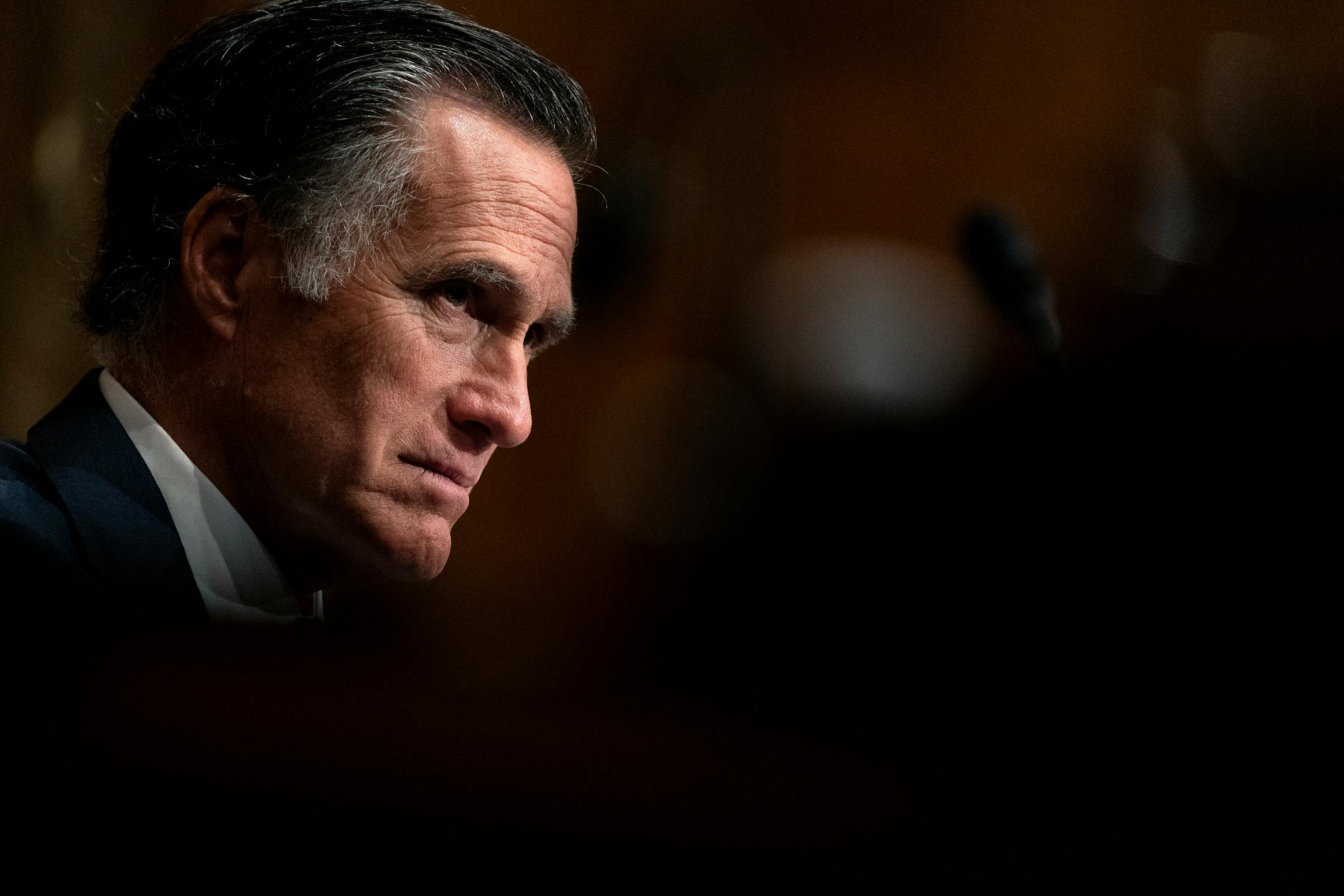
FILE — Sen. Mitt Romney (R-Utah) at the U.S. Capitol in Washington, Dec. 11, 2020. The retiring senator has given us a gift in the form of conversations for a new book in which he puts on record what many in the news media have been hearing for years off the record — that the Republican Party has become a party of fakers, with congressional leaders who laugh at Donald Trump behind his back while swooning over him before the cameras, writes the New York Times columnist David Brooks. (Anna Moneymaker/The New York Times)
U.S. Sen. Mitt Romney, R-Utah, at the Capitol. Romney has said he will not seek re-election in 2024. (Anna Moneymaker, New York Times/The Minnesota Star Tribune)

Star Tribune opinion editor's note: Two columnists for the New York Times — David Brooks and Michelle Goldberg — weigh in on news that the Utah senator (and former Republican presidential candidate) won't run again in 2024. We include both of their texts here, with Brooks up first.

"Mitt Romney has given us a gift," by David Brooks

Sometimes you do things that make you feel ashamed. It was the first day of the Republican convention in 2012, and I had nothing to write about, so I wrote a humor column mocking the Romney family for being perfect in every way. It was a hit with readers, but the afternoon it was published I crossed paths with two of Mitt Romney's sons, and they looked at me with hurt in their eyes, which pierced me. I'd ridiculed people for the sin of being admirable.

A few years later, before he was a senator, Romney asked me to come out to Utah to give a talk to a group he was convening. It's a pain to write a speech and get on a plane, but I did it in penance for my sins. Of course, all the Romneys were lovely to me, as is their nature. And I learned a lesson: The partisans may applaud if you ridicule those you admire, of any political stripe, but stay faithful to them.

We all struggle to be the best version of ourselves we can be, and Romney's struggle is now taking him into retirement and out of the Senate. On the way he gave us a gift, in the form of a series of conversations with the Atlantic's McKay Coppins, who has written a book on him, excerpted in the magazine.

Romney puts on the record what so many of us have been hearing for years off the record — that the Republican Party has become a party of fakers, that its congressional leaders laugh at Donald Trump contemptuously behind his back while swooning over him before the cameras.

Sen. Mitch McConnell, R-Ky., is the tragic figure in Romney's tale. He comes across as — and I believe actually is — a decent man who is trying to mitigate the worst of Trump's effect on his party. But we see the daily corrosions that McConnell must endure to keep up this front — turning a blind eye to Trump's crimes, turning a blind eye to the threats that were coming in the lead-up to the events of Jan. 6, 2021.

At one point, McConnell resorts to the rationalization we've heard a thousand times — that if Trump loses and the Democrats win, they will pass a hard-left agenda that will ruin America forever. McConnell has to exaggerate how radical Joe Biden is, and what the electorate will support, in order to justify supporting his own party's lamentable leader.
McConnell's core problem is that you can't negotiate with narcissism. Every time you make a concession to Trump's selfishness, it voraciously seeks to devour another pound of your flesh.

Paul Ryan also makes a sad appearance in this story. Romney tells Coppins that Ryan called him during the first impeachment trial, seemingly lobbying Romney to acquit. Preserve your viability with Republicans, Ryan advises; preserve your ability to do good.

It's advice that once seemed plausible and that guided many upright people to enter the Trump administration as voices of sanity. The first problem with it is that the cult of Trumpism demands absolute fealty. One moment of honest dissent and you are cast from the ranks. The second problem is that loyalty to Trump is ultimately enforced by the threat of violence. As the Coppins piece makes clear, there were Republicans who chose not to vote yes on impeachment or conviction because the outcome either way was inevitable and because they didn't want potential assassins coming after them or their families. We have gone beyond the bounds of normal democratic governance.

The third problem is that if you ally yourself with a con artist, you have to become part of the con yourself. You have to become Sen. Ted Cruz, R-Texas, who went to Princeton University and Harvard Law and is married to an employee of Goldman Sachs, ludicrously popping a brewski live on TV — an elite nerd's attempt to appear populist.

Over the Trump years we've learned how easy it is to anesthetize one's moral circuits. John McCain kept his moral compass, and so did Romney, but they are the exceptions. Many others joined the general fakery. You start by lying about yourself, and pretty soon you're lying to yourself.

The pivotal moment for Romney seems to have come Jan. 6 — not what the insurrectionists did to get into the Capitol, but what the Republican legislators did in the chambers after the rioters had been cleared out, continuing their efforts to negate the election. This is where five years of negotiating with narcissism had brought the party.

Romney's retirement, which goes into effect in 2025, will mark the end of an era, the end of the Republican Party that once featured people like Abraham Lincoln, Theodore Roosevelt and, more recently, George Romney, Mitt's father, and George H.W. Bush. Realistically, Romney will have little role in trying to produce a better GOP future. What replaces Trumpism will be different from what came before.

I admire him for deciding to step down at the senatorially young age of 76. As we've all come to see, the hunger for continued relevance is the corroding lust that devours the very old. Romney stands for the valuable idea that there are things more important in life than politics and winning elections.

The GOP needed to change and become more in touch with the working class — but not in the vicious way Trump has championed. As long as Trump is leading it, the Republican Party cannot be reformed. It can only be deprived of power.

"Mitt Romney's tragic ambivalence," by Michelle Goldberg

Rolling out the announcement that he won't run for re-election, Sen. Mitt Romney of Utah has framed it as a passing of the torch. "At the end of another term, I'd be in my mid-80s," he said in a video statement. "Frankly it's time for a new generation of leaders. They're the ones that need to make the decisions that will shape the world they will be living in." He clearly means this as a rebuke to the 80-year-old Joe Biden and the 77-year-old Donald Trump, neither of whom, he said, "are leading their party" to confront the major issues facing our country. "The next generation of leaders must take America to the next stage of global leadership."

The problem with this argument is that Romney despises the next generation of Republican leaders. He's watched the transformation of Sen. J.D. Vance of Ohio into a Trump lackey with disgust. "I don't know that I can disrespect someone more than J.D. Vance," he told McKay Coppins, author of a forthcoming Romney biography. He's similarly contemptuous of Sen. Josh Hawley of Missouri for indulging the lies that led to the Jan. 6 insurrection. I doubt he's a fan of Florida congressman Matt Gaetz or the hucksterish presidential aspirant Vivek Ramaswamy.

Besides, as Coppins reveals in an Atlantic excerpt from his book, Romney himself thought of running a third-party campaign for president in 2024, deciding against it only out of fear that it would throw the election to Trump. So as much as I believe that America is stagnating under the death grip of the gerontocracy, I don't think that's why Romney is bowing out. Rather, he's given up on a second Senate term because his brand of stolid, upstanding conservatism has become obsolete, replaced with a conspiratorial, histrionic and sometimes violent authoritarianism. His reluctance to say so clearly, at the cost of breaking with his party definitively, is evidence of something tragic in his character.

We know what Romney really thinks because of the access he offered Coppins, with whom he met weekly, giving him diaries, private papers and emails. "A very large portion of my party really doesn't believe in the Constitution," Romney told him.

When Romney gave a speech at the Utah Republican Party's conven

FILE ' Sen. Mitt Romney (R-Utah) during a hearing at the Dirksen Senate Office Building in Washington, July 20, 2021. Romney is leaving office because his brand of stolid, upstanding conservatism has become obsolete, replaced with a conspiratorial, histrionic and sometimes violent brand of authoritarianism, writes the New York Times columnist Michelle Goldberg. (Stefani Reynolds/The New York Times)
In a book written about him, an excerpt of which was published in the Atlantic, U.S. Sen. Mitt Romney, R-Utah, says that “a very large portion of my party really doesn’t believe in the Constitution,” (Stefani Reynolds, New York Times/The Minnesota Star Tribune)

tion in 2021, he was prepared for boos, but emerged shaken by the sheer intensity of the red-faced fury that confronted him. He was, writes Coppins, afraid of his own constituents. "There are deranged people among us," he said, and in Utah, "people carry guns." After Jan. 6, Coppins writes, Romney spent $5,000 a day on security for his family.

But Romney isn't using the announcement of his coming retirement to warn the country against the danger of a right-wing movement that routinely resorts to threats of violence. He certainly isn't defecting from the Republican Party for the remainder of his time in the Senate. Instead, by putting age at the center of his argument, he's setting himself above the fray, pretending that both parties are equally at fault in bringing the country to this perilous pass. Romney has shown far more decency and courage in response to Trump than almost all his colleagues, but in this case, he's still pulling his punches.

There's something Hamlet-like in Romney's temporizing. He wants to defend the party of his revered father, the liberal Republican George Romney, but he's often been hesitant about striking at the venal interloper who's taken it over. During the 2016 campaign, Romney gave a speech warning of the "trickle-down racism" a Trump presidency would bring, an echo of George Romney's refusal in 1964 to endorse Barry Goldwater, an opponent of the Civil Rights Act. Yet, as ABC News reported, even though Romney didn't support Trump himself, he "said that he wouldn't be spending the next six months trying to convince anyone not to vote for Trump."

It's possible that Republican leaders, had they acted quickly and decisively in 2016, could have thwarted Trump before he'd consolidated his messianic hold over the party's base. But Romney, like other establishment Republicans, underestimated the autocratic threat posed by Trump, or overestimated his party's patriotic fortitude. It's a mistake he would make again.

After Trump was elected, Romney evidently thought he could save the Republican Party from the inside, abasing himself in a bid to become Trump's secretary of state. Entering the Senate, he tried to chart a path for a post-Trump conservatism while ignoring Trump himself as much as possible. While promising to speak out about Trump's worst excesses, he wrote in the Washington Post, "I do not intend to comment on every tweet or fault." (For that, he had the pseudonymous Twitter account Pierre Delecto, where he could applaud squibs about Trump's moral depravity and evident unfitness.)

Romney deserves our admiration and gratitude for being the sole Republican to vote to convict in Trump's first impeachment, and then for voting again to convict him in his second. After a lifetime as a loyal Republican, it must have been extraordinarily difficult to break with his partisan allies.

But he must understand that the problem isn't only Trump, but Trump's party, which is also his party. There is no telling what sort of impact it would have if the last pre-Trump Republican nominee for president quit the GOP and worked for its defeat — maybe hardly any. But given the stakes, what excuse is there for not trying? "Authoritarianism is like a gargoyle lurking over the cathedral, ready to pounce," Romney told Coppins. He should be less coy in sounding the alarm.

Star Tribune Opinion publishes a mix of national and local commentaries online and in print each day. To contribute, click here.

about the writer

about the writer

Multiple authors

More from Commentaries

See More
card image
Richard Tsong-Taatarii/The Minnesota Star Tribune

As federal enforcement escalates, civilians are left to witness and absorb the risks.

card image
card image