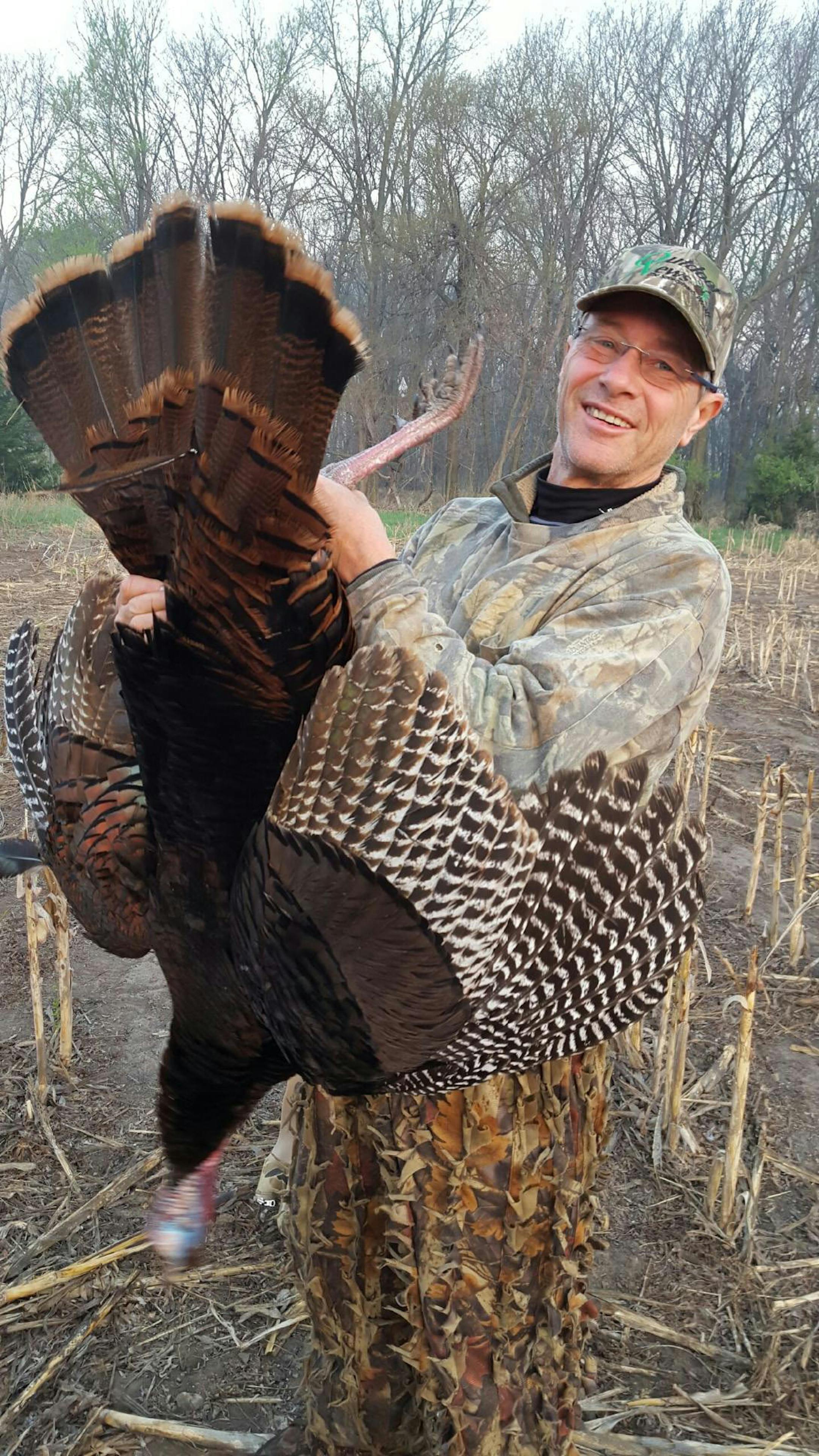
IN THE FLINT HILLS REGION, KANSAS – I watched a big tom on opening day of the Kansas wild turkey hunting season.
It wasn't hard. He wanted to be seen.
Some 200 yards from my blind, the tom strutted to the crest of a picked cornfield, fanned his feathers and made clear he was the boss. From this spot he lorded over seven hens, a subordinate tom and a handful of jakes that pecked in soil desperate for a hard drink. I called repeatedly. They did not move. The only thing that moved was the sun. It kept sinking ever faster, its orange glow dimming as it dipped beneath the horizon.
At last, after legal shooting hours, the birds began their cautious march from field to forest. All walked warily within 25 yards of me. Some came within 5. The big tom brought up the rear. It was a fascinating yet frustrating parade. It ended when one by one — a flutter here, a whoosh there — the flock flew into the outstretched arms of towering cottonwoods trees.
"Good hunt. No bird. But there's always tomorrow," I announced upon returning to camp. That was true for Rad Royer, too. Gary Drotts and Greg Kvale had done better. They bagged birds before noon.
Residents of the Brainerd area, we four do what many turkey hunters do. We migrate. Come spring, we travel to a distant destination and hope for the best. Long ago, it was Minnesota's Houston County. Later it was the Black Hills of South Dakota. Later still, we hunted in central Minnesota, seeking descendants of wild turkeys that Drotts introduced into Crow Wing and Cass counties while serving as a state wildlife manager.
Clearly, these regional adventures are small potatoes compared to those who travel extensively in pursuit of a grand slam, the harvesting of all four subspecies of wild turkey: Eastern, Osceola, Rio Grande and Merriam. The National Wild Turkey Federation (NWTF) keeps track of such hunters. William Barrington of Minnetonka has accomplished this feat six times.
Similarly, we hold no candle to those who have earned a super slam, the taking of a wild turkey in every state except Alaska. Six hunters have done this. The first was Daniel Rorrer of Oulaski, Va., in 2011, according to the NWTF website.