
Minnesota Zoo: Into the wild

Artists working with the Minnesota Zoo created a realistic world for grizzly bears, leopards and wild boars out of rebar, concrete and paint.

June 4, 2008 at 12:23PM
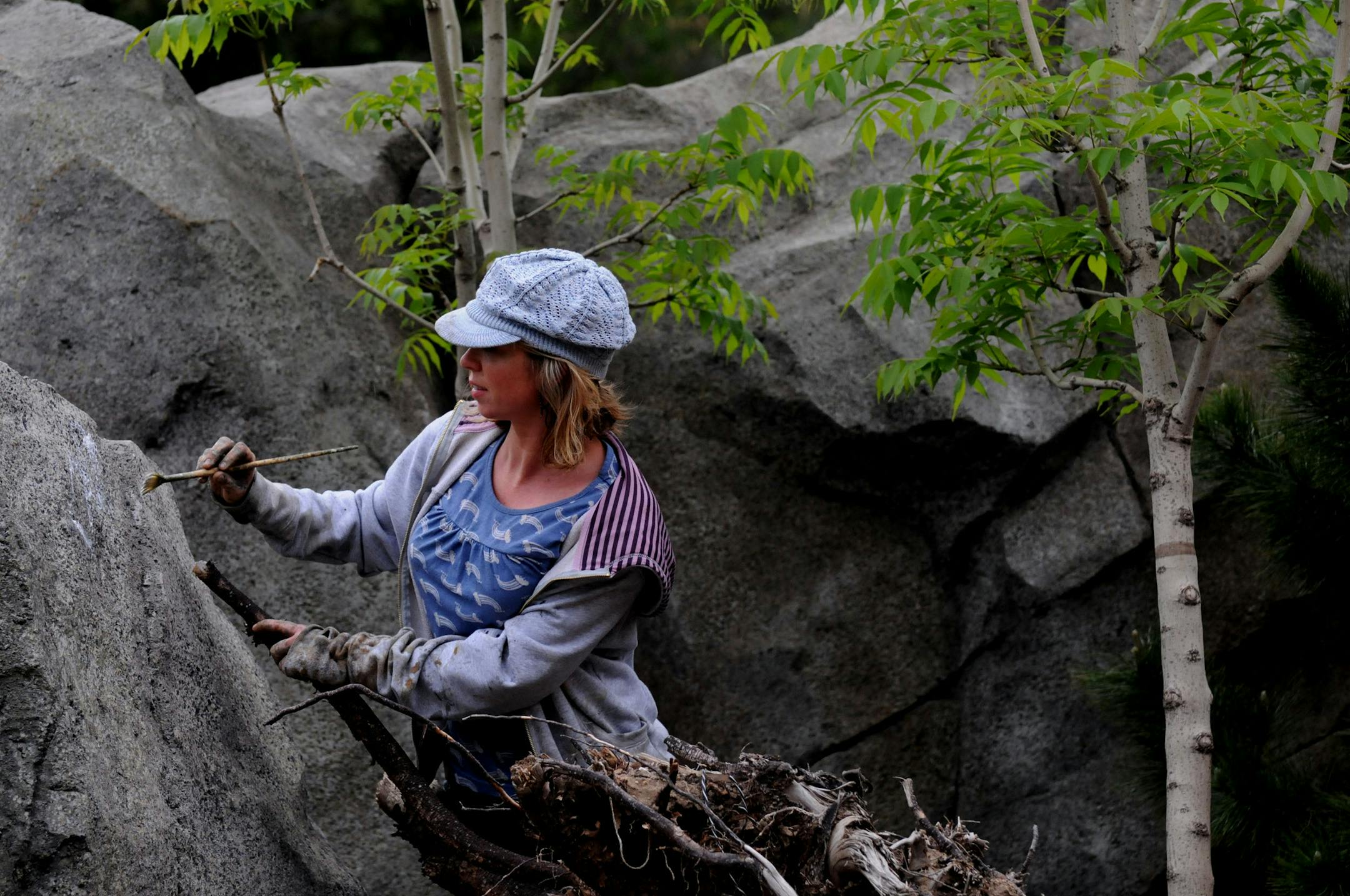
Gina Louise is one of a team of about six artists that has created 55,000 square feet of realistic looking rock face from concrete at the Minnesota Zoo's new exhibit. The artists spent more than a year working on the exhibit.
Gina Louise is one of a team of about six artists that has created 55,000 square feet of realistic looking rock face from concrete at the Minnesota Zoo's new exhibit. The artists have spent more than a year working on the exhibit, which is supposed to open soon. (Star Tribune/The Minnesota Star Tribune)

Visitors to the Minnesota Zoo's soon-to-open Russia's Grizzly Coast exhibit will find themselves winding through rocky, dramatic terrain.

They'll travel through basalt and sandstone cliffs, walk through a lava tube and lean against lichen on the rocks that tower above.

But there's a catch: The rocks and lichen aren't real.

Over the past year, a team of professional zoo artists has constructed 55,000 square feet of realistic-looking rock face. They shot wet concrete onto a rebar structure, and -- with carving tools and a trained eye -- created a believable world of grizzly bears, wild boars and Amur leopards from an empty zoo field.

"You start with a picture, and you have a shape in the steel," said artist Gina Louise, while walking through the construction site as work neared an end, her hands stained with paint. "The carving is where the artists sort of have to interpret what the client wants and what the story is. There's a story behind it that you're trying to tell."

"Creating a facade"

Creating rocks from scratch is not a career artists in training usually have in mind. It's a career you sort of fall into, said lead artist Diane Minks.

Minks got her start working in the film industry, constructing sets and designing props and costumes. She's since worked on some acclaimed zoo projects, including the Congo Gorilla Forest at the Bronx Zoo, designed by current Minnesota Zoo Director and CEO Lee Ehmke.

Louise, a graduate of the Minneapolis College of Art and Design, was working on the design of a Rainforest Cafe in Chicago when she heard about a job at Animal Kingdom in Florida.

"It's really conventional construction, with an artistic spin on it," Minks said. "It is very much like building a building, with the same materials, but the external facade looks different."

Although real rocks are scattered throughout the exhibit -- in stream beds and as places to sit -- real rocks can't be used all over, Minks said. The sheer weight of equipment required and the size of the solid rocks themselves would make that idea unworkable.

The artificial rocks also are multi-functional. The central rock in the bear exhibit is completely hollow. There's an entry point for the animals to come into the exhibit, and an area for keeper access, according to Ehmke.

There's a lookout perch so keepers can watch the animals and locations where they can put food to encourage the bears to forage.

Ledges are carved into the rocks instead of jutting out, so animals can't climb and escape. Artists also need to make sure there are no areas for bacteria pools to form.

"It really has to be a working space," Minks said, "There are things you have to hide so the public doesn't see them. You're creating a facade to hide the mechanics of a working exhibit."

Requested by name

The rock artists are working with a company called Cemrock, of Tucson, Ariz. The $23.6 million exhibit covers 3.5 acres and is being paid for by the state.

It the beginning, the artists were given a scale model of where the rocks would go and pictures of what they're supposed to look like.

"You get to problem solve," Louise said. "You take the shape that you have, and somehow connect the dots and fill in the blanks of the story. It's sort of like you have your story line, but the actual words aren't put in there yet, so you get to do the words."

When the Minnesota Zoo bid the Grizzly Coast project, according to Ehmke, it was very specific about the rocks: It requested, by name, a series of artists it wanted to build its mountainous world.

"There are only a few people in the country who do this sort of stuff," Ehmke said. "And a subset of them are really good at it. They're sensitive to the ability to re-create the geology that is part of a story line that we're building. They're artists, and they're also great at understanding the relationship of what they're doing for the animals and the public experience. They have the ability to make it real."

Emily Johns • 952-882-9056

about the writer

about the writer

EMILY JOHNS, Star Tribune