
Film review: Three major problems the Vikings have on defense

A reeling Vikings defense is preparing for the high-powered Lions offense on Sunday. Just how many issues do they need to solve?

The Minnesota Star Tribune
October 29, 2025 at 12:01PM
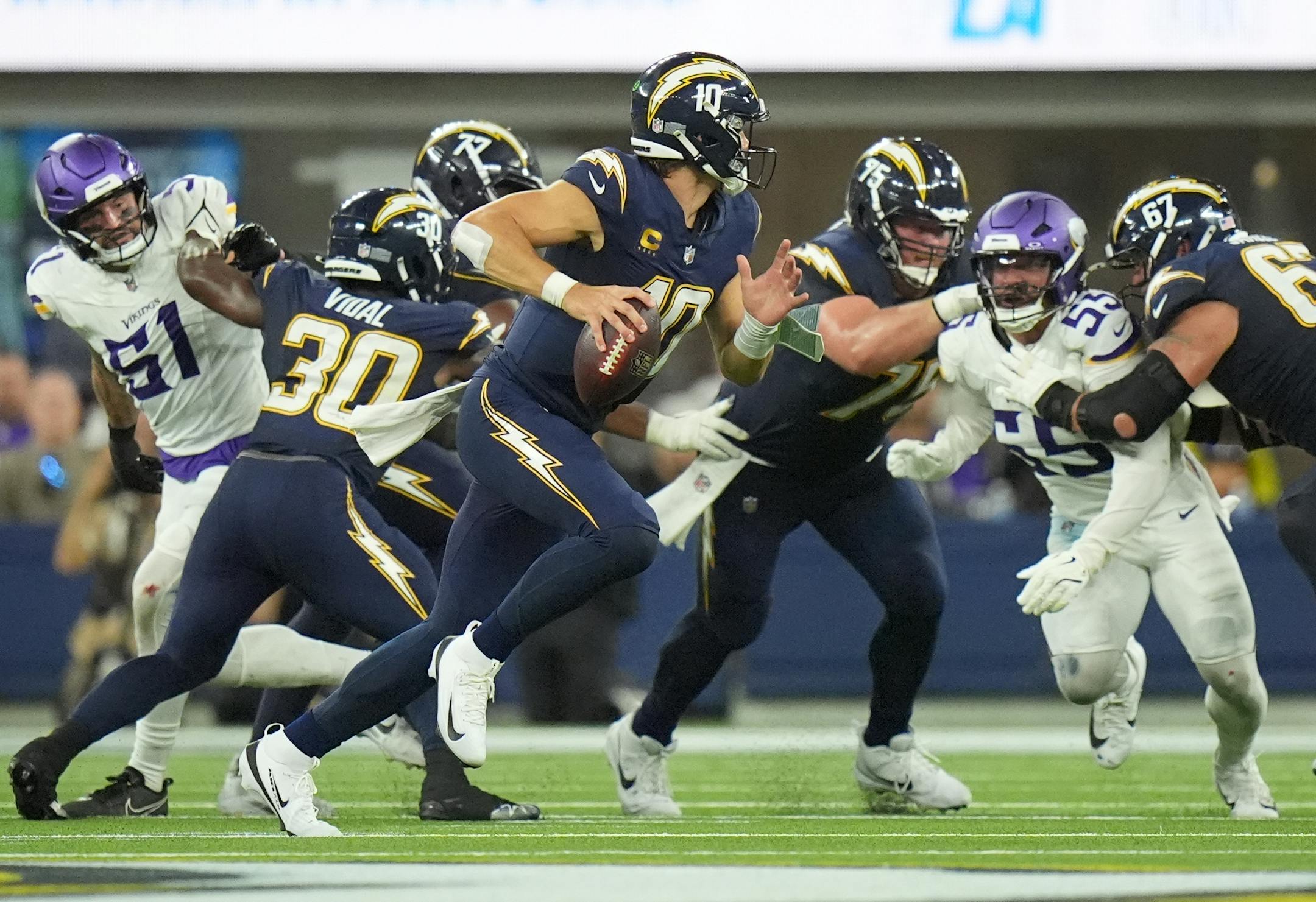
Chargers quarterback Justin Herbert tries to avoid the Vikings defense during their game Thursday at SoFi Stadium in Inglewood, Calif. (Jerry Holt/The Minnesota Star Tribune)

Coaches and defenders emerged from the Vikings’ 37-10 drubbing by the Chargers, in which they were outscored by 27 points and outgained by 255 yards, with the continued mantra of getting “back to the basics.”

In two games since the bye week, the Vikings defense has allowed season-worst yardage and scoring outputs. Bye week adjustments to curb a leaky run defense have not produced desired results. A sound-but-unspectacular secondary has now started springing leaks.

Up next: A trip to Ford Field, where the Lions averaged more than 390 yards and 31 points last season while causing two Vikings losses.

“We just got to do the little things very consistently,” linebacker Eric Wilson said. “Everyone has somewhat of a role and you just have to own up to it and do your best.

“Doesn’t matter what it is. Is it tackling? Is it getting off blocks? Is it covering somebody?”

A little bit of everything went wrong during last week’s 37-10 loss to the Chargers, but coach Kevin O’Connell continued to talk about the fundamentals of run defense that evade this expensive and veteran group.

“What are we doing as far as setting edges?” O’Connell said. “What are we doing as far as defeating blocks, playing the cutback and then continuously trying to chase improvement from a tackling standpoint? ... Then allow our defense to set themselves up in [downs and distances] where they can be aggressive in pass-likely situations to try to maybe cause some chaos.”

Here are one observer’s top three on-field issues facing this Vikings defense.
ADVERTISEMENT

No. 1: Run defense

Even before the dam broke in the second half in Los Angeles, the Vikings run defense was still middling while holding the Eagles’ Saquon Barkley and the Chargers’ Kimani Vidal to modest results over six quarters.

Barkley and Vidal each had success rates of more than 50%, meaning more than half the time they achieved either 40% of needed yardage on first downs, 60% on second downs or 100% on third and fourth downs. It means they often kept their quarterbacks in favorable downs and distances.

Then came the second half in L.A.

Vidal took 12 carries for 93 yards after halftime while salting away an easy victory against the Vikings. It was an all too familiar but unsettling look for fans watching a defense that has dissolved from last year’s top-five run defense to this year’s below-average group.

Problems persist in the first and second levels of the front. Coaches are still making lineup adjustments in search of answers without Andrew Van Ginkel, who has been out since Week 3 because of a neck injury since.

Dallas Turner has struggled to consistently set edges in the run game, which may have prompted the bye week change of playing inside linebacker Eric Wilson on the edge. That’s where Wilson started the game in L.A. over Turner, whose playing time has decreased slightly in the last two weeks.

Defensive tackle Javon Hargrave’s playing time has also decreased after getting $19 million guaranteed on a two-year deal in March. Defensive tackle Jonathan Allen, who got $23 million guaranteed in the same free-agent spending spree, has not been a consistent difference maker.

The Chargers, like the Steelers (and the Lions, Sunday’s foe), enjoy putting the biggest people on the field and running behind them. Even when defensive coordinator Brian Flores and his assistant coaches tried to match heavy personnel with heavy personnel, the Vikings consistently struggled to control the line of scrimmage.

In the video below, you’ll see the first three plays out of halftime: a 7-yard run by Vidal, an 8-yard run by Vidal, and a 9-yard run by Vidal. Each one found some path up the gut of the Vikings defense. The Chargers had two tight ends on the field for each, bulking up with a fullback on the final two. The Vikings stayed in their 4-3-4 base personnel with Wilson dropping to the edge.

Linebacker Blake Cashman appears to over-run the 7-yard gain. The Vikings’ wide alignment vs. L.A.’s seven blockers on the line creates a gap off the left tackle for an 8-yard gain, in which Wilson got cleared out and linebacker Ivan Pace Jr. couldn’t close. During the ensuing 9-yard gain, Pace and Cashman are stonewalled against another interior run.

Notable numbers on the Vikings’ run defense via Sports Info Solutions:

  • t-24th, 0.06 expected points added per carry
    • 24th, 130.4 rushing yards/game
      • 19th, 4.3 yards/attempt
        • 19th, 11.3% of runs with a broken or missed tackle
          • 26th, 4.4 yards/attempt vs. two-TE sets

            The Lions: fourth in yards/game and eighth in yards/carry from two-TE sets. But Lions running back Jahmyr Gibbs is incredible in any setting.

            No. 2: ‘Blitzes’ are getting torched

            Quotation marks are around “blitzes” because coaches will debate what’s considered a blitz in media coverage. But for this purpose, we’ll look at the times Flores has sent five or more pass rushers in these last two losses.

            Vikings’ pass defense while sending 5+ rushers

            Jalen Hurts’ 15 drop-backs

            • 10 of 12 passing
              • 220 yards
                • 2 TDs
                  • 3 sacks

                    Justin Herbert’s 18 drop-backs

                    • 11 of 13 passing
                      • 150 yards
                        • 2 TDs
                          • INT
                            • 2 sacks

                              Not good! The film isn’t much better. When O’Connell said postgame in L.A. that they “got outcoached,” the Chargers’ answers vs. Vikings blitzes were part of that.

                              On this second-and-6 play during the opening drive, Cashman and Pace blitz while Chargers tight end Oronde Gadsden II runs into the void for a quick 13-yard gain. Herbert quickly found a rhythm after his early misfire; the overturned Isaiah Rodgers pick in which Herbert threw low while under pressure from a blitzing Josh Metellus.

                              This isn’t a blitz getting torched, but a Vikings’ coverage bust despite the Chargers loading up seven in protection in anticipation of Minnesota’s rush.

                              L.A.’s longest play of the night came when Turner crashed hard inside against a play-action fake. Herbert rolled outside him, bought time and found Gadsden 40 yards downfield after an apparent coverage bust by Metellus. This looks like a standard Cover 2, in which Metellus should be responsible for the deep half that Gadsden occupies. He bites on a shallower route as Herbert rolls his way.

                              This ended up being a five-man pass rush against seven blockers. Despite the Chargers having just three receivers against six defenders in coverage, they gained 40 yards.

                              No. 3: Plays on the ball

                              Last year, the Vikings led the NFL with 95 pass deflections that included 24 interceptions (also league-leading).

                              They’ve seen a precipitous drop in 2025. Minnesota has gone from averaging about 5.5 deflections and picks each week to fewer than 2.5 deflections and picks through seven games this season. Only the Baltimore Ravens (16) currently have fewer pass deflections than the Vikings’ 17.

                              Lack of opportunity is absolutely a factor. Only the Atlanta Falcons are seeing fewer throws against them than the Vikings (26.6 per game), which is a product of Minnesota’s porous run defense and always playing from behind. Opponents needed to throw 37.5 times per game against the Vikings last year, the most in the league. Another precipitous drop. It’s why run defense is ranked as the No. 1 problem by this observer.

                              Even when given opportunities, the Vikings secondary did not cover well in L.A. Take this first-and-10 play in the first quarter for another example. This is just a five-yard penalty because Greenard jumps offsides, but it could’ve been a lot worse.

                              The Vikings’ deep three defenders — Rodgers, Metellus and safety Harrison Smith — play this like a Cover 3, but no one passes off Chargers receiver Quentin Johnston, the go route, for Chargers receiver Ladd McConkey, the deep crossing route. McConkey drops what could’ve been another 20+ gain.

                              In the video below, you’ll see another example of the Chargers going back to the same route concept. But the Vikings cover it well downfield from an inverted Cover 2, forcing a 7-yard checkdown in which a 36-year-old Smith is hanging onto a 22-year-old Gadsden’s heels.

                              about the writer

                              about the writer

                              Andrew Krammer

                              Reporter

                              Andrew Krammer covers the Vikings for the Minnesota Star Tribune, entering his sixth NFL season. From the Metrodome to U.S. Bank Stadium, he's reported on everything from Case Keenum's Minneapolis Miracle, the offensive line's kangaroo court to Adrian Peterson's suspension.

                              See Moreicon

                              More from Vikings

                              See More
                              card image
                              Carlos Gonzalez/The Minnesota Star Tribune

                              Tom Brady and Kurt Warner have criticized the pure progression scheme the Vikings and many other teams use for stunting young quarterbacks’ growth by not asking them to decipher coverages.

                              card image
                              card image