

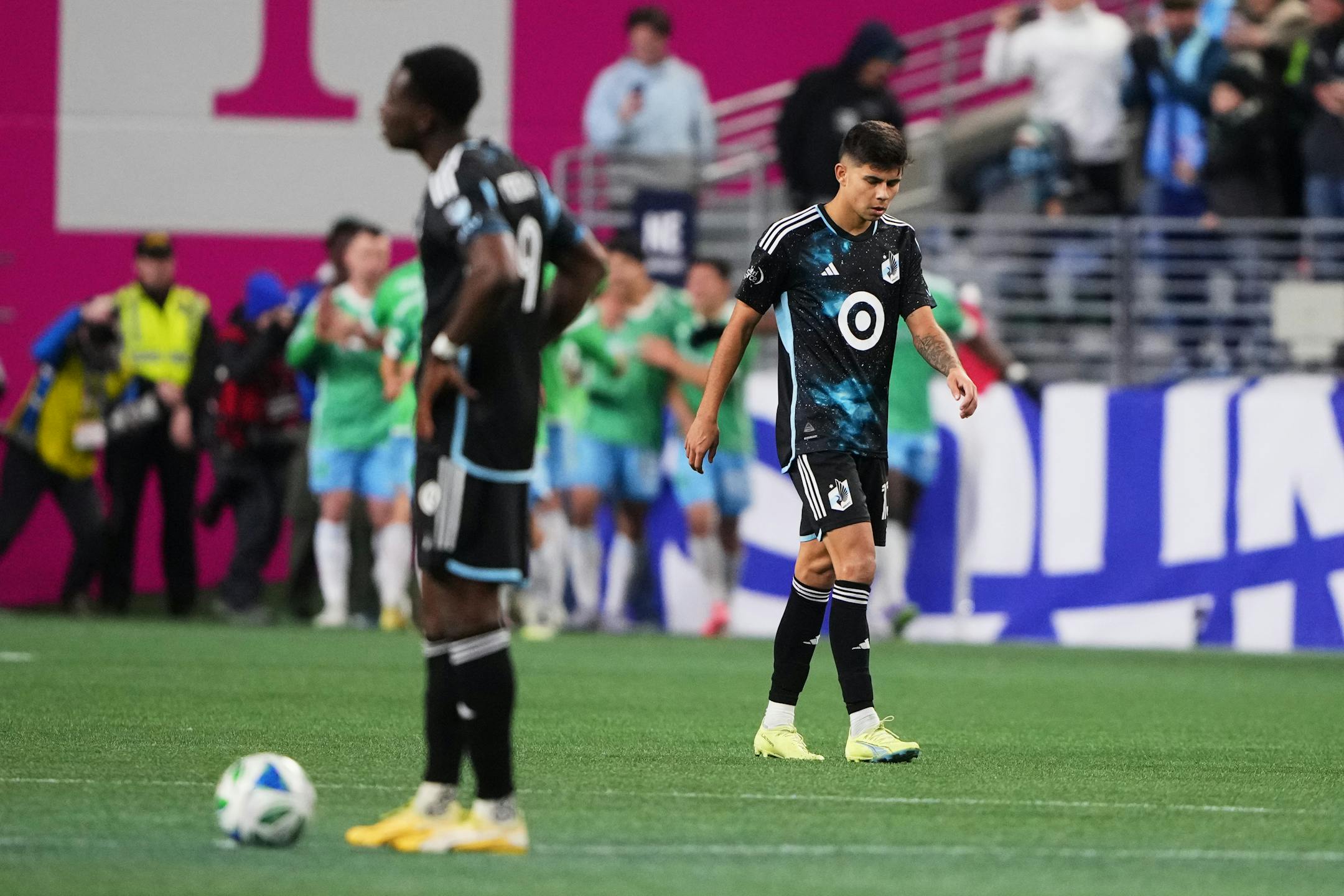
As Minnesota United and the Seattle Sounders head into the deciding Game 3 of their first-round playoff series on Saturday, the fifth game between the two teams this season, neither has much in the way of tactical surprises left to spring. It’s less about wrong-footing the opposition, and more about execution and intensity and energy. The Loons, despite knowing what was coming in Game 2 on Monday, ended up on the wrong side of that.
Before the game, Loons coach Eric Ramsay picked out left center back Nicolás Romero as a key player for his team, noting that the Sounders had created chances late in Game 1 against the left side of his team’s defense.
In the first half of Game 2, the Sounders might as well have set their offensive playlist on repeat: control the ball in defense, work it to Obed Vargas or Alex Roldan on the right side of the field, look for Jordan Morris making a run down the channel between Romero and left back Anthony Markanich.
By the time the 45 minutes were up, Seattle led 3-0, with one goal from a corner kick and two that had gone through the left side of the Minnesota defense. A pair of goals in first-half stoppage time gave Minnesota something to play for, but the damage was done.
“The chances they created in Game 2, we kind of prepared in a way for that, that they were going to try to get us, and that’s the area they kind of exposed us again tonight,” Michael Boxall said after the game. “We were a little bit passive for the second and third goals, and I think once we kind of got on the front foot and just made that last step to apply the pressure, I think that’s the difference.”
Romero had earned a yellow card in the first half, and has a history of slightly rash decision-making, so Minnesota might have thought about hooking him at halftime anyway. But the way things had gone in the first half seemed to force Ramsay’s hand, and Morris Duggan came in for the second half.
Ramsay stressed that it wasn’t a matter of blame being handed out. “If you look at the goals back, there’s no huge, glaring errors,” he said postgame. “It’s just them being a team right at the top of their game, and they really punished us.”
That said, Markanich wanted to take accountability and hold his hand up for his share of blame. “The second half was much more controllable than the first half, so I think we got that sorted out,” he said.


