
Minnesota to launch ambitious moose recovery plan after 15-year decline

Wildlife managers will try to reshape up to 150,000 acres of forest to help moose survive in Minnesota.

The Minnesota Star Tribune
December 20, 2025 at 1:00PM
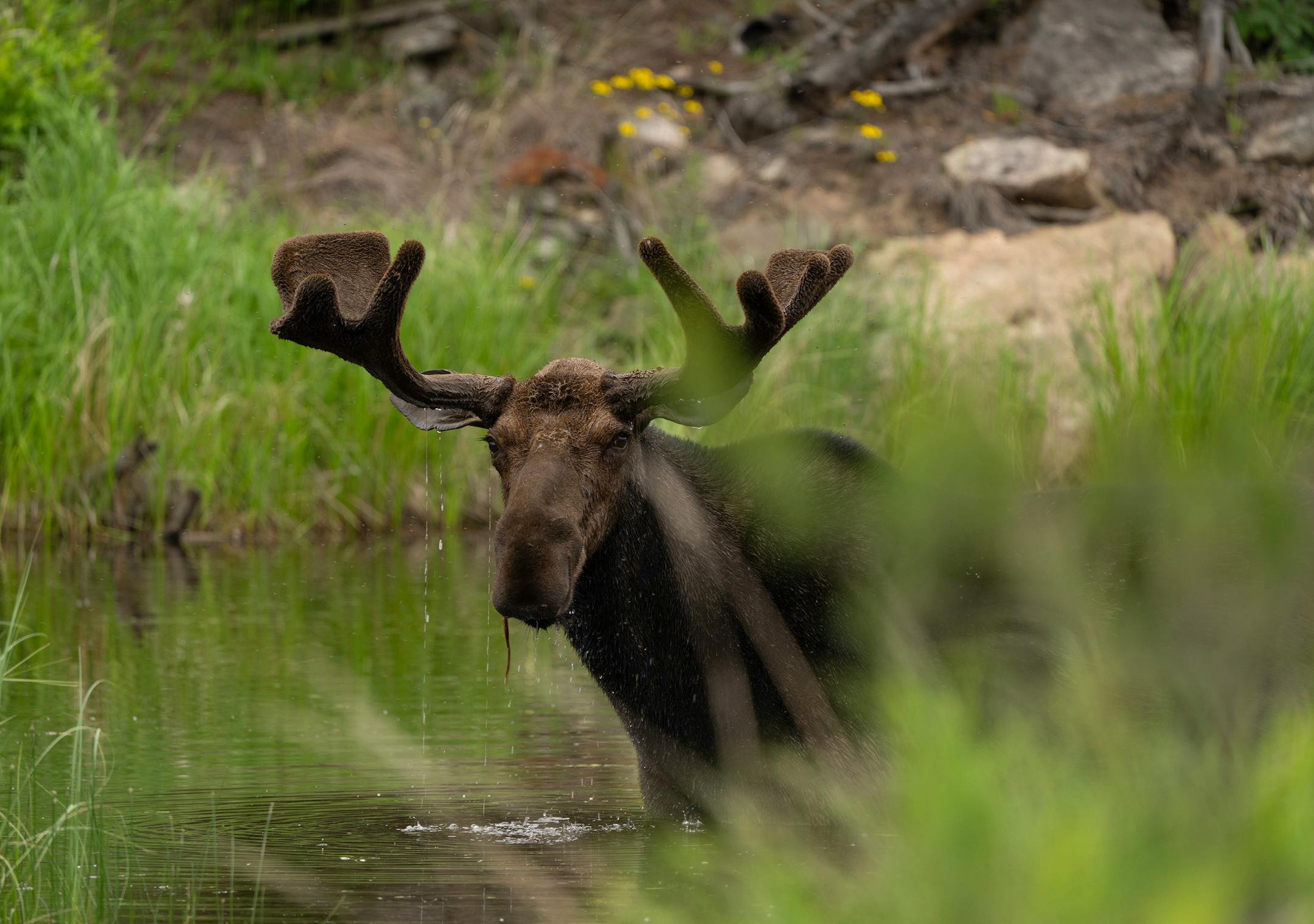
A bull moose browses in a wetland near the end of the Gunflint Trail on June 16, 2024. (Jeff Wheeler/The Minnesota Star Tribune)

More than 15 years after the sudden collapse of Minnesota’s moose population, state and tribal biologists will reshape the landscape of northeast Minnesota to try to bring their numbers back.

A moose habitat plan, the product of three years’ work by a coalition of agencies, and wildlife and conservation groups, is expected to be released in the coming weeks. It calls for designating large swaths of habitat, up to 150,000 acres in total, in Cook, Lake and St. Louis counties.

Already publicly owned, the land would be managed for moose, with prescribed burns and timber harvests to encourage the growth of young aspen and shrubs they need to forage, while protecting old and deep black spruce stands and marshes, where they shelter and calve.

Moose are almost universally beloved but have never had the broad coordinated support that smaller game species such as ducks, pheasants and deer have utilized to great success. With the plan, it seems like that support is finally starting to swell, said Seth Moore, the director of biology and environment for the Grand Portage Band of Lake Superior Chippewa.

“We’re still in the early steps,” he said. “But the hope is that we spend the next decade really getting serious about creating new moose habitat in our core moose range.”

The habitat plan will not address deer density, predator control or the potential reopening of a moose hunting season. Those potential fights, and the political storms that follow, will be saved for another day.

The first and most urgent step for a strong moose population, wildlife managers said, is getting their habitat in order.

The moose die-off started around 2010.

Before then, there were reliably between 8,000 and 9,000 moose living in the woods and muskegs across most of northern Minnesota. But that winter, in an annual aerial survey, spotters struggled to find them.

The moose population fell to an estimated 5,700 in 2010 and then kept falling. By 2013, it was down to 2,700. State wildlife officials were so worried that moose would disappear from the state that they stopped collaring them during studies, fearing that the stress of trapping even a few individuals would only quicken the species’ demise. By 2014, the moose were gone from northwestern Minnesota and have not returned.

They now only live in the Arrowhead region, north of Lake Superior. Their numbers seem to have stabilized, fluctuating between 3,000 and 4,000 a year over the last decade.

As scientists raced to find out what went wrong, they found no simple answers or clear fixes. A number of threats had attacked Minnesota’s moose at once. A parasitic brainworm, carried by whitetail deer, has been spreading as deer densities have grown during mild winters, they found.

The parasite does not hurt deer but is deadly to moose.

Winter ticks have also bloomed during especially mild or snowless winters. Thousands of ticks can swarm a moose and cause them to become anemic. As the animals try to scratch the bloodsuckers off their bodies, they end up tearing away their fur, leaving bare skin exposed in the winter.

Scientists have also pointed to longer summers and hotter nights that have stressed the population as Minnesota’s climate has changed, according to the University of Minnesota and U.S. Department of Agriculture. In addition, Minnesota’s forests are much different now than they were in the early 2000s.

After the housing market collapsed in 2008, several of northern Minnesota’s wood mills closed for good. Demand for lumber sharply fell. The state is harvesting about 1 million fewer cords of timber than it did before the collapse. That’s left tens of thousands of acres of woods to age out of useful moose habitat, no longer young enough to provide good forage and not diverse enough to offer good shelter.

“It’s not just moose but nearly all of the wildlife that humans like to see and experience really need young forest,” Moore said. “Moose, deer, snowshoe hare, partridge, all game species and all the predators that need those species to be abundant require young forage.”

Decades of wildfire suppression and the loss of so much of the timber industry have allowed much of the state’s forest to grow into middle age, he said.

Under the habitat plan, the Minnesota Department of Natural Resources will work with counties, Grand Portage and other tribes, as well as nonprofit habitat groups like the Nature Conservancy and the Ruffed Grouse Society, to start managing a more diverse woods, with a better blend of tree species and wetlands, and young and old stands.

The DNR would like to hire a project coordinator to help overcome the bureaucratic fragmentation on work that will need to cross county and tribal lines. The agency will ask lawmakers for funding for the position early next year. That coordinator will fight for grants and organize controlled burns, timber harvests, and seed and shrub plantings among various agencies and nonprofit groups.

Under ideal conditions, moose habitat would be made up of 20% to 50% of high-quality forage, which includes young aspen, birch and maples, as well as various shrubs, according to the plan. Between 25% and 30% would include deep and thick conifer cover — especially white cedar and black spruce trees that are at least 35 years old and close enough that they have interlocking crowns, said Nancy Hansen, a wildlife manager for the DNR who is acting as the agency’s interim coordinator for the project.

Those evergreens protect moose from heat in the summer and keep enough snow off the forest floor in the winter for moose to more easily avoid wolves.

“Ideally cover patches are at least 2 acres in size and interspersed within forage patches,” she said.

There would also be plenty of ponds, lakes and wetlands.

One of the biggest hurdles for helping moose has always been the sheer size of their habitat. Their individual home ranges vary, but typically span more than 8,000 acres.

“So that would mean 1,600 to 4,000 acres of good browse, and 2,000 to 2,400 acres of good conifer cover, plus lakes, wetlands, and older forest,” Hansen said.

Habitats that large all but guarantee that multiple owners, agencies or governments would need to work together to protect them.

about the writer

about the writer

Greg Stanley

Reporter

Greg Stanley is an environmental reporter for the Minnesota Star Tribune. He has previously covered water issues, development and politics in Florida's Everglades and in northern Illinois.

See Moreicon

More from Environment

See More
card image
Jeff Wheeler/The Minnesota Star Tribune

Wildlife managers will try to reshape up to 150,000 acres of forest to help moose survive in Minnesota.

card image
card image