

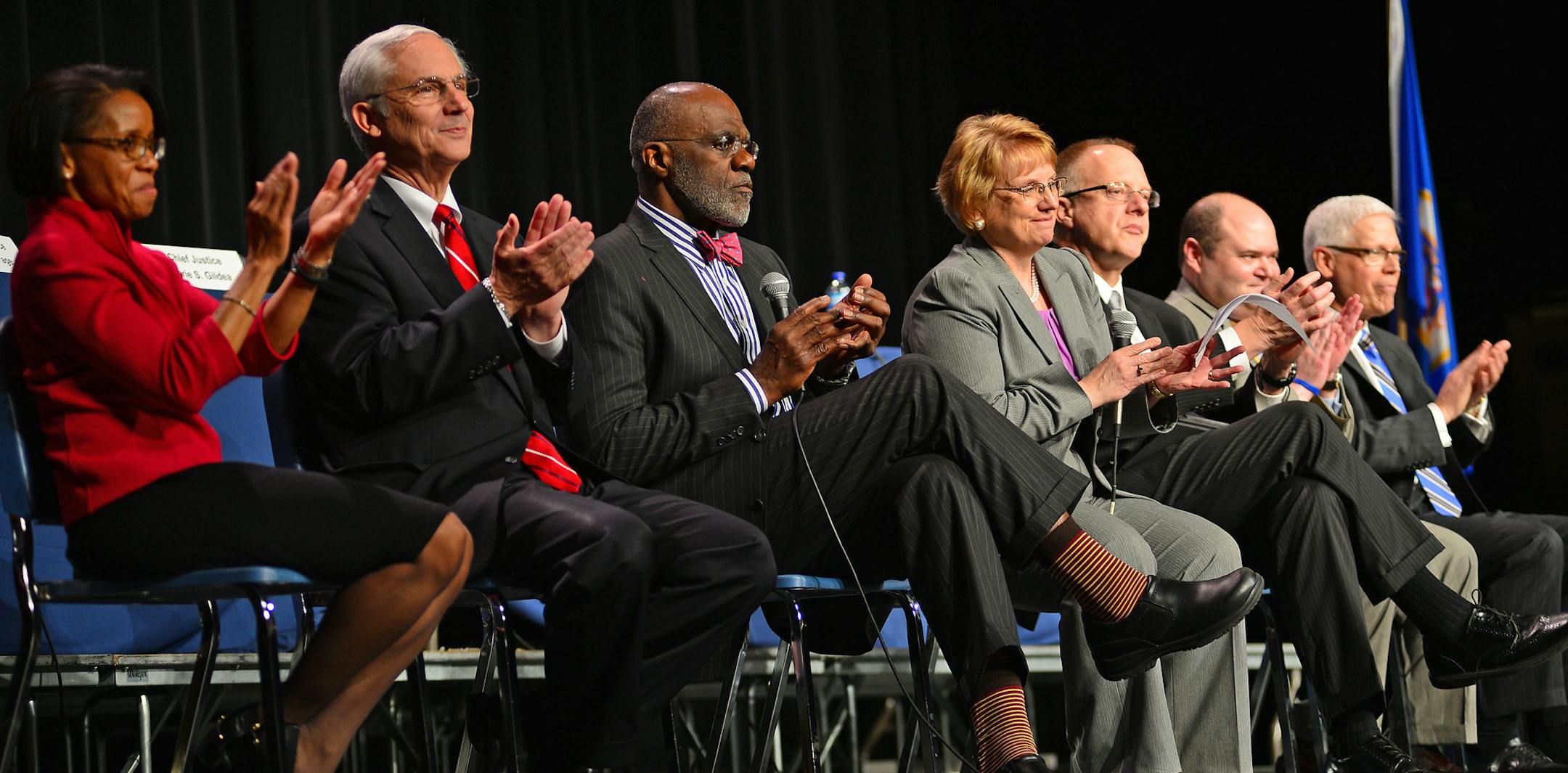
Minnesota's Supreme Court justices don't expect to be treated to a jazz band playing "Welcome to the Jungle" by Guns N' Roses before hearing arguments in a complex case.
But Monday's courtroom was the auditorium at Champlin Park High School in Brooklyn Park, with the justices and attorneys doing their thing on a brightly lit stage as part of a biannual working field trip to a Minnesota school.
More than 700 students packed in to hear the case of Daniel Garcia-Mendoza, then hit up the justices with questions.
The case was labyrinthine but important. The court's eventual decision could affect the rights of people whose property is forfeited during civil cases.
It began in March 2012, when a rookie police officer pulled over Garcia-Mendoza in Minneapolis in a stop later found to be illegal. He was ticketed for not having a driver's license, and his sport-utility vehicle was searched and towed without his consent. During the search, officers found and seized 8 ounces of methamphetamine and $611.
Federal investigators then looked into Garcia-Mendoza's dealings, ultimately charging him with selling drugs. Hennepin County District Court dropped its charges, and in a federal plea deal, he pleaded guilty to one count unrelated to the arrest in Minneapolis. He was sentenced to 10 years in prison.
When Garcia-Mendoza returned to district court to challenge the seizure of his cash and property, the judge said that although the traffic stop was unconstitutional, the forfeiture should stand because he had agreed to it in his federal plea deal.
The case then went to the state Appeals Court. There, Garcia-Mendoza's attorney argued that because the stop was illegal, law enforcement shouldn't have been able to seize the property. He cited a legal principle called the exclusionary rule, which holds that unconstitutionally seized evidence can't be admitted in court.
![Joecelia Dalmeida a senior at Champlin Park High wants to be a lawyer and asked a question of the Minnesota Supreme Court The Minnesota Supreme Court convened at Champlin Park High School in Champlin, Minn., today in an effort to open the doors of the Judicial Branch to the public. More than 850 students from the area schools watched the court in action.] Richard.Sennott@startribune.com Richard Sennott/Star Tribune Champlin Minn. Thursday 5/12/2014) ** (cq)](https://arc.stimg.co/startribunemedia/LWGF6VPZO3DUEDLNL5SFGGQKBU.jpg?&w=1080)


