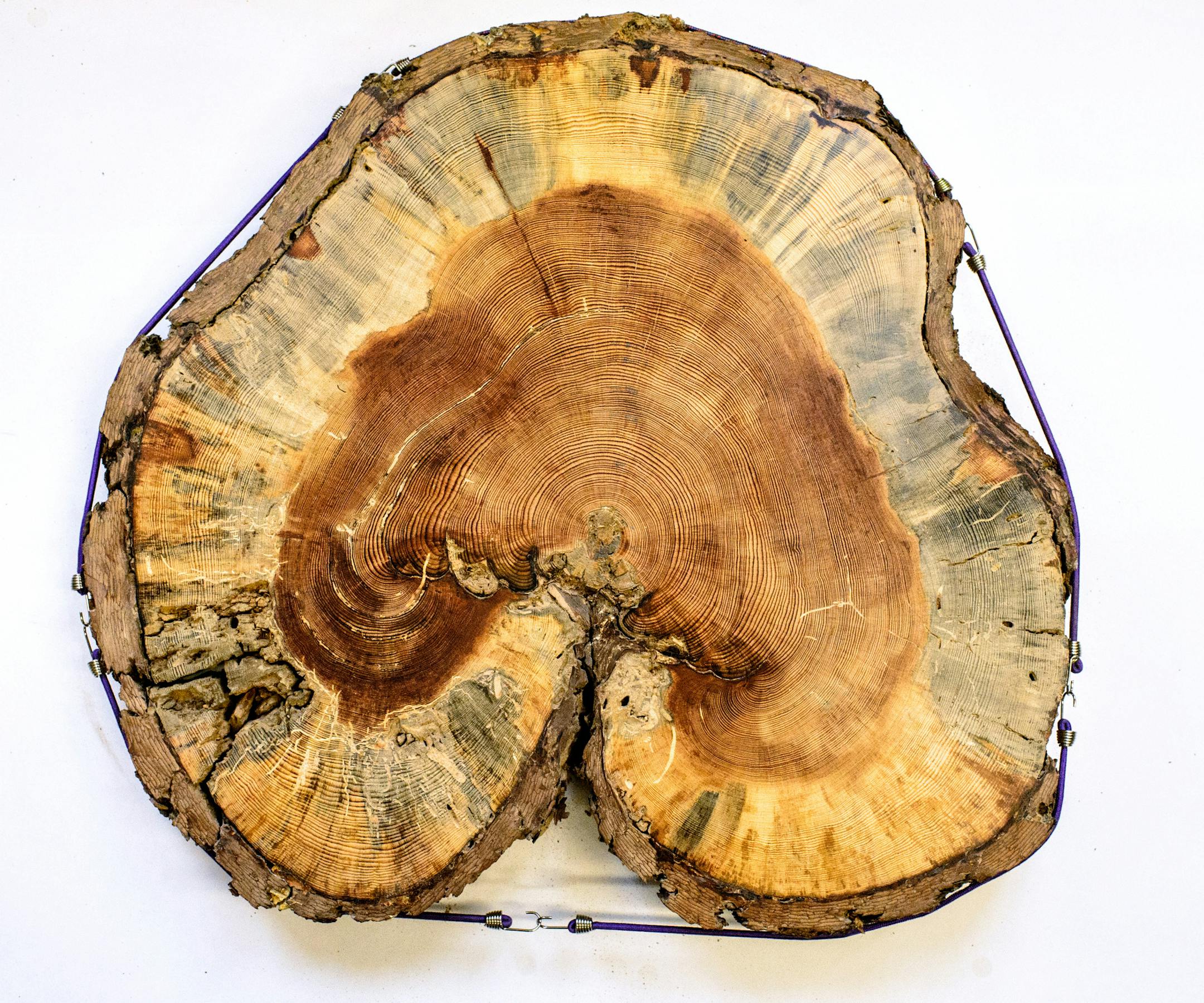
The towering red pine that lived for nearly 250 years Up North is no more.
But its remains hold valuable clues that reveal the ups and downs not only of the tree's life, but of its surrounding environment.
Most of us know that a tree's age can be determined by counting its rings. But three scientists at the University of Minnesota say that's just the beginning. Those rings also bear witness to floods, drought and other milestones, making it possible to track climate, weather and natural disaster trends spanning centuries.
"Right here you can see the birth," Kurt Kipfmueller said, running his fingers across the surface of a large stump extracted from Voyageurs National Park. Tracing a circle at the stump's center, he noted: "It goes back to 1769."
Kipfmueller and his colleagues — Dan Griffin and Scott St. George — act almost like medical examiners performing an autopsy, inspecting the dead trees under microscopes, searching for tell-tale clues.
The Minnesota team represents one of the most prominent research groups of its kind in the country. They conduct their examinations in a pine-scented lab on the university's West Bank campus, surrounded by stacks of tree slabs cut into cross sections.
Where others see dead wood, these guys spot treasure.
"Trees are like nature's bookkeepers," St. George said. "Every year they are influenced by different aspects of their environment — the weather, forest fires, our actions and the actions of animals. Because wood is so sturdy, information that gets written down now will maybe last for 10 years or 100 years or even 1,000 years."
![The tree ring guys, aka Dan Griffin, Kurt Kipfmueller, and Scott St. George, with some of their samples. ] GLEN STUBBE * gstubbe@startribune.com Monday, January 26, 2015 When three 'U' scientists want to learn more about drought, floods and fire, they look for these key witnesses: the trees. By studying the rings of a tree stump they can find clues that help, for example, determine that the recent California drought was the state's worst one in 1,200 years. A profile on this trio of scientists a](https://arc.stimg.co/startribunemedia/SD6ZJP5RNR44JUSD2MHWLRYBMI.jpg?&w=1080)