

It was quiet on a recent morning in the ninth-grade English classroom at Minnetonka High School, where everyone had their head in a book.
That was until teacher Tessa Ikola made the same announcement her students would hear throughout the school day — and have been hearing for most of their school careers: "Pull out your iPads, please!"
There was a flurry of activity as the students dug in their backpacks and pulled out the school-issued devices. Soon, they were clustered in groups, poking away at an interactive vocabulary quiz while their scores flashed on a digital screen in the front of the classroom. Later, they followed along on their iPads as Ikola explained an essay assignment. And when it was time to work, there were no pencils or notebooks or the clatter of keyboards — just a sea of glowing screens.
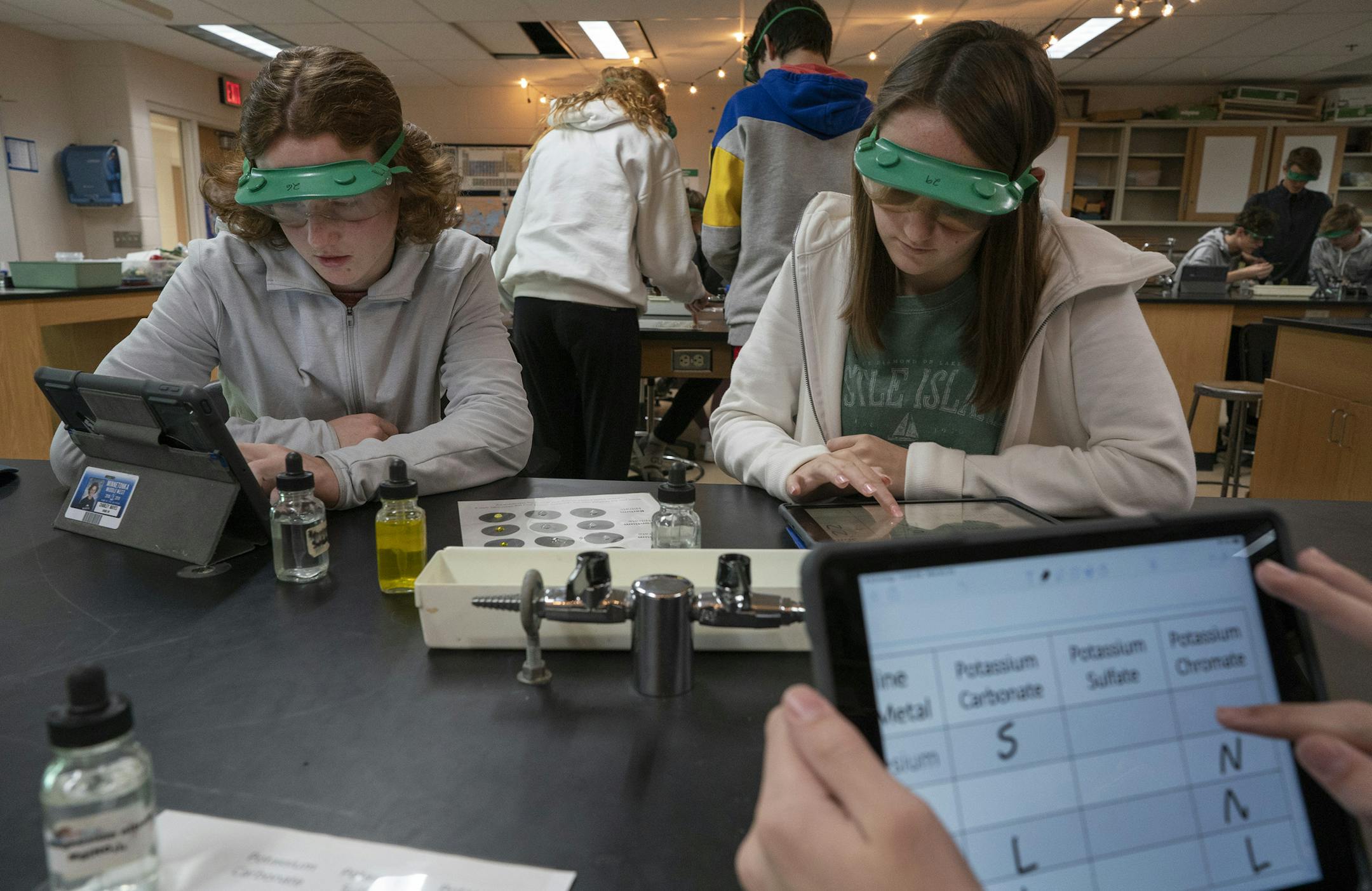
Over the last decade, school districts across Minnesota have raced to make technology a central part of students' lives in and outside the classroom. They've spent hundreds of thousands — or in some cases, millions — of dollars annually to equip each student and teacher with a tablet or laptop. Everything from classroom instruction to note taking has become something that can be done digitally; in many classes, textbooks and paper worksheets are largely a thing of the past.
Many administrators and teachers say the shift is necessary; without the right tools and training, they say students will be left behind in an increasingly digital world. They note that the technology boom has created new ways for students to collaborate on projects, allowed teachers and parents to more closely monitor progress, and put powerful devices in the hands of young people who may otherwise have lacked access to them. But with several years of experience with tech-heavy learning, there are still plenty of challenges — and debate over the impact of all those iPads and Chromebooks on academic success, equity and students' focus.
The period in which Minnesota schools dove headfirst into "one-to-one" technology programs coincides with a time in which test scores have dropped or remained flat, and schools have struggled to narrow wide achievement gaps between racial and socioeconomic groups. As some districts have ramped up technology spending they've also faced budget deficits, swelling class sizes and staff cuts.
Meanwhile, early research into the effect of more screens in classrooms has been limited, and the results mixed, leaving educators and parents with mostly anecdotal evidence to determine how much the devices are helping students learn and grow.
Maijue Lochungvu, assistant director of St. Paul Public Schools' Personalized Learning Department, said officials pay close attention to test scores and other measures to determine what's working, but also listen closely to teachers' experiences with technology.
![Kate Simington a 9th grader at Minnetonka High School, worked on a ipad in her English Class.] Jerry Holt • Jerry.holt@startribune.com Minnetonka High School students using ipads in the classrooms Wednesday Oct. 30, 2019. in Minnetonka, MN. Jerry Holt](https://arc.stimg.co/startribunemedia/NWL2CXPMOBG45CG3XHMV7HCRDY.jpg?&w=1080)
![Minnetonka English teacher Tessa Ikola gave instructions to her students who used ipads in her class.] Jerry Holt • Jerry.holt@startribune.com Minnetonka High School students using ipads in the classrooms Wednesday Oct. 30, 2019. in Minnetonka, MN. Jerry Holt](https://arc.stimg.co/startribunemedia/XV3XYQIWVZJXBBWDRLBZYL5JOE.jpg?&w=1080)
![Minnetonka English teacher Tessa Ikola left worked with 9th grader Kate Simington on ipads in her class.] Jerry Holt • Jerry.holt@startribune.com Minnetonka High School students using ipads in the classrooms Wednesday Oct. 30, 2019. in Minnetonka, MN. Jerry Holt](https://arc.stimg.co/startribunemedia/ALMZ7ECSPHJOV5Y7FBJK5HYYGQ.jpg?&w=1080)
![Minnetonka English teacher Tessa Ikola left worked with 9th grader Kate Simington on ipads in her class.] Jerry Holt • Jerry.holt@startribune.com Minnetonka High School students using ipads in the classrooms Wednesday Oct. 30, 2019. in Minnetonka, MN. Jerry Holt](https://arc.stimg.co/startribunemedia/AHIR5ZU2CEKAFDJFL35SJFUXLI.jpg?&w=1080)


