

 0:54
0:54Minnesota's sizable African communities raised their voices Wednesday against the terrorist attack in Kenya.
Just back from a visit with the president of Somalia and Kenyan ambassador in Washington D.C., a group of young Minnesota Somali artists denounced the attack on a Nairobi shopping mall and stressed a need to tackle the issues that lead some youth to terrorism.
"No one becomes radicalized overnight," said Mohamed Farah, executive director of Ka Joog. Members of the group of men in their 20s who have grown up in the U.S. spoke at a news conference at the Southern Theater in Minneapolis.
The process is gradual, the root cause: a lack of jobs, mentors and activities that give youth a voice. "These are underlying issues that we must face as a community to combat Al-Shabab," Farah said.
Some 20 young Minnesota men have left for Somalia to fight with Al-Shabab — a small fraction of the Minnesota Somali community, Ka Joog members pointed out. They said Al-Shabab's recruiting tactics have changed over the years, and the group now has a strong social media presence.
Ka Joog tries to counter with its own messages on Facebook and Twitter, said Abdul Mohamed, marketing and public relations director. "We have to put ourselves in their shoes and appeal to the youth," he said, noting that the terrorists also use religion in their sales pitch to recruit members. "Al-Shabab as a terrorist organization, they're very good at what they do. They tell these children that there's a religious, a better life. They use a religious justification to back their efforts," he said.
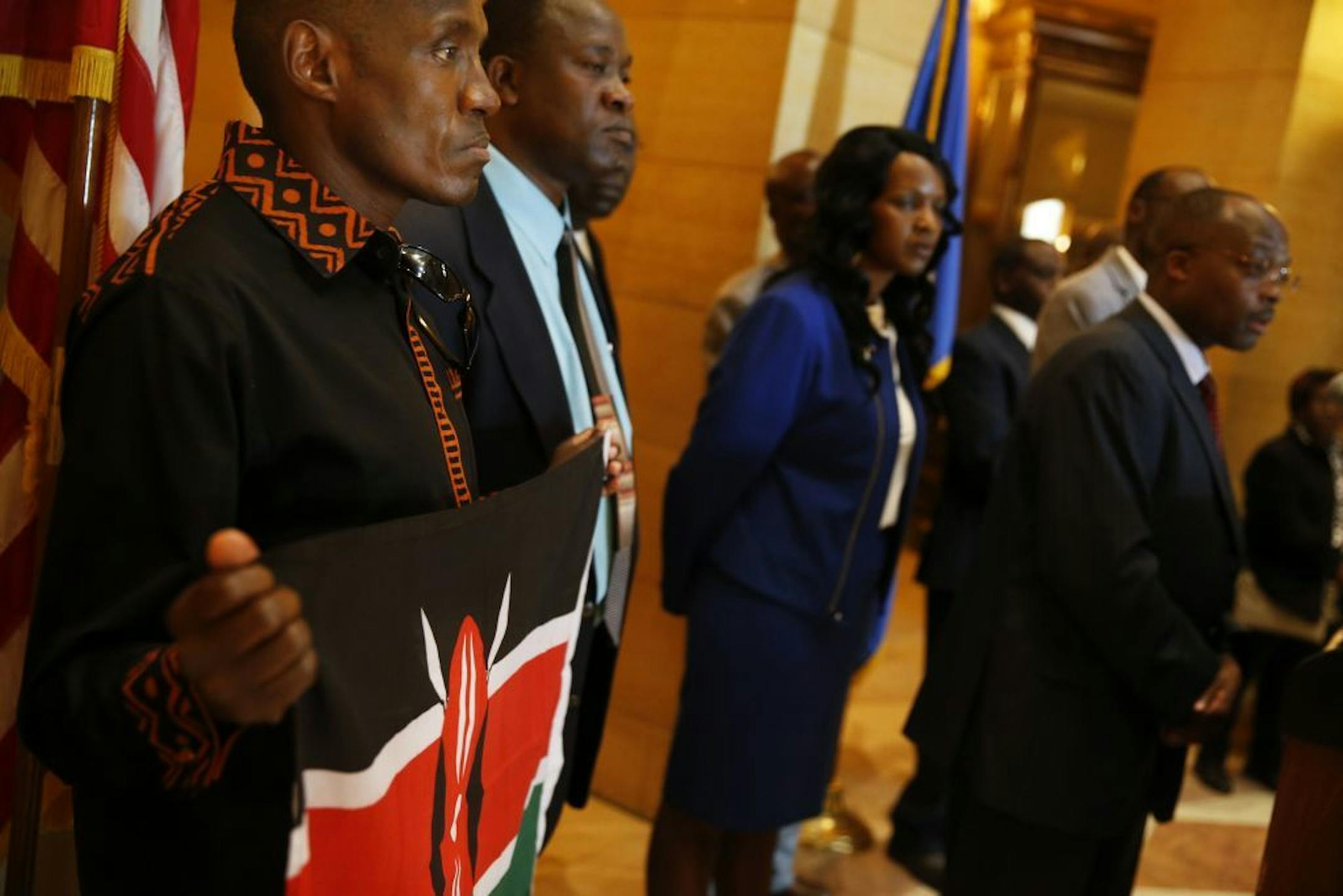
Members of Minnesota's Kenyan community also stood before the media at the State Capitol Wednesday to say they will not retaliate for the Nairobi attack, and they believe that Kenyans and Somalis in Minnesota can work to strengthen their ties here.
"To see this act of unspeakable terror upon our citizens reminds us all that we live in a world where others seek to destroy our way of life," said Pastor Zipporah Bogonko. "Yet, we will not retaliate with hate or retribution but extend our love and hospitality — that is who we are as a people."
![Mohamed Farah, executive director of Ka Joog spoke with other members of the group at a press conference to address the concerns of the Somali community in the wake of the killings at the Kenyan mall. Ka Joog is a volunteer group that works with Somali youth with the goal of motivating them to realize their potential and to achieve their dreams. Combatting the efforts of recruiting groups like El Shabaab Wednesday, Sept. 25 at Northrop Plaza ] GLEN STUBBE * gstubbe@startribune.com ORG XMIT: MIN1](https://arc.stimg.co/startribunemedia/KUIGGH26G4NXBJTMMDM33IRHXM.jpg?&w=1080)
![In the rotunda of the state capitol in St. Paul, Kihanya Mwaura held the Kenyan flag in solidarity with other Minnesotan Kenyans who were taking a stand against the attacks by Al Shabab in the shopping mall in Nairobi. Mwaura learned that his cousin's husband was killed in the Westgate mall.]richard tsong-taatarii/rtsong-taataarii@startribune.com](https://arc.stimg.co/startribunemedia/E5GFG7EKJZQH3V2YJFI4P5TGFE.jpg?&w=1080)


