

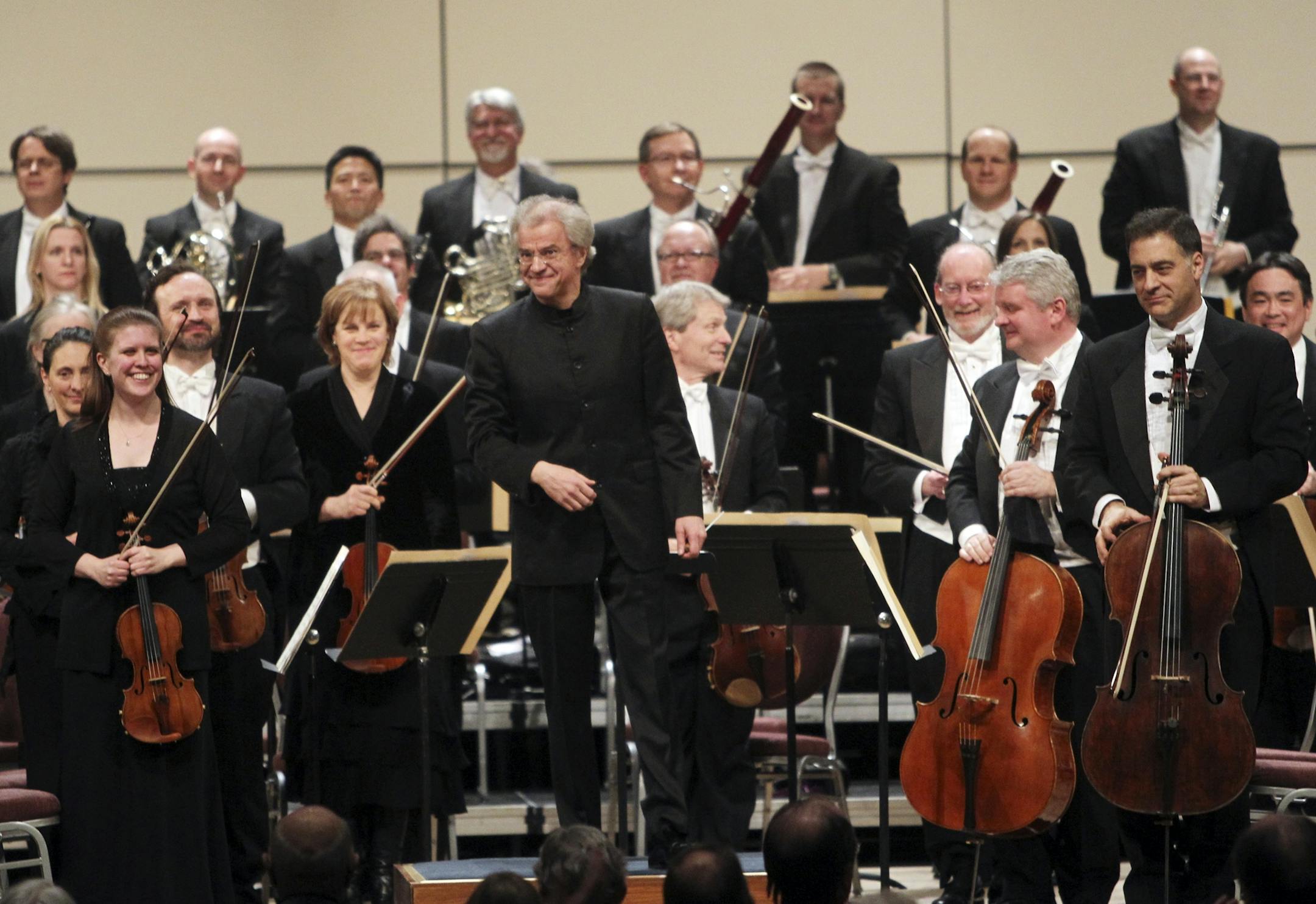
My wife and I traveled to Los Angeles last week to hear a world-class symphony orchestra. Last fall, we went to Chicago for the same purpose. How sad is that?
We have (or had) a world-class symphony orchestra in Minnesota, but the orchestra does not play (because of a lockout and bruised egos on all sides). As we checked the news in our L.A. hotel room before the concert, we read of Osmo Vänskä's latest letter to Minnesota Orchestra management, voicing his concerns about the Carnegie Hall concerts scheduled for the orchestra this fall.
As a lawyer who works in the business world, I understand the need for revenue and expenses to balance. Management's goal of making sure the orchestra sits on a stable foundation for years to come is important. Yet, I have not heard management express that its goal is to maintain a world-class orchestra.
I would think that the board and management would understand that you cannot cut your way to prosperity. When you have some of the world's finest musicians and conductors making world-class music, it is not a lack of a quality product that is the problem. You need to look inward — it is management's responsibility to sell tickets, raise money and balance the budget. Very few organizations cut their way to more success. Great music is not found on a spreadsheet.
Meanwhile, as a one-time musician, I understand that musicians want to make music and probably do not have MBAs in finance. The world did change in 2009, and lots of organizations and people took serious hits. Many have not yet recovered. So times have changed, and the musicians will have to change, too. Refusing to bargain because you were insulted so deeply by the initial offer does not advance the cause. Blaming management for manipulating the endowment funds does not advance the cause, either. Great music is not found on a spreadsheet.
The communities of Cleveland, Chicago, New York and Los Angeles have found a way to support world-class orchestras. We should expect no less in Minnesota. Attempting to replicate the orchestra models in Indianapolis or Baltimore would be a sad commentary on the intellectual energy and quality of life that is supposed to exist in the Twin Cities.
It is time to set aside the bruised egos on both sides. As a lawyer, I spend my life solving problems. This problem did not arise overnight, and it is not going to get fixed in one simple negotiation. Great music and art have always been, since at least the time of J.S. Bach, a patron-sponsored business, not a profit-generating business. Seeking to squeeze business efficiencies in a traditional context may not be the answer. Here is the outline of a plan to start the process rolling:
We need a five-year plan — one that will assign responsibilities on all sides to find a more stable platform for the continuation of our world-class orchestra. Management says there is a $5 million problem. For the next five years, do the following (all with new money):


