
Minnesota immigrant farmers face bigger challenge getting foothold after USDA change

Farmers who have been historically disadvantaged based on race or gender will no longer be eligible for specific USDA benefits and grants.

Sahan Journal
August 9, 2025 at 7:00PM
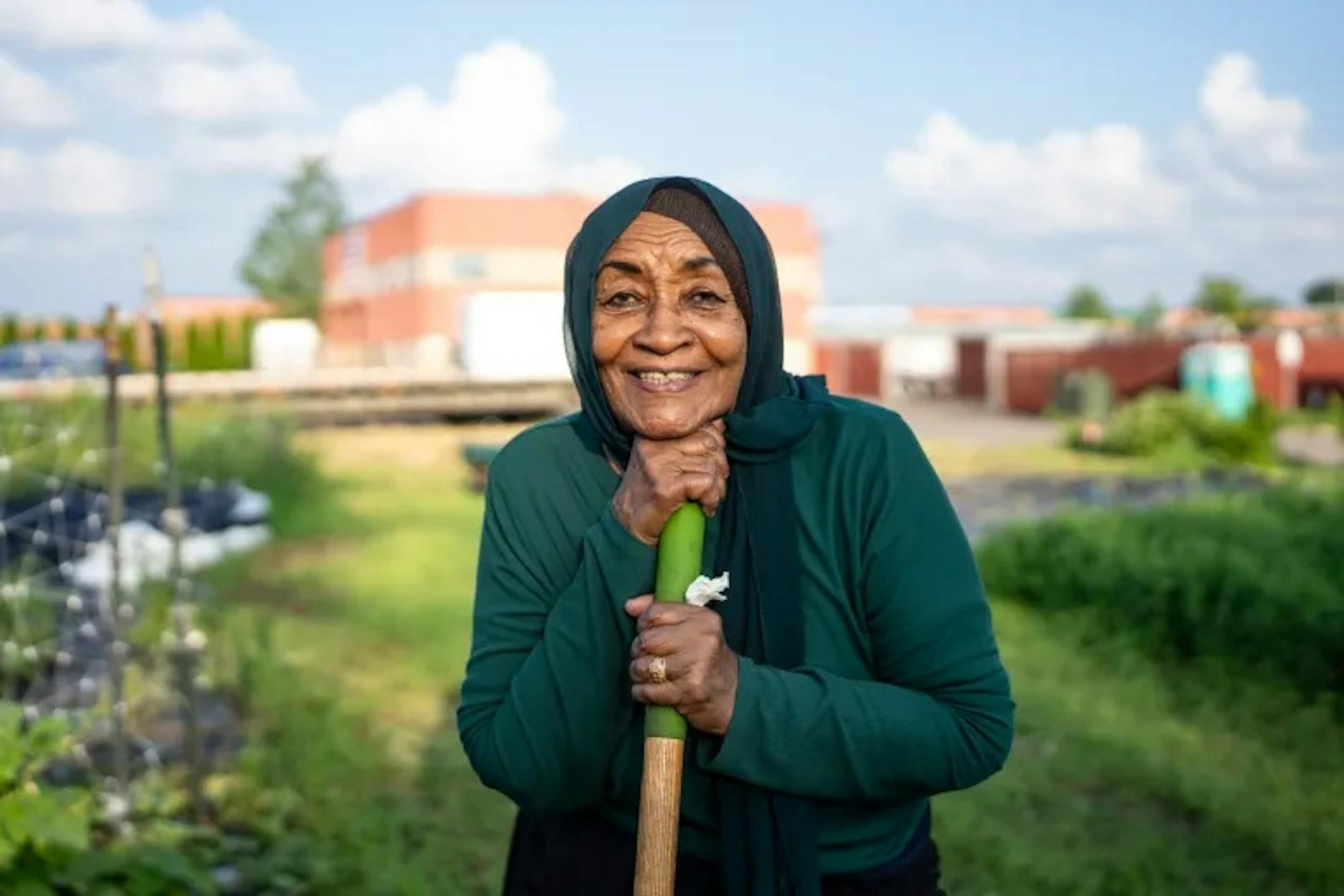
Nemat Eisa, the mother of Sudanese Farming Group co-founder Khalid Elhassan, paused for a portrait after helping to weed the group's plot in New Hope in July. Community members as young as 3 and as old as 90 help with the farming. (Aaron Nesheim, Sahan Journal)

At a half-acre community garden in New Hope, Sudanese families share authentic meals every Sunday, made with vegetables they spent months cultivating together including okra, purslane (an edible succulent) and molokhia (a leafy green).

Khalid Elhassan said he was inspired to start the Sudanese Farming Group — which also runs a 6.5-acre farm in Northfield where they raise sheep — after hearing an MPR interview with the head of a Somali American farmers group in 2021.

“Back then, I didn’t know there were other Black, immigrant farmers here,” Elhassan said.

He reached out to the Food Group, which helped his group find and rent land, source rare seeds and develop technical knowledge.

Executive Director Sophia Lenarz-Coy said the Food Group’s targeted programming is meant to level the playing field by providing better access to farming resources.

“We believe that anybody who wants to farm should be able to,” she said.

But a recent federal change could jeopardize the future of Elhassan’s farm and others like it.

As of July 10, the U.S. Department of Agriculture no longer acknowledges the “socially disadvantaged farmer” designation. Farmers who have been historically disadvantaged based on race or gender will no longer be eligible for specific USDA benefits and grants. The announcement did not specify which awards will be cancelled.

The USDA stated “past discrimination has been sufficiently addressed.”

Only 61 of Minnesota’s farmers were Black, which is less than 1%, according to Census of Agriculture data released in 2024. Sixty-nine percent of farmers were male, and the average age of farmers was 57.

Elhassan does not get direct funding from the federal government, but the nonprofits that support his farm rely on federal grants.

The Food Group helped the Sudanese Farming Group get started. Their mission is to provide healthy, culturally connected food to communities in need, buying food from local farmers to distribute to food shelves.

The Food Group oversees Big River Farms, an incubator farm near Marine on St. Croix where farmers can learn about cultivating crops and starting a business.

The Food Group relies on two key federal grants to support underserved farmers, Lenarz-Coy said. Through the Local Food Purchase Assistance Program, the Food Group buys locally-grown produce from emerging farmers and distributes it at affordable prices. The USDA American Rescue Plan Act Technical Assistance Grant is a federal grant that funds the Food Group’s educational programs at Big River Farms.

The Food Group is able to access these funds, but its leaders are unsure if these funds will remain available given the recent USDA announcement, which inhibits them from expanding their programs and planning for the future, Lenarz-Coy said. She said the organization would continue working to serve its clients even if funding is lost.

“In this political climate, things are changing pretty rapidly to make this work that’s already been hard, harder,” Lenarz-Coy said.

Lenarz-Coy said the Food Group is lucky to have diversified revenue and could still function with less federal funding. In 2024, 36.9% of the Food Group’s revenue came from government grants, according to its annual report.

Elhassan said the Sudanese Farming Group does not get federal funding directly, but the new policy could cut down on the resources, such as farming tools and educational mentoring, they get from nonprofits that rely on federal funding, including the Food Group and Sharing Our Roots. He said that his own farm is stable and can survive the federal change, but new farmers who want to get started will face more barriers.

Funwi Tita, who is originally from Cameroon, is a member of the Minnesota African Immigrant Farmers Association, a coalition of about 60 African farmers. He said members of MAIFA are facing a lot of fear and uncertainty about the future of their farms.

Tita also founded Better Greens, a farm totaling 11 acres in Monticello, Minn. and Otsego, Minn. where he cultivates African vegetables, including ugu (pumpkin) leaves, kunde (a type of bean) and African spinach. His mission is for everyone to have access to culturally-specific vegetables.

This year, Tita added 5 acres to his farm after he sold out of produce last season.

“We are in demand, and we are a need,” Tita said.

Tita distributes his food with the help of nonprofit food shelves, including the Food Group, the Good Acre and Second Harvest Heartland, and will soon sell his produce at the Seward Co-op.

Tita said the appeal for many farmers to begin growing food is the prospect of selling, and farmers rely on nonprofits to buy and distribute their crops. If nonprofits lose funding, farmers may not be able to sell produce.

“It’s really a shock in the community,” Tita said. “And I know that shock is still trickling down, but just understanding the impact is just really frightening for most farmers.”

Minnesota Agriculture Commissioner Thom Petersen said in an email the reversal of the federal policy will add to the many uncertainties farmers face, including weather, tariffs, market access and access to resources.

“We remain committed to ensuring that Minnesota agriculture thrives, now and in the future,” Petersen wrote.

About the partnership

This story comes to you from Sahan Journal, a nonprofit newsroom dedicated to covering Minnesota’s immigrants and communities of color. Sign up for a free newsletter to receive Sahan’s stories in your inbox.

about the writer

about the writer

Yvette Higgins

More from News & Politics

See More
card image
Jenny Berg/The Minnesota Star Tribune

The victim and suspect were in a relationship, police said.

card image
card image