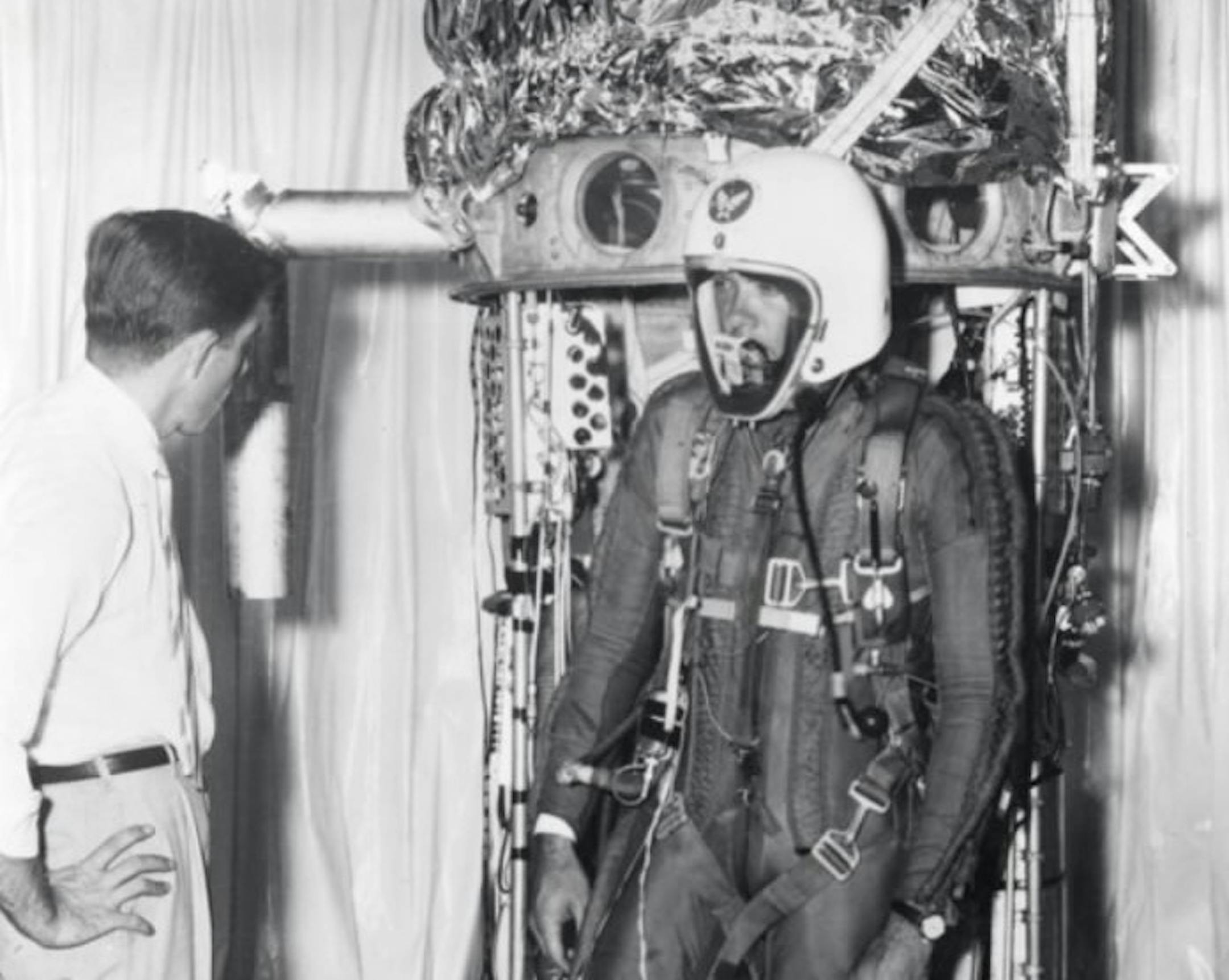
A scientist turned Air Force major named David Goodman Simons climbed into a space suit and squeezed into an air-conditioned aluminum capsule about the size of a phone booth. It was mid-August 1957, at the Minneapolis office and lab of Otto Winzen, a former General Mills researcher who had developed plastic balloons for the Navy.
Once Simons was sealed in and his breathing equipment tested and found to be working properly, the capsule was loaded on a truck — with Simons strapped inside — for a 125-mile drive to an open pit mine on the Iron Range.
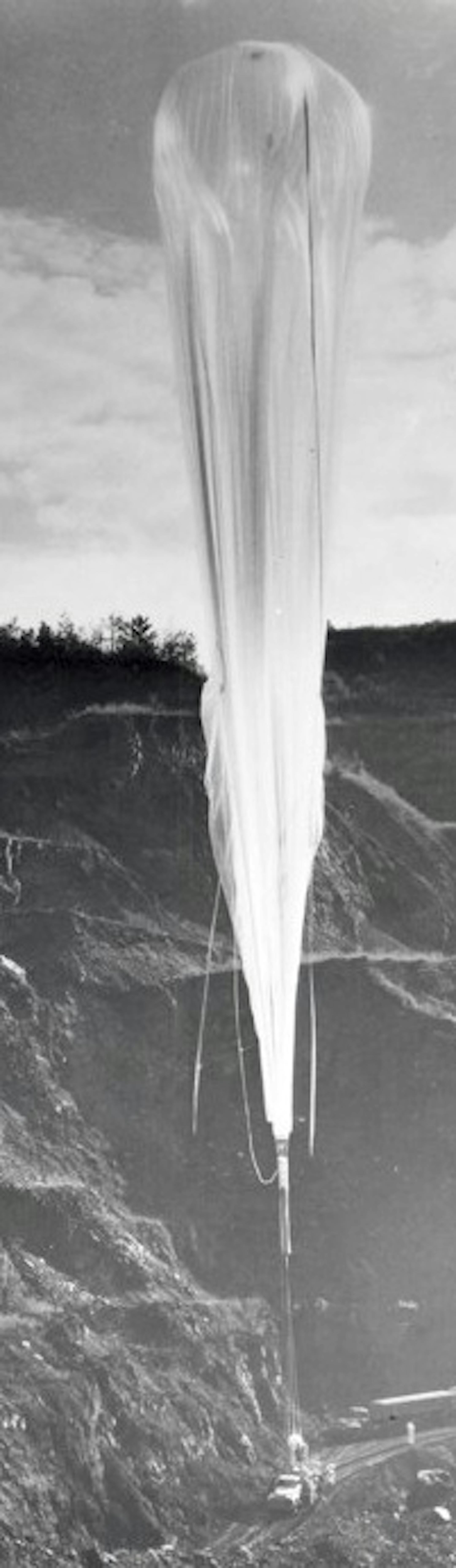
From the bottom of that Portsmouth Mine, 40 stories down and just north of Crosby, Minn., Simons would avoid surface winds during inflation, before riding his metallic gondola beneath a massive, paper-thin helium balloon to the edge of space. In the hair-raising ascent, he'd undergo an array of medical tests 19 miles up to see how humans withstood such altitudes during a 32-hour, pre-NASA flight for a secret Air Force program called Project Man High.
Just before takeoff on a flight where Simons reached 102,000 feet to set an altitude record, his commanding officer — Col. John Paul Stapp, a University of Minnesota doctor, professor and researcher — quipped: "Major, you are about to reach the high point of your career."
He landed in a flax field just across the Minnesota-South Dakota border — and on the Sept. 2, 1957, cover of Life magazine. But on Oct. 4, the Soviets launched Sputnik I, the beach ball-sized first artificial satellite. It orbited Earth in 98 minutes, igniting the Cold War space race and kick-starting the creation of NASA and its Mercury, Gemini and Apollo manned space flights. Minnesota's pioneering balloon flights, meanwhile, were rendered into the offal of history — obscured and forgotten.
Now that the Mars Atmosphere and Volatile Evolution craft, better known as MAVEN, has trekked 442 million miles to study Martian climate change, it's a good time to rekindle Minnesota's largely unknown role in the early, pre-space program. It's also a good reminder that some of the state's most intriguing history doesn't necessarily trace back to the Civil War. This historic balloon ride happened a mere 57 years ago.
"Simons and his colleagues set the stage for the space age," Tom Crouch, a curator at the National Air and Space Museum in Washington, said in a New York Times obituary when Simons died four years ago. "The Mercury capsules and the ones used by the Soviets were just one jump beyond the balloon capsules that these guys used … they were the last step before you go to space."
Simons had gained fame by flinging mice, monkeys and guinea pigs into weightlessness to test cosmic radiation effects. He became an early lab rat himself, subjecting himself to before-and-after blood tests with a microphone tracking his heart rate. In his Life story, he told readers stars don't twinkle in space, they shine consistently.