

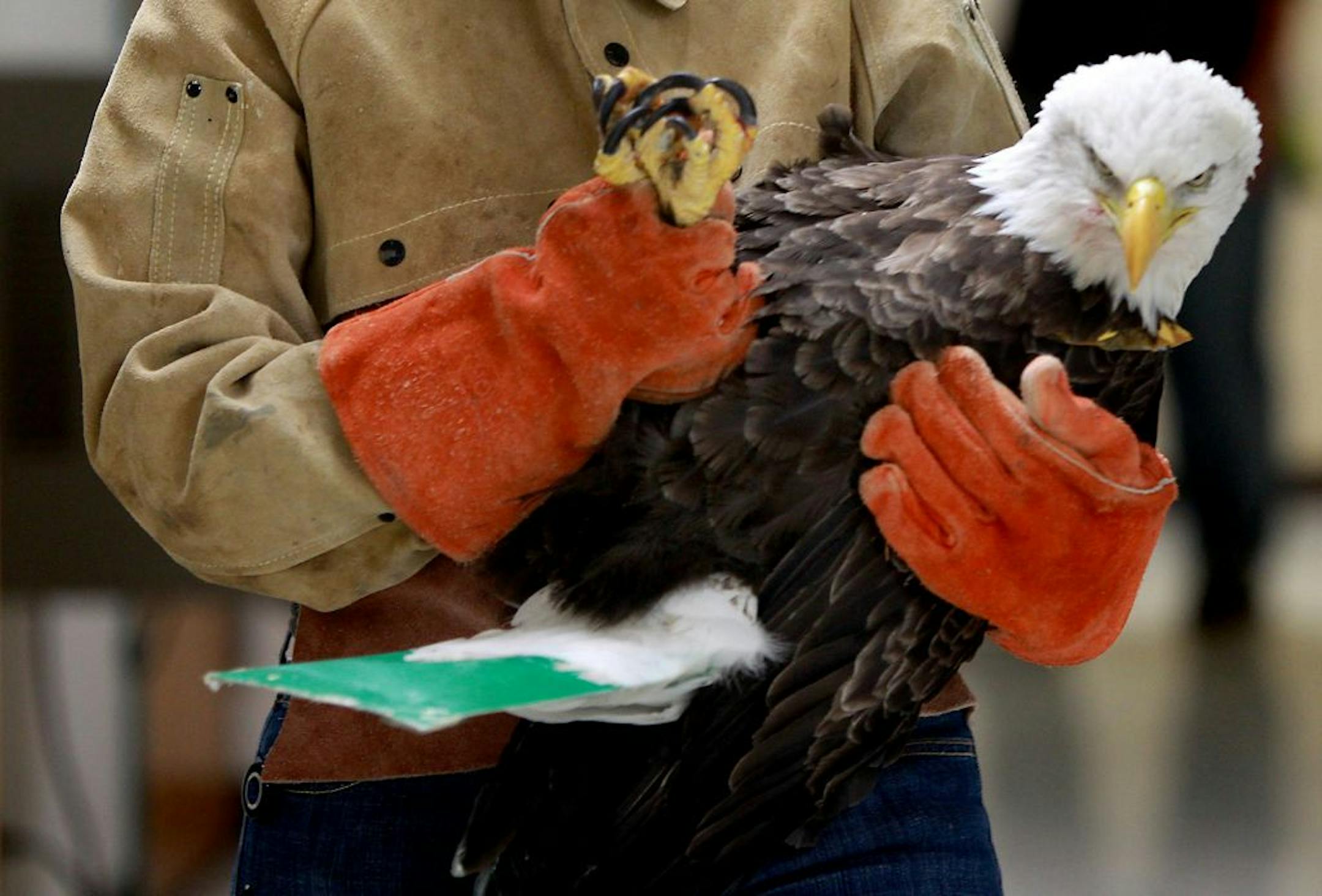
Christmas Eve anglers on the Mississippi River were stunned as Bill Doms paddled past them with a bald eagle perched on his kayak.
But the bird's odd placement wasn't a stunt. It was sign that something was very wrong.
Doms paddled hard to get the eagle to waiting Wright County sheriff's deputies and a volunteer from the Raptor Center at the University of Minnesota, hopeful that the whatever ailed it could be treated.
But toxicology tests showed otherwise. In the end, the majestic bird had to be killed, yet another victim of lead poisoning.
Despite more than a decade of efforts to curtail the carnage, dozens of Minnesota eagles die each year after ingesting lead fragments, sometimes as small as a pencil tip, while feeding on the carcasses of deer shot by hunters using the toxic ammunition. And this season, little or no snow on the ground has meant that gut piles and carcasses remain exposed to the birds of prey longer into the winter.
"I'm incredibly frustrated, angered and disappointed," Dr. Pat Redig, a veterinarian and founder of the U's Raptor Center. "I've been talking ad nauseam about this for 16 years."
But nearly every year, 25 to 30 eagles die from lead poisoning, he said. And some years, as many as 45 eagles have succumbed to lead poisoning, Redig said. Last year, 17 eagles -- 13 since October -- were brought into the Raptor Center with lead poisoning. Only two recovered enough that they could be released; a third is being observed.
"It's sad," said Doms, an avid outdoorsmen and hunter. "The eagle isn't just the national symbol of our country, but it's probably one of the most majestic animals you'll ever see."


