

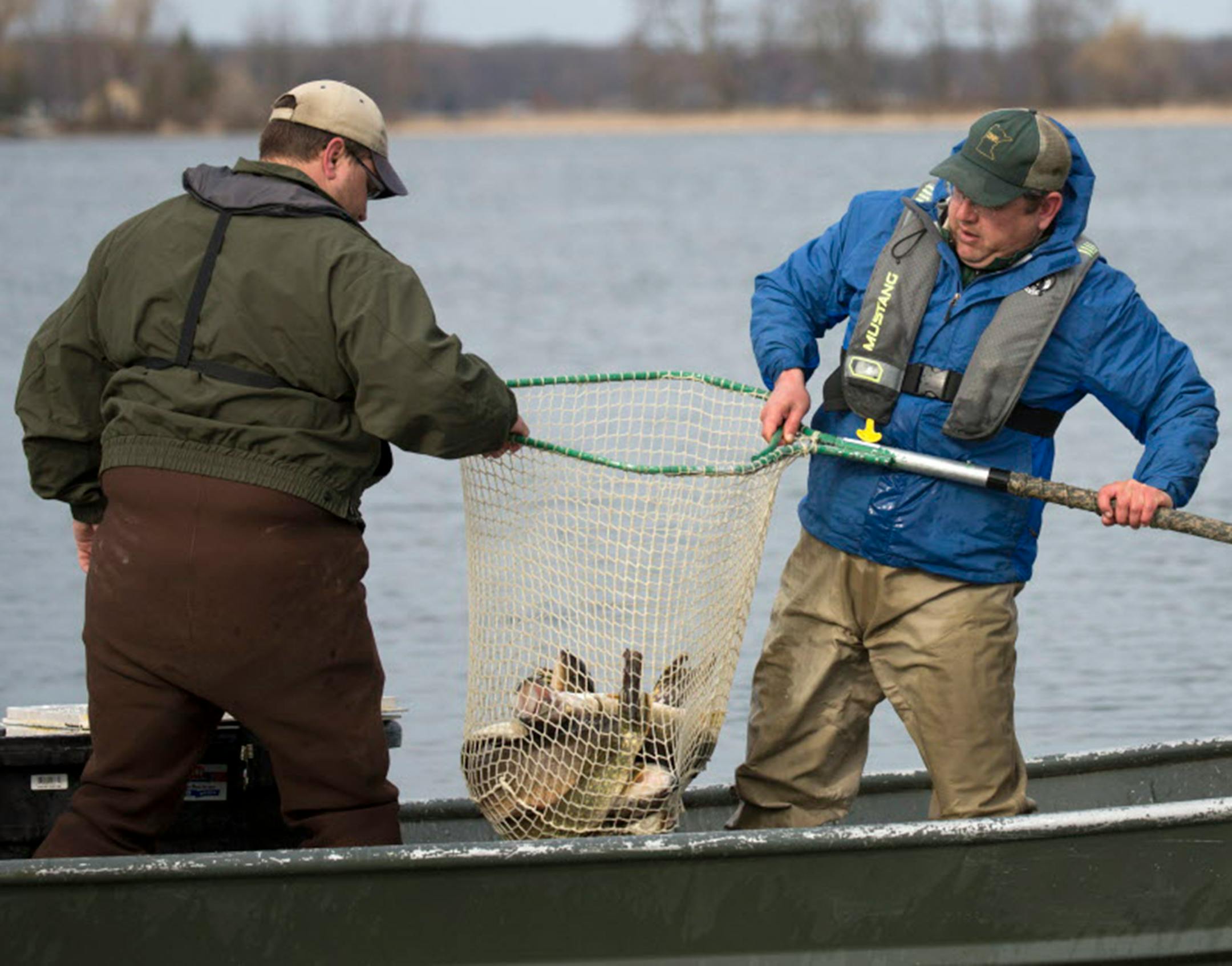
Minnesota fisheries managers canceled all spring egg-taking operations, leaving a void of walleye stocking in more than 330 lakes, the Department of Natural Resources announced Tuesday.
DNR fisheries chief Brad Parsons said the field work to produce 281 million baby walleyes can't be done in a way that would keep employees safe from the transmission of COVID-19. Close contact can't be avoided when setting up fish traps, nets and docks, he said.
DNR staff members also work shoulder-to-shoulder when selecting the wild fish, stripping them of eggs and milt, and mixing the gametes in pans and pails. It's an April fisheries ritual in Minnesota that dates at least to the 1920s.
"It's really hard to conduct these operations without getting really close,'' Parsons said. "It's a highly choreographed process.''
The decision to cancel egg-taking at all 15 sites also nixes 2020 hatchery production of northern pike, muskie, steelhead and lake sturgeon. For all species, the process involves moving the fertilized eggs to indoor tanks where they grow into fry. Most are returned quickly to the wild, but others are released into DNR rearing ponds for stocking in the fall as fingerlings.
Anglers might notice a drop in catch rates on affected lakes when the 2020 class of stocked fish would have normally grown into "keeper" size, but those gaps will be less noticeable as years pass, he said.
"Missing one year will not cause long-term harm to the fish population of any water body,'' the DNR said. Still, the news was described internally at the DNR as "disappointing'' when it was announced early Tuesday in an e-mail.
The DNR said 330 lakes were due for walleye fry stocking this year while another 224 lakes are due for walleye fingerling stocking. Parsons said the DNR will mitigate the loss of walleye fingerlings this year by buying them from private growers and by collecting baby walleyes that couldn't be harvested last year from state rearing ponds.


